• HOME
  • NEWS
  • EXPLORE
    • CAREER
      • Companies
      • Jobs
    • EVENTS
    • iGEM
      • News
      • Team
    • PHOTOS
    • VIDEO
    • WIKI
  • BLOG
  • COMMUNITY
    • FACEBOOK
    • INSTAGRAM
    • TWITTER
Thursday, September 24, 2026
BIOENGINEER.ORG
No Result
View All Result
  • Login
  • HOME
  • NEWS
  • EXPLORE
    • CAREER
      • Companies
      • Jobs
        • Lecturer
        • PhD Studentship
        • Postdoc
        • Research Assistant
    • EVENTS
    • iGEM
      • News
      • Team
    • PHOTOS
    • VIDEO
    • WIKI
  • BLOG
  • COMMUNITY
    • FACEBOOK
    • INSTAGRAM
    • TWITTER
  • HOME
  • NEWS
  • EXPLORE
    • CAREER
      • Companies
      • Jobs
        • Lecturer
        • PhD Studentship
        • Postdoc
        • Research Assistant
    • EVENTS
    • iGEM
      • News
      • Team
    • PHOTOS
    • VIDEO
    • WIKI
  • BLOG
  • COMMUNITY
    • FACEBOOK
    • INSTAGRAM
    • TWITTER
No Result
View All Result
Bioengineer.org
No Result
View All Result
Home NEWS Science News Chemistry

Breakthrough alpha-ray treatment of cancer without external radiation

Bioengineer by Bioengineer
April 2, 2019
in Chemistry
Reading Time: 3 mins read
0
IMAGE
Share on FacebookShare on TwitterShare on LinkedinShare on RedditShare on Telegram

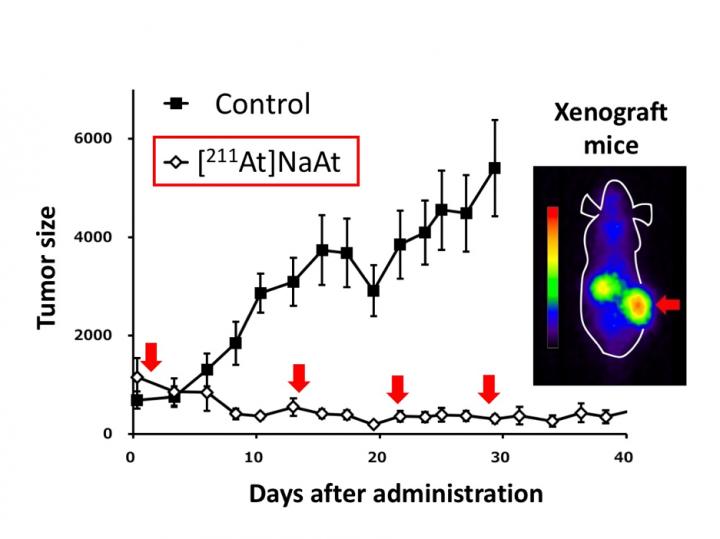
Osaka University researchers produced astatine (At-211) using a large accelerator, which enabled highly therapeutic alpha rays to be used in nuclear medicine treatment to suppress refractory thyroid cancer
IMAGE

Credit: Department of Nuclear Medicine, Osaka University Graduate School of Medicine

Osaka, Japan – For many years, radioactive iodine which emits beta rays has been used for treatment of thyroid cancer. Generally, 5-year survival rates may exceed 90%. However, some thyroid tumors become resistant to iodine treatment (“iodine-refractory”), and a breakthrough approach is needed. Many research groups have attempted to determine new methods for treatment of iodine-refractory thyroid cancer; none have shown compelling results–until now.

A research team led by Jun Hatazawa has studied targeted alpha therapy which has higher therapeutic effects while limiting damage to normal surrounding cells. In a new study published in the Journal of Nuclear Medicine, the researchers used a large accelerator in the Nuclear Physics Research Center and the facilities of the Institute for Radiation Science to successfully manufacture a therapeutic drug, sodium astatide for injection, which emits highly therapeutic alpha rays from At-211 ions.

“When we administered the therapeutic drug, sodium astatide, to mice that had received grafts of thyroid cancer cells, we noted a marked tumor regression effect due to alpha-ray exposure,” says Tadashi Watabe, corresponding author on the study. “In particular, the mice with higher doses of sodium astatide survived for nearly three times as long as untreated mice, and their tumors were several-fold smaller in size.”

In the study, mice with thyroid cancer cells showed transient weight loss when they received higher doses of sodium astatide. Notably, mice that received lower doses of sodium astatide showed considerable tumor suppression without weight loss, indicating that fractionated alpha-ray exposure may allow effective treatment without severe side effects. As a next step, preparations are being made for a clinical trial of sodium astatide therapy for alpha-ray treatment of iodine-refractory thyroid cancer with multiple metastases.

Sodium astatide radiation therapy provides systemic alpha-ray exposure that is expected to be an innovative treatment for a variety of cancers with multiple metastases, including refractory thyroid cancer. Most importantly, injection of the sodium astatide therapeutic drug may enable breakthrough outpatient treatment of cancerous lesions throughout the body without involving external radiation therapy.

###

The article, “Enhancement of astatine-211 uptake via the sodium iodide symporter by the addition of ascorbic acid in targeted alpha therapy of thyroid cancer,” was published in the Journal of Nuclear Medicine at DOI: https://doi.org/10.2967/jnumed.118.222638.

About Osaka University

Osaka University was founded in 1931 as one of the seven imperial universities of Japan and now has expanded to one of Japan’s leading comprehensive universities. The University has now embarked on open research revolution from a position as Japan’s most innovative university and among the most innovative institutions in the world according to the Nature Index Innovation 2017. The university’s ability to innovate from the stage of fundamental research through the creation of useful technology with economic impact stems from its broad disciplinary spectrum.

Website: https://resou.osaka-u.ac.jp/en/top

Media Contact
Saori Obayashi
[email protected]

Original Source

https://resou.osaka-u.ac.jp/en/research/2019/20190327_1

Related Journal Article

http://dx.doi.org/10.2967/jnumed.118.222638

Tags: cancerMedicine/HealthNuclear PhysicsPharmaceutical ChemistryPharmaceutical Science
Share12Tweet8Share2ShareShareShare2

Related Posts

Nanoparticle-Coated Fabrics Promise Antibacterial, Self-Cleaning and Conductive Clothing

Nanoparticle-Coated Fabrics Promise Antibacterial, Self-Cleaning and Conductive Clothing

September 24, 2026
Bismuth Tungstate Wrapped in Conductive Polymer Yields Supercapacitor Electrode That Barely Fades Over 1,000 Cycles

Bismuth Tungstate Wrapped in Conductive Polymer Yields Supercapacitor Electrode That Barely Fades Over 1,000 Cycles

September 24, 2026

New Sum-Connectivity Descriptors Give Molecular Graphs a Sharper Predictive Edge

September 24, 2026

Ball-Milled and CVD Silicon Anodes Face Off in All-Solid-State Batteries

September 24, 2026
Please login to join discussion

POPULAR NEWS

  • Outsiders Watch, Hospitals Reveal: A Three-Step Method That Turns Clinical Frustration Into Innovation

    29 shares
    Share 12 Tweet 7
  • Hidden Infections and Scarred Livers: Urban Schistosomiasis Runs Deeper Than Brazil’s Official Numbers Suggest

    29 shares
    Share 12 Tweet 7
  • Entropy and AI join forces to catch costly serverless wallet attacks

    29 shares
    Share 12 Tweet 7
  • Middle East Ageing Crisis Could Become an Economic Win, Study Finds

    29 shares
    Share 12 Tweet 7

About

We bring you the latest biotechnology news from best research centers and universities around the world. Check our website.

Follow us

Recent News

Outsiders Watch, Hospitals Reveal: A Three-Step Method That Turns Clinical Frustration Into Innovation

Hidden Infections and Scarred Livers: Urban Schistosomiasis Runs Deeper Than Brazil’s Official Numbers Suggest

Entropy and AI join forces to catch costly serverless wallet attacks

Subscribe to Blog via Email

Enter your email address to subscribe to this blog and receive notifications of new posts by email.

Join 85 other subscribers
  • Contact Us

Bioengineer.org © Copyright 2023 All Rights Reserved.

Welcome Back!

Login to your account below

Forgotten Password?

Retrieve your password

Please enter your username or email address to reset your password.

Log In
No Result
View All Result
  • Homepages
    • Home Page 1
    • Home Page 2
  • News
  • National
  • Business
  • Health
  • Lifestyle
  • Science

Bioengineer.org © Copyright 2023 All Rights Reserved.