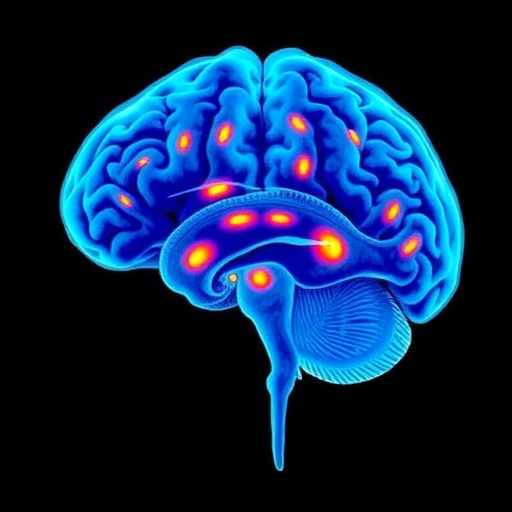
In a landmark study published in Nature Neuroscience, researchers have uncovered the elusive neural dynamics within the brainstem that regulate the entry into REM (rapid eye movement) sleep. This research illuminates how low-dimensional population activity patterns act as a gating mechanism, orchestrating the brain’s transition into one of the most enigmatic and vital stages of sleep. The findings promise to reshape our understanding of sleep regulation at a fundamental neural circuit level and may offer profound implications for neurological and psychiatric disorders linked to REM sleep abnormalities.
REM sleep, characterized by vivid dreaming and heightened brain activity, has long fascinated neuroscientists for its unique signatures and critical role in memory consolidation, emotional regulation, and brain plasticity. Despite decades of intensive research, the precise neural underpinnings gating the transition into REM sleep remained largely speculative due to the complexity of brainstem circuitry and limitations in capturing its dynamic activity. This new study leverages cutting-edge population recording techniques combined with innovative computational analyses to strip down this complexity into core dynamic modes that define REM gating.
The investigators used multi-site electrophysiological recordings from the brainstem of freely behaving rodents, capturing hundreds of neurons simultaneously as animals cycled through awake, non-REM, and REM states. Employing dimensionality reduction algorithms, they distilled these high-dimensional signals into a succinct set of population dynamics—essentially revealing the ‘neural language’ that brainstem neurons use to collectively initiate REM sleep. This approach departs from traditional single-cell analyses, recognizing that sleep state transitions arise from coherent network-level dynamics rather than isolated neuronal activity.
At the core of the findings is a low-dimensional manifold—a mathematical representation of neural activity trajectories—that succinctly encodes the progression into REM sleep. This manifold was observed to act as a ‘gateway’, whereby brainstem population activity follows distinct trajectories that gate the timely and selective entry into REM epochs. Crucially, the researchers demonstrated that perturbing this neural trajectory via optogenetic or pharmacological manipulations disrupted the normal onset and maintenance of REM sleep, underscoring the causal role of these dynamics.
The study’s detailed mapping of brainstem population states revealed an intricate interplay between cholinergic, glutamatergic, and GABAergic neurons, each contributing to the shape and flow of the activity manifold underlying REM gating. By combining cell-type-specific recordings with network-level models, the research sheds light on how these diverse neurotransmitter systems coordinate to sculpt brainstem activity sequences critical for sleep regulation. This integrated view advances our mechanistic insight beyond traditional neurotransmitter-centric frameworks.
Notably, the research addresses a longstanding question concerning the variability and robustness of REM sleep transitions. The low-dimensional manifold framework explains how neural population dynamics maintain consistency despite inherent neural noise and variability, ensuring reliable REM gating. This suggests that the brainstem employs a stable attractor landscape—an energy-efficient strategy—to buffer against perturbations and maintain sleep architecture integrity.
Furthermore, the temporal precision of the identified dynamics aligns elegantly with behavioral markers of REM sleep, such as rapid eye movements and cortical desynchronization. This temporal coordination across brain regions implies that brainstem population dynamics serve as a master regulator, orchestrating downstream cortical and subcortical circuits essential for the full expression of REM sleep phenomenology.
The translational implications of these results are profound. REM sleep disturbances feature prominently in a range of neuropsychiatric conditions, including depression, schizophrenia, and neurodegenerative diseases. By unraveling the fundamental gating mechanisms in the brainstem, this study lays the groundwork for targeted therapeutic strategies aimed at restoring normal REM sleep transitions. Precision modulation of brainstem network dynamics could become a viable avenue to ameliorate symptoms linked to REM sleep dysregulation.
Another remarkable aspect is the study’s demonstration of how machine learning and computational neuroscience can synergize to uncover hidden organizational principles in complex biological networks. The use of dimensionality reduction and dynamical systems theory enabled the researchers to transcend the limitations imposed by the sheer scale and heterogeneity of brainstem neurons. This methodological advance could inspire a new wave of research dissecting other elusive brain states and transitions.
Additionally, the study highlights the evolutionary conservation of REM sleep regulating circuits. Comparative analyses suggest similar low-dimensional dynamics govern REM gating across mammalian species, emphasizing the fundamental and conserved nature of these neural strategies. This evolutionary perspective enhances the relevance of animal models in deciphering human sleep disorders and paves the way for cross-species translational research.
Beyond sleep, the principles elucidated here may extend to other brain state transitions such as anesthesia induction, arousal regulation, and even pathological states like epilepsy. Understanding how low-dimensional neural manifold trajectories control state gating can inform broader neurophysiological models and interventions across diverse conditions where brain state regulation is disrupted.
In sum, this pioneering work provides a comprehensive and mechanistic framework that connects neural population dynamics in the brainstem to the gating of REM sleep. By revealing a low-dimensional landscape that governs REM entry, the research creates a conceptual bridge between microcircuit activity and whole-brain behavioral states. This paradigm shift radically advances sleep neuroscience and opens rich avenues for innovative clinical applications.
As neuroscientists continue to explore the brain’s complex state transitions, the integration of population-level recordings with computational tools—exemplified by this study—will be indispensable. Unlocking the brain’s low-dimensional signatures offers unprecedented capacity to decode its inner workings and design precise interventions for disorders tethered to disrupted brain states.
With REM sleep’s role expanding from mere ‘dream time’ to a critical function in brain health and disease, understanding its gated entry through low-dimensional dynamics marks a pivotal moment in neuroscience. This knowledge not only enriches our grasp of sleep biology but also catalyzes novel translational possibilities, embodying the future of integrative brain research.
Subject of Research: Neural population dynamics in the brainstem regulating REM sleep gating
Article Title: Low-dimensional population dynamics in the brainstem gate REM sleep
Article References:
Lozano, D.E., Hong, J., Jin, X. et al. Low-dimensional population dynamics in the brainstem gate REM sleep. Nat Neurosci (2026). https://doi.org/10.1038/s41593-026-02314-z
Image Credits: AI Generated
DOI: https://doi.org/10.1038/s41593-026-02314-z
Tags: brainstem electrophysiologybrainstem population dynamicscomputational neuroscience in sleeplow-dimensional neural activitymemory consolidation and REM sleepneural circuit dynamicsneural gating mechanismsneuropsychiatric disorders and REM abnormalitiesrapid eye movement sleepREM sleep regulationrodent sleep studiessleep state transitions