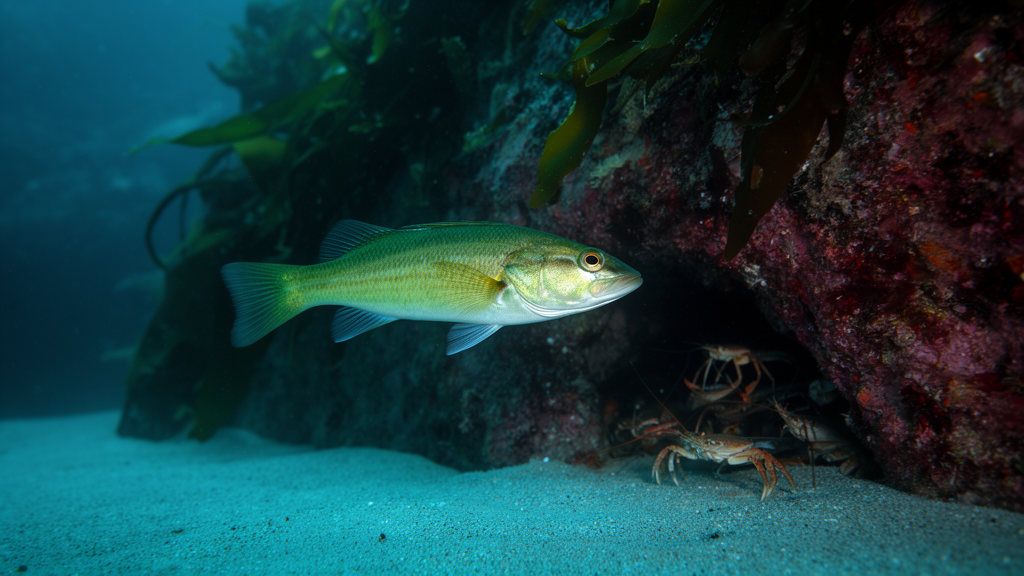
Along nearly 1,800 kilometres of the northwestern Atlantic coastline, the cunner wrasse changes its menu as it grows. A new study combining traditional microscopic gut content analysis with DNA metabarcoding found that adult body size, measured through weight and total length, significantly influences the dietary composition of Tautogolabrus adspersus, while biological sex plays only a minor and inconsistent role. Small cunner contained more soft-bodied organisms such as ascidians and anemones, whereas the guts of larger fish held more hard-shelled prey including bivalves and crustaceans. The researchers attribute this shift, at least in part, to the jaw gape limitations of smaller individuals, which may simply be unable to crush and swallow heavily armoured invertebrates.
The study, published in BMC Marine Science, was led by Christopher J.D. Bender, Camden D. Moir and Elizabeth G. Boulding of the University of Guelph. The team analysed 225 adult cunner collected between late July and September across four calendar years, 2018, 2019, 2022 and 2024, from 16 locations spanning roughly 1,755 kilometres, from Bay Bulls in eastern Newfoundland to the Mount Sinai Inlet near Port Jefferson, New York. Specimens ranged from 89 to 312 millimetres in total length, with a mean of about 193 millimetres, and from 11 to 412 grams in weight, averaging roughly 135 grams. All fish were captured by baited hook or baited trap deployed from wharves, docks and jetties in waters two to ten metres deep, over rocky, cobble and sand-gravel bottoms.
A crucial methodological decision shaped the entire analysis. Because earlier work on cunner diets had compared fish from different regions without correcting for the fact that fish in some regions are simply larger, the authors first tested whether body size differed among their sampling regions. Pairwise Mann-Whitney U tests on weight, length and Fulton’s condition factor confirmed significant differences in weight and length between certain pairs of regions. To disentangle geography from body size, they constructed additional datasets: one containing only large specimens from eastern and southern Newfoundland, one containing only small specimens from Cape Breton, southcentral and southwestern Nova Scotia and New York, and a combined large-plus-small group, omitting an intermediate-sized southern Newfoundland cohort from 2019. Condition factor, by contrast, showed no significant differences among regions and needed no such filtering.
For the morphological half of the study, gastrointestinal tracts were removed under DNA-free conditions, preserved in 70 percent ethanol, and their contents identified to the lowest possible taxonomic rank under a dissecting microscope, then weighed as separate groups. This yielded eleven measured variables covering ten distinct taxa plus an unidentified category. Principal component analysis followed by PERMANOVA testing revealed that weight and length significantly influenced diet composition in the first two principal components of several sample groups, and the two size metrics proved largely interchangeable in effect size, with weight slightly larger. Condition factor was significant only in the southcentral Nova Scotia group, suggesting minimal influence on diet overall. Region also had a significant effect, although no single region stood apart from all others in pairwise comparisons.
The prey patterns behind those statistics were striking. Soft-bodied prey such as ascidians and hydroids appeared frequently in smaller cunner, while larger fish had consumed crustaceans, bivalves and gastropods with tougher external armour. This pattern repeated across multiple datasets, including the large 2022 southern Newfoundland collection and the full dataset. One exception emerged in southcentral Nova Scotia, where smaller cunner preferentially ate hard-shelled organisms, particularly acorn barnacles and caprellid amphipods, over soft-bodied prey. The authors suggest this inversion may reflect the restricted size range sampled there, which included only small and medium fish, limiting the study’s ability to detect a size trend in that region.
The DNA metabarcoding arm of the study added molecular resolution. Gut content DNA was extracted from homogenised samples, amplified across three published primer sets targeting the mitochondrial COI barcoding region, and sequenced on Illumina MiSeq and NextSeq platforms, generating 73.36 million total reads, or roughly 29.32 million trimmed paired-end reads after processing. Bioinformatic analysis through the MetaWorks pipeline initially detected more than 3,000 species across four eukaryotic kingdoms; after removing bait, contaminants such as human, dog and cat DNA, and filtering detections below a 0.3 shared base-pair threshold, 583 species remained. For multivariate diet analysis the authors restricted the data to metazoan taxa, producing a final dataset spanning 14 phyla, 247 genera and 312 species.
Metabarcoding broadly corroborated the morphological findings. Percent frequency of occurrence analysis of the top 20 detected metazoan genera showed that soft-bodied taxa such as Ciona, Metridium and Nicolea were absent from the large-fish group, while hard-bodied taxa such as the mussel Mytilus and the amphipod Gammarus were present; the reverse held in the small-fish group. Non-metazoan detections added further texture: small cunner more frequently carried DNA from red macroalgae genera such as Neoporphyra, Polysiphonia and Scagelia, and from diatoms including Melosira, Navicula, Nitzschia and Pinnularia. The authors caution that these microscopic and algal detections could reflect accidental ingestion while foraging on hard substrates, or consumption of crustaceans that had themselves eaten diatoms, and that little is known about whether cunner can digest these organisms for nutrition. Notably, the primers used rarely amplified green macroalgae, so the absence of genera like Ulva likely reflects primer bias rather than true dietary exclusion.
Sex, by contrast, told a much weaker story. In the morphological data, comparisons between males and females were typically non-significant, with only the southern Newfoundland 2022 dataset and the large-only group showing significant associations. Because those datasets contained only the largest fish captured, separating the effect of sex from the effect of size proved difficult. Within the large group, males had consumed more ascidians and hydroids while females had taken more gastropods, crustaceans and bryozoans, but small cunner of both sexes showed substantial dietary overlap. The metabarcoding PERMANOVAs found no significant effect of sex in most regional datasets, and although some larger conglomerate datasets registered significant interactions, the effect sizes were considerably smaller than those of size metrics or region. The authors conclude that sex appears to be a minor influence whose inconsistent detection across datasets suggests the relationship may not be substantiative.
The ecological implications extend beyond one species. Cunner act as primary and secondary consumers of benthic macroinvertebrates, and the size-based dietary shift means a single individual links different parts of the food web over its lifetime. Small cunner feeding on hydroids and sea anemones, taxa that draw energy from pelagic sources through algal detritus, may shunt pelagic-derived energy back into pelagic pathways, while large cunner preying on mysid shrimp, amphipods and Mytilus mussels reinforce coupling between benthic and pelagic energy flows, ultimately connecting these lower trophic levels to larger pelagic predators that eat cunner. The authors also note that cunner have been trialled as cleaner fish in Canadian salmonid aquaculture, making a fuller picture of their natural diet practically relevant.
The study comes with candid limitations. Sample sizes varied among locations, size ranges within many local groups were narrow, which the authors say likely reduced their ability to detect size effects, and the vast geographic spread of sampling means region remains a potential confound even after the dataset restructuring. Metabarcoding provides presence-absence data rather than quantified consumption, and soft-bodied and hard-bodied prey likely shed DNA at different rates, complicating direct comparisons. Gape size was never measured directly, so jaw mechanics remain a plausible but untested explanation inferred from body size alone. The authors call for future work measuring bite force, gape size and breadth and their allometry with length, alongside standardised controls for region and prey community composition, and investigations into whether cunner derive nutrition from the macroalgae so frequently detected in their guts.
Subject of Research: How body size and sex shape the dietary composition of cunner wrasse across the northwestern Atlantic
Article Title: Joint morphological and DNA metabarcoding gut content analysis revealed that adult body size, but not biological sex, influences variance in dietary composition within and among cunner wrasse (Tautogolabrus adspersus) populations
Article References: Bender, C. J. D., Moir, C. D., & Boulding, E. G. (2026). Joint morphological and DNA metabarcoding gut content analysis revealed that adult body size, but not biological sex, influences variance in dietary composition within and among cunner wrasse (Tautogolabrus adspersus) populations. BMC Marine Science, 1(1), Article 2. https://doi.org/10.1186/s44479-026-00002-3
Image Credits: AI Generated
DOI: 10.1186/s44479-026-00002-3
Keywords: cunner wrasse, Tautogolabrus adspersus, DNA metabarcoding, gut content analysis, dietary ecology, body size, gape limitation, PERMANOVA, northwestern Atlantic, marine food webs, benthic macroinvertebrates, BMC Marine Science
News Source: Violet Maxwell. (October 29, 2026). Body Size, Not Sex, Shapes What Cunner Wrasse Eat Across the Northwest Atlantic. Scienmag.