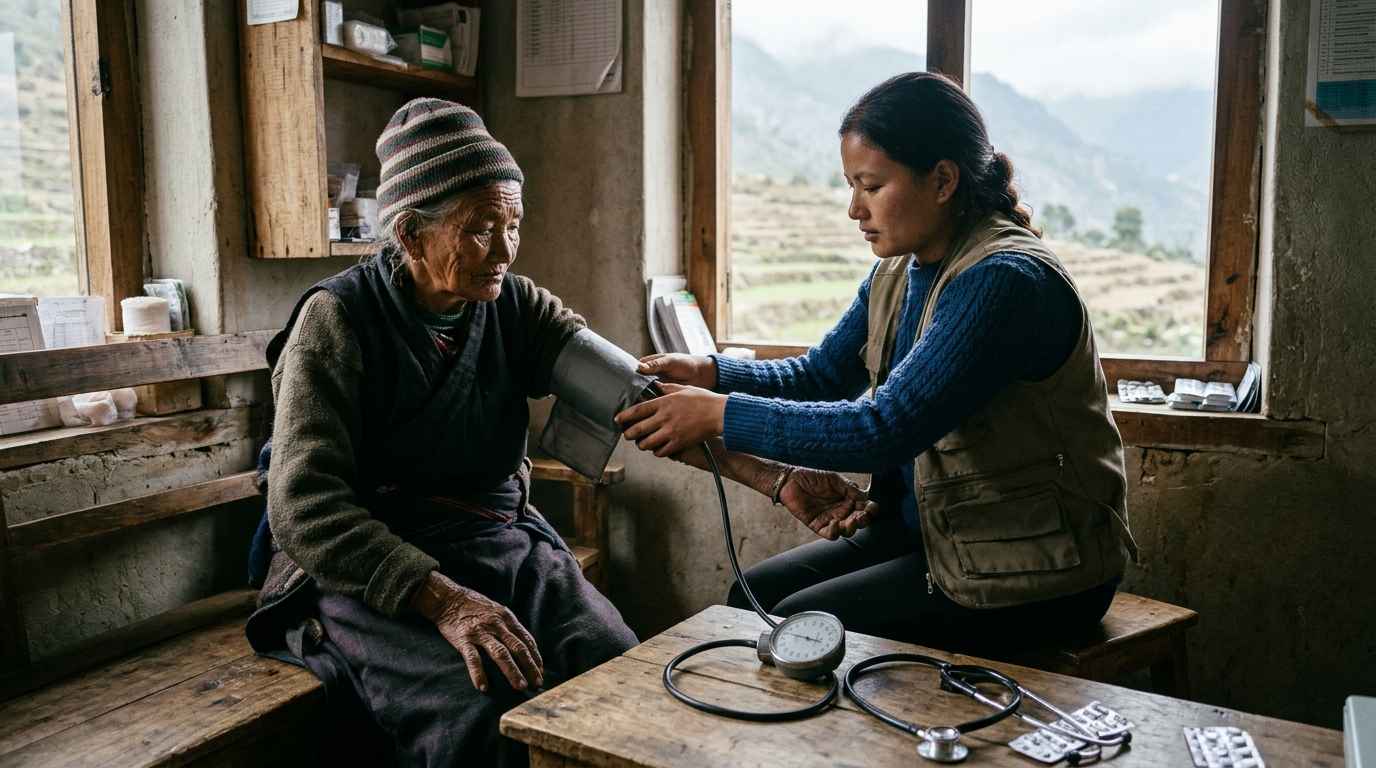
Hypertensive outpatients at Karnali Academy of Health Sciences in Jumla, Nepal, are being treated with regimens that fall well short of World Health Organization prescribing standards, according to a cross-sectional study of 197 patients published in Pharmacology Research & Perspectives. The study found that only 34.4 percent of prescribed drugs were written by generic name against a WHO benchmark of 100 percent, and that prescriptions averaged 4.05 drugs per encounter, roughly double the WHO reference of fewer than 2.0. At the same time, the investigators judged the clinical selection of antihypertensive classes and the low rate of injection use to be appropriate for the setting.
The research team, working at the sole tertiary-care academic hospital in Karnali Province, enrolled adult patients aged 18 years and older who attended the outpatient department between June 2025 and December 2025, provided informed consent, and had been prescribed at least one antihypertensive medication. Patients receiving inpatient or emergency care were excluded, as were individuals with cognitive impairment, communication difficulties, or psychiatric conditions that would interfere with participation. The target sample was calculated with Cochran’s formula and adjusted for an anticipated 5 percent non-response rate, yielding 197 participants. Data were gathered prospectively: after consent, the researcher reviewed each patient’s outpatient prescription from the same visit and recorded details on a structured proforma, an approach designed to capture prescribing in real time and avoid recall bias.
The questionnaire used for data collection was developed in English after reviewing comparable published studies, then refined through a pre-test with 18 hypertensive outpatients, face validation by a pharmacy professor, and content review by medical experts and a statistician. Internal consistency measured by Cronbach’s alpha reached 0.70, which the authors describe as acceptable reliability. Responses were double-entered into Microsoft Excel 2019, cleaned for inconsistencies, and analyzed in IBM SPSS Statistics version 26.0 using descriptive statistics and chi-square tests, with p-values below 0.05 considered significant.
The participants were nearly evenly split by sex, with 51.3 percent male and 48.7 percent female, and the largest age group was 50 to 59 years at 23.9 percent of the sample. Mean age was 51.58 years. Education levels were modest: 39.1 percent had secondary schooling and 22.3 percent were illiterate. Housewives made up 37.6 percent of the cohort and farmers 28.4 percent, reflecting the agrarian economy of Karnali Province. A family history of hypertension was reported by 64.0 percent of participants. Lifestyle risk factors were striking: 94.4 percent reported high salt intake and 76.1 percent reported physical inactivity, while smoking stood at 17.8 percent and alcohol consumption at 23.4 percent.
Clinically, the cohort carried a heavy burden of established disease. Mean duration of hypertension was 7.97 years, mean systolic blood pressure was 155.91 mmHg, and mean diastolic pressure was 95.27 mmHg. Under the JNC-7 classification, 45.2 percent of patients fell into Stage 1 hypertension and 44.7 percent into Stage 2, with only one patient recording normal blood pressure. Overweight and obesity dominated the body mass index distribution, with 41.1 percent overweight and 33.5 percent distributed across the three obesity classes. Diabetes mellitus was the most common comorbidity at 22.8 percent, followed by dyslipidemia at 19.8 percent and chronic kidney disease at 11.7 percent.
Across the 799 drugs prescribed to the cohort, antihypertensives accounted for 44.7 percent, with other cardiovascular drugs and anti-ulcer agents each at 8.0 percent and lipid-lowering drugs at 7.8 percent. Among the 357 antihypertensive prescriptions, calcium channel blockers led at 32.8 percent, followed by angiotensin receptor blockers at 24.6 percent, diuretics at 19.3 percent, beta-blockers at 17.6 percent, and ACE inhibitors at just 5.6 percent. Amlodipine was the single most prescribed agent, representing 30.3 percent of antihypertensive prescriptions, ahead of telmisartan at 17.1 percent and atenolol at 13.4 percent. Within classes, amlodipine dominated the calcium channel blockers at 92.3 percent, telmisartan accounted for 69.3 percent of ARB prescriptions, and atenolol for 76.2 percent of beta-blockers.
Defined Daily Dose analysis based on the WHO Anatomical Therapeutic Chemical classification reinforced the same hierarchy. Amlodipine accumulated 3,390 DDDs, telmisartan 1,890, and atenolol 980, out of a cumulative total of 10,163 DDDs for all antihypertensive drugs in the study. Ramipril was a notable outlier, generating 1,140 DDDs from only 19 prescriptions, which the authors interpret as prescribing at longer durations or higher strengths. Telmisartan was prescribed at an average daily dose of 40 mg, exactly matching the WHO DDD for that drug.
Therapy patterns leaned toward combination treatment. Dual therapy was the most common regimen at 43.7 percent of patients, monotherapy accounted for 39.1 percent, triple therapy 15.7 percent, and quadruple therapy 1.5 percent, with a mean of 1.82 antihypertensive drugs per patient. The most frequent combinations were CCB plus ARB in dual therapy and CCB plus ARB plus diuretic in triple therapy. Chi-square analysis showed a highly significant association between therapy type and both JNC-7 stage and age group, each with p-values below 0.001: patients with Stage 2 hypertension and older patients were more likely to receive dual or polytherapy, while those with normal or prehypertensive readings predominantly received monotherapy. Gender showed no significant association with therapy pattern, with a p-value of 0.530, which the authors read as evidence that treatment decisions were not influenced by patient sex.
The WHO core prescribing indicators told a more mixed story. The average of 4.05 drugs per encounter substantially exceeded the reference standard of fewer than 2.0, a level of polypharmacy the authors attribute to the prevalence of comorbidities requiring multiple medications, the use of multiple antihypertensive agents, co-prescribing of gastroprotective agents such as pantoprazole, and adjunctive therapies including vitamins, supplements, and analgesics. Generic prescribing at 34.4 percent fell far below the 100 percent standard, and the authors identify this gap as likely the single most important modifiable factor in the study, noting that nearly two-thirds of prescriptions relied on brand names in a low-income setting where out-of-pocket costs matter. Antibiotic encounters at 14.2 percent and injection encounters at 7.6 percent fell within or below the WHO reference ranges of 20 to 26.8 percent and 13.4 to 24.1 percent respectively, which the authors interpret as reasonable antibiotic use and appropriate restraint with injections. Adherence to Nepal’s National List of Essential Medicines stood at 79.9 percent, below the 100 percent benchmark but described as moderate.
The authors conclude that antihypertensive prescribing at the hospital is clinically appropriate in drug selection and injection use but deviates significantly from WHO rational drug use standards in generic prescribing and polypharmacy, gaps they say directly increase patient costs and health risks. They caution that the study did not collect detailed individual-level information on dietary sodium intake, contraindications, previous treatment, adverse effects, renal function, electrolyte status, or prescriber preference, so the relatively low use of diuretics and ACE inhibitors cannot be judged inappropriate from prescription frequency alone. As a descriptive cross-sectional study from a single referral center in a remote district, the findings describe prescribing at one institution and time period rather than establishing causal relationships, but they offer a concrete baseline for interventions aimed at improving prescribing quality, affordability, and blood pressure control in underserved settings.
Subject of Research: Antihypertensive drug utilization and WHO prescribing indicators among hypertensive outpatients at a tertiary hospital in Jumla, Nepal
Article Title: Drug Utilization Patterns and WHO Prescribing Indicators Among Hypertensive Outpatients at Karnali Academy of Health Sciences, Nepal: A Cross‐Sectional Study
Article References: Aryal, B., Yadav, B. K., Sapkota, B., & Adhikari, S. (2026). Drug Utilization Patterns and WHO Prescribing Indicators Among Hypertensive Outpatients at Karnali Academy of Health Sciences, Nepal: A Cross‐Sectional Study. Pharmacology Research & Perspectives, 14(6), Article e70341. https://doi.org/10.1002/prp2.70341
Image Credits: AI Generated
DOI: 10.1002/prp2.70341
Keywords: hypertension, drug utilization, WHO prescribing indicators, Nepal, polypharmacy, generic prescribing, essential medicines, cross-sectional study, antihypertensives, outpatient care, rational drug use, Karnali
News Source: Ophelia Keating. (November 5, 2026). Blood Pressure Prescriptions in Remote Nepal Reveal Sharp Gaps From WHO Standards. Scienmag.