Aquaculture feeds face a fundamental problem: fishmeal, the protein backbone of most carnivorous fish diets, is expensive, variable in quality, and tied to pressure on wild fisheries. A study published in Aquaculture Science and Management reports a controlled feeding trial in which black soldier fly (Hermetia illucens) larval meal completely replaced fishmeal in the diet of Parachanna obscura, an obscure snakehead species being domesticated in Benin, without harming growth, survival, or feed utilization. In fact, the fishmeal-free diet produced some of the best results of the entire experiment.
The research, conducted by Germain Aissetche, Diane N. S. Kpogue Gangbazo, Arnauld S. M. Djissou, Marthe S. Djossa, Théophile Godome, and Ibrahim Imorou Toko, was motivated by the search for novel alternative protein sources at a time when the sustainability of aquaculture practices has become crucial due to pressure on wild fisheries and demographic growth. Parachanna obscura attracted their attention because, although other fish species are being domesticated in Benin, aquaculture there remains dominated by the production of just two species despite the country’s rich inland waters. Captive production of P. obscura has drawn considerable research interest, but its full domestication has not yet been achieved because key production factors remain incompletely understood. Even though the nutritional requirements of the species are known, developing a balanced, sustainable diet based on local feed resources for its juveniles remains a major challenge.
Insects have recently been cited as promising alternative proteins for animal feed because of their high protein content and interesting lipid profiles, and the black soldier fly stands out as a top candidate because of its nutritional quality. Several research groups have already replaced fishmeal with black soldier fly larvae meal in diets for African catfish (Clarias gariepinus), blue tilapia (Oreochromis aureus), and Carassius auratus with very satisfactory results. What set the new study apart was that black soldier fly larvae meal had not yet been incorporated into the diet of P. obscura, a species with significant aquaculture potential.
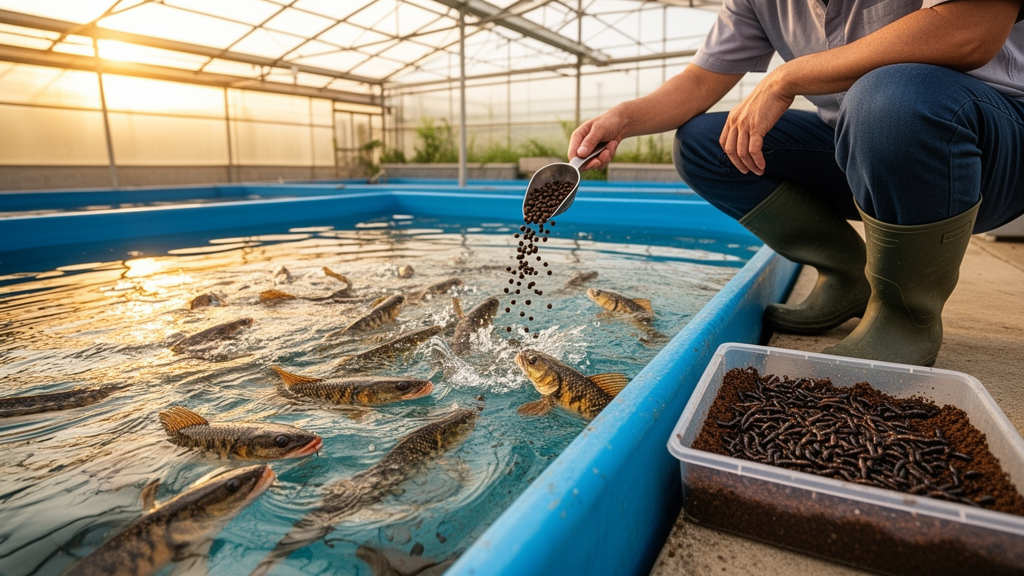
The experimental design was straightforward but rigorous. Four iso-proteic, iso-lipidic, and iso-energetic diets, labeled T0 through T3, were formulated with black soldier fly larval meal incorporation levels of 0%, 33.33%, 66.66%, and 100% of the fishmeal fraction. Six hundred postlarvae with an initial mean body weight of 0.3 grams were stocked into twelve above-ground tanks at a density of 50 fish per 100 liters of water, corresponding to 0.5 individuals per liter. Each diet was tested in triplicate using a randomized design, and the trial lasted 28 days. During feed preparation, raw ingredients were finely ground, weighed, and homogenized; purified lysine and methionine, vitamins, minerals, and soybean oil were added in prescribed proportions, and the dough was extruded into spaghetti-like strands, dried at 30 degrees Celsius for 36 hours, and stored sealed at 4 degrees Celsius.
Fish were fed at 5% of tank biomass per day, three times daily, after a one-week acclimation on a mixture of the experimental diets. Because postlarvae are tiny, the feeds were ground to match the size of their mouth openings. Every seven days, the researchers counted and weighed the fish in each tank to track biomass development and adjust rations. Each morning, before the first feeding, temperature, pH, and dissolved oxygen were measured with a portable multiparameter probe. Biochemical analyses of proteins, lipids, ash, and dry matter were performed in triplicate on ingredients, diets, and fish samples using standard AOAC methods, with crude protein determined by the Kjeldahl method and lipids quantified by Soxhlet hot extraction with a chloroform-methanol mixture.
The results were striking. Survival rates ranged from 96.67% to 98% across all diets, with no significant differences among treatments, indicating that the insect meal posed no survival risk at any inclusion level. In contrast, final mean weight, average daily gain, and specific growth rate differed significantly among diets and increased with higher inclusion levels of black soldier fly larvae meal. The highest values for these growth parameters were obtained with treatments T2 and T3, the diets containing 66.66% and 100% larval meal respectively. Feed efficiency was also significantly affected by diet, with the fully fishmeal-free T3 diet yielding the highest feed efficiency of all.
The economic picture reinforced the biological one. The best economic conversion ratio, which combines feed cost with the feed conversion ratio, was obtained with the diet containing 66.66% black soldier fly meal. Protein efficiency ratio and protein productive value, two measures of how efficiently dietary protein is converted into fish body protein, peaked in fish fed diet T2. The experimental diets also significantly affected the proximate composition of fish carcasses, with levels of ash, protein, lipid, and dry matter in the final samples all higher than in the initial fish. Together, these findings led the authors to conclude that black soldier fly larval meal can totally replace fishmeal in diets for P. obscura postlarvae without negatively affecting their zootechnical performance.
Water quality monitoring helps explain why the trial was clean. pH values ranged from 6.98 to 7.21, slightly above the recommended range for the species but close to neutral, indicating chemically balanced water with reduced risk of rapid pH fluctuations that could stress the larvae. Dissolved oxygen levels varied between 5.13 and 5.42 milligrams per liter, slightly below the recommended range, but P. obscura is known for its remarkable ability to survive in low-oxygen environments thanks to a respiratory system that allows it to breathe at the water surface. Temperatures recorded during the trial were consistent with the species’ optimal requirements. No significant differences in any measured physicochemical parameter were observed among treatments, so water conditions could not have driven the growth differences between diets.
The authors attribute the superior performance of fish fed the insect meal to its nutritional profile. Black soldier fly larvae meal is rich in high-quality protein, essential amino acids, and digestible lipids, properties that enhance nutrient absorption and growth. The findings align with earlier work reporting enhanced growth performance in freshwater fish fed insect-based diets, and with studies showing that 50% and 75% black soldier fly meal can successfully replace fishmeal in Clarias gariepinus larvae without compromising zootechnical performance, feed utilization, or health status. Similar outcomes have been reported in tilapia larvae, in rainbow trout fed insect meal achieving growth comparable to traditional fishmeal diets, and in Nile tilapia, where researchers recommended black soldier fly larvae as a fishmeal substitute. Based on their results, the authors suggest that P. obscura postlarvae convert black soldier fly meal more efficiently than C. gariepinus larvae did in a comparable study.
Beyond growth, the economics matter for farmers. Incorporating black soldier fly larvae meal into aquaculture diets improves the economic feed conversion ratio and reduces dependence on fishmeal, which is costly and subject to price fluctuations driven by overexploitation of fishery resources. Black soldier fly production is less expensive because it utilizes organic waste, thereby promoting a circular economy. The authors caution that this was a 28-day trial on postlarvae under controlled conditions, so the findings apply to the early rearing stage rather than the full production cycle. Still, the conclusion is clear: in this controlled experiment, a diet containing no fishmeal at all outperformed the fishmeal-based control, offering snakehead aquaculture in West Africa a locally relevant, sustainable path forward.
Subject of Research: Replacing fishmeal with black soldier fly larval meal in diets for Parachanna obscura postlarvae
Article Title: Valorization of black soldier fly (Hermetia illucens) larval meal in the diet of Parachanna obscura (Günther, 1861) postlarvae reared under controlled conditions
Article References: Aissetche, G., Kpogue Gangbazo, D. N. S., Djissou, A. S. M., Djossa, M. S., Godome, T., & Toko, I. I. (2026). Valorization of black soldier fly (Hermetia illucens) larval meal in the diet of Parachanna obscura (Günther, 1861) postlarvae reared under controlled conditions. Aquaculture Science and Management, 3(1), Article 8. https://doi.org/10.1186/s44365-025-00027-1
Image Credits: AI Generated
DOI: 10.1186/s44365-025-00027-1
Keywords: black soldier fly, Hermetia illucens, fishmeal replacement, aquaculture, Parachanna obscura, postlarvae, feed conversion ratio, insect meal, Benin, sustainable feed, growth performance, snakehead
News Source: Daisy Hatcher. (October 29, 2026). Black Soldier Fly Larvae Fully Replace Fishmeal in Snakehead Fish Diets, Trial Shows. Scienmag.