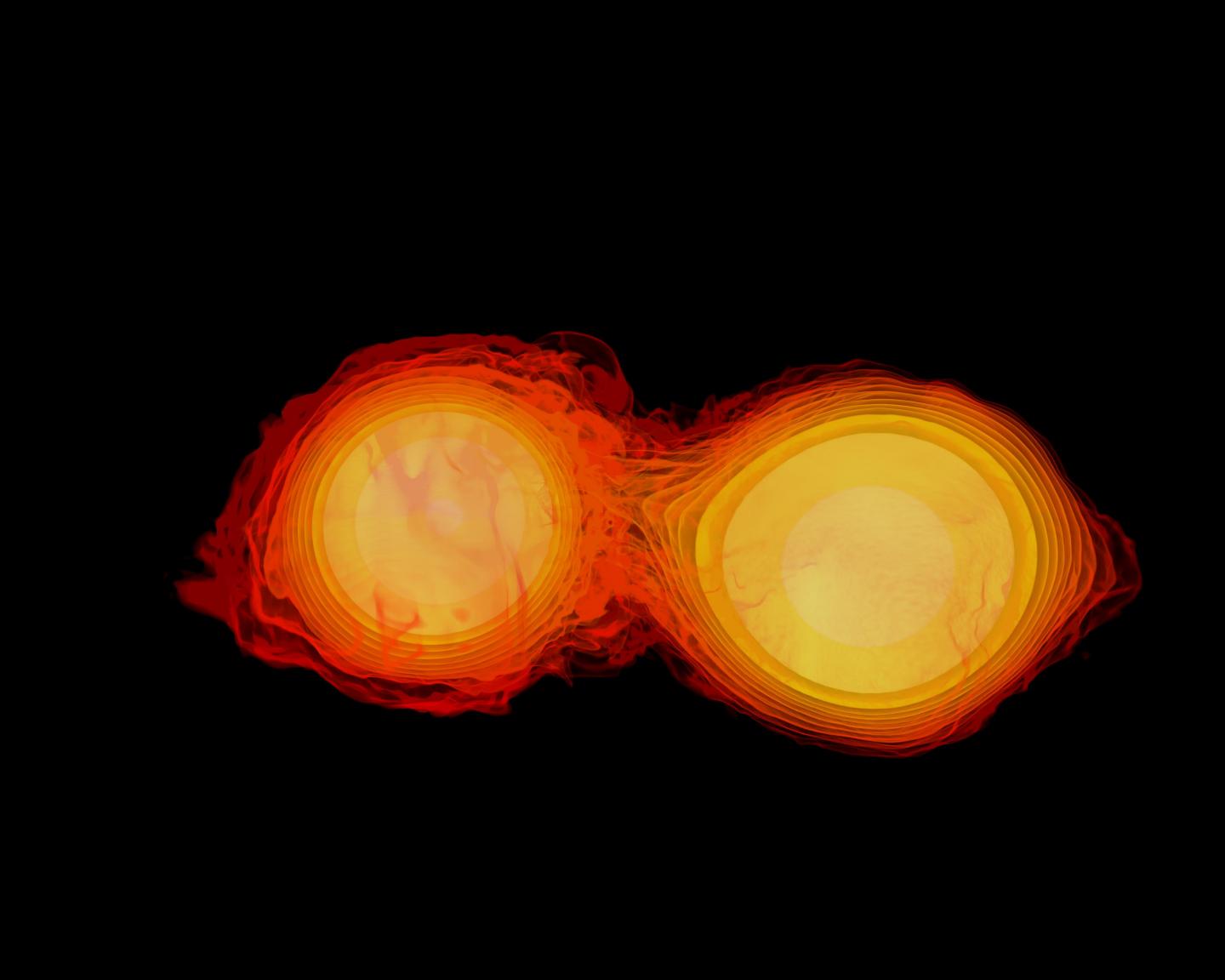
Scientists have for the first time detected black holes eating neutron stars, “like Pac Man”, in a discovery documenting the collision of the two most extreme and enigmatic objects in the Universe.
The Laser Interferometer Gravitational-Wave Observatory (LIGO) in the US and the Virgo gravitational-wave observatory in Italy have captured the gravitational waves from the death spiral and merger of a neutron star with a black hole, not once but twice. The findings are published today.
The researchers say their observations will help unlock some of the most complex mysteries of the Universe, including the building blocks of matter and the workings of space and time.
More than 1,000 scientists were involved with the world-first detections, with many from Australia, including The Australian National University, leading the way.
Distinguished Professor Susan Scott, a co-author on the study based at the ANU Research School of Physics in the Centre for Gravitational Astrophysics, said the events occurred about a billion years ago but were so massive that we are still able to observe their gravitational waves today.
“These collisions have shaken the Universe to its core and we’ve detected the ripples they have sent hurtling through the cosmos,” she said.
“Each collision isn’t just the coming together of two massive and dense objects. It’s really like Pac-Man, with a black hole swallowing its companion neutron star whole.
“These are remarkable events and we have waited a very long time to witness them. So it’s incredible to finally capture them.”
One event included a black hole with a mass nine times bigger than our own sun and a neutron star with two times our sun’s mass. The other event included a black hole with about six times the mass of our sun and a neutron star with 1.5 times its mass.
Professor Scott, also a Chief Investigator at the ARC Centre of Excellence for Gravitational Wave Discovery (OzGrav), said the international team had previously captured many events involving two black holes colliding as well as two neutron stars smashing together.
“Now, we’ve completed the last piece of the puzzle with the first confirmed observations of gravitational waves from a black hole and a neutron star colliding,” she said.
Dr Johannes Eichholz, from the ANU Centre for Gravitational Astrophysics and an Associate Investigator with OzGrav, said the two detections were originally made on 5 and 15 January 2020.
“These kind of detections are incredibly rare,” he said.
“We haven’t detected these events once – but twice and within 10 days of each other.
“Like the ripples from these two events, which have been felt a billion years later, these findings will have a profound impact on our understanding of the Universe for many years to come.”
###
The findings are published today in The Astrophysical Journal Letters.
FOR INTERVIEW:
Distinguished Professor Susan Scott
ANU Research School of Physics
M: +61 450 522 939
E: [email protected]
For media assistance, contact James Giggacher on +61 436 803 488 or ANU Media on +61 2 6125 7979 or [email protected]
Additional information about the gravitational-wave observatories
The ARC Centre of Excellence for Gravitational Wave Discovery (OzGrav) is funded by the Australian Government through the Australian Research Council Centres of Excellence funding scheme. OzGrav is a partnership between Swinburne University of Technology (host of OzGrav headquarters), The Australian National University, Monash University, University of Adelaide, University of Melbourne, and University of Western Australia, along with other collaborating organisations in Australia and overseas.
This material is based upon work supported by NSF’s LIGO Laboratory which is a major facility fully funded by the National Science Foundation and operated by Caltech and MIT, which conceived of LIGO and led the Initial and Advanced LIGO projects. Financial support for the Advanced LIGO project was led by the NSF with Germany (Max Planck Society), the UK (Science and Technology Facilities Council) and Australia (Australian Research Council-OzGrav) making significant commitments and contributions to the project. Nearly 1300 scientists from around the world participate in the effort through the LIGO Scientific Collaboration, which includes the GEO Collaboration. A list of additional partners is available at https:/
The Virgo Collaboration is currently composed of approximately 700 members from 125 institutions in 15 different countries. The European Gravitational Observatory (EGO) hosts the Virgo detector near Pisa in Italy, and is funded by Centre National de la Recherche Scientifique (CNRS) in France, the Istituto Nazionale di Fisica Nucleare (INFN) in Italy, and Nikhef in the Netherlands. A list of the Virgo Collaboration members can be found at http://public.
Media Contact
James Giggacher
[email protected]