


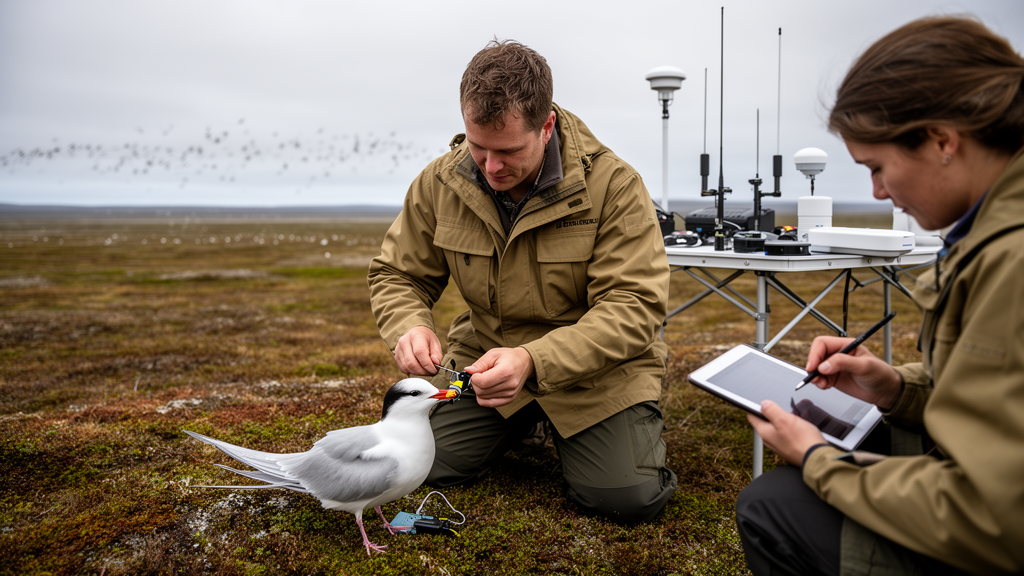
Biologging devices that track the movements and behaviors of individual animals could transform how scientists forecast where species will go as environments change, according to a comment article published in BMC Zoology. The article, authored by Alexa L. Fredston and Roxanne S. Beltran, argues that predicting how movement strategies shape fitness in a changing world requires building mechanistic models of species’ ranges and range shifts that align environmental data with the scales at which individual animals perceive their surroundings and make decisions.
The core problem the authors identify is a mismatch of scales. Many existing approaches to species distribution modeling describe where animals occur without capturing the biological processes that put them there. The comment calls for jointly modeling biological processes from the individual to the population scale, so that the fine-grained decisions of a single animal—where it moves, when it moves, and how it responds to its immediate environment—connect coherently to the broader patterns of redistribution that determine a species’ shifting range.
Biologgers are central to this proposed transition. These miniature devices, attached to animals, record individual-level movement and behavior data that can reveal how animals experience and respond to their environments at the scale of individual perception and decision-making. By pairing such data with environmental information matched to those same scales, researchers could build models that are mechanistic rather than merely descriptive, capturing the processes that generate observed distributions instead of only their outcomes.
The authors frame this as a move from description to explanation and prediction. In their conclusion, they write that this transition will allow researchers to move beyond merely describing where animals are toward understanding how and why they are there. Aligning environmental data with the scales of individual perception and decision-making, and jointly modeling processes across biological scales, would enable mechanistic forecasts of redistribution under novel conditions and let scientists begin to predict how movement strategies influence fitness, demographic processes, and ultimately species redistribution in a changing world.
The article is published as a comment, a format that presents an argument or perspective rather than reporting a new empirical study. Consistent with that, the authors state that no datasets were generated or analysed during the current study. The proposals therefore describe a research agenda—what the field should do—rather than results demonstrating that a particular model has already succeeded. The article also uses the abbreviation SOTM for “species on the move” and SDM for “species distribution modeling,” situating itself within ongoing discussions of shifting species ranges.
Published open access on 24 July 2026 in BMC Zoology, volume 11, article number 23, the comment joins a growing body of work on species redistribution under climate and environmental change. Its argument is directed at researchers who model ranges and range shifts: the tools to observe individual animals in detail already exist in biologging technology, and the modeling task is to bring those observations together with environmental data at matching scales, so that forecasts of range shifts could become more reliable in novel conditions while revealing how the movement strategies of individual animals feed through fitness and demography into the redistribution of entire species.
Subject of Research: Using biologging data to build mechanistic, cross-scale models for forecasting animal movement and species range shifts
Article Title: Leveraging biologgers to better forecast animal movement and range shifts across scales
Article References: Fredston, A. L., & Beltran, R. S. (2026). Leveraging biologgers to better forecast animal movement and range shifts across scales. BMC Zoology, 11(1), Article 23. https://doi.org/10.1186/s40850-026-00276-0
Image Credits: AI Generated
DOI: 10.1186/s40850-026-00276-0
Keywords: biologging, animal movement, range shifts, species distribution modeling, fitness, mechanistic models, BMC Zoology, climate change, ecology, individual decision-making, population scale, species redistribution
News Source: Margaret Porter. (October 30, 2026). Biologgers could sharpen forecasts of animal movement and range shifts. Scienmag.



