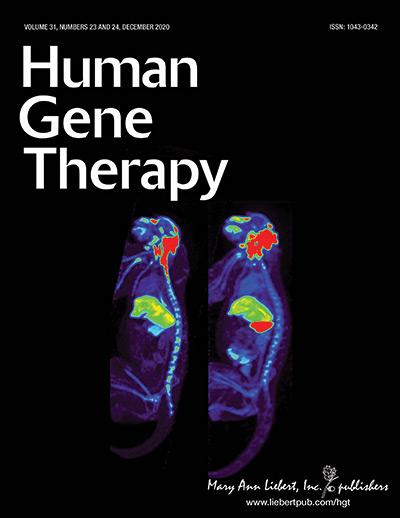
Credit: Mary Ann Liebert, Inc., publishers
New Rochelle, NY, January 15, 2021–The biodistribution of adeno-associated virus (AAV) gene transfer vectors can be measured in nonhuman primates using a new method. The method quantifies whole-body and organ-specific AAV capsids from 1 to 72 hours after administration. Study design and results are presented in the peer-reviewed journal Human Gene Therapy. Click here to read the full-text article free on the Human Gene Therapy website through February 15, 2021.
AAV capsids were labeled with I-124 and delivered using two routes of administration: intravenous and directly into the cerebrospinal fluid (CSF). Biodistribution was measured by quantitative positron emission tomography (PET) at 1, 24, 48, and 72 hours after AAV administration. Two AAV vectors – AAVrsh.10 and AAV9 – were compared.
“Following intravenous administration, both vectors behaved in a similar fashion, distributed primarily to the liver and to a lesser extent heart. Neither were detected at significant levels in the brain. Both vectors administered intravenously also distribute to the vertebrae,” state Ronald Crystal, Weill Cornell Medical College, and coauthors. About 50% dispersed throughout the body, in part in skeletal muscle.
Following administration into the CSF, the labeled capsid had a half-life of approximately 10 hours, suggesting the possibility of slow diffusion into the brain.
In animals with pre-existing immunity, compared to naïve animals, there was a 10-fold increase in biodistribution to the spleen.
“PET imaging is a powerful tool to track biodistribution, which is a critical property affecting the safety and efficacy of gene therapy,” according to Editor-in-Chief of Human Gene Therapy Terence R. Flotte, MD, Celia and Isaac Haidak Professor of Medical Education and Dean, Provost, and Executive Deputy Chancellor, University of Massachusetts Medical School.
###
Research reported in this publication was supported by the National Institutes of Health under Award Number EB027918. The content is solely the responsibility of the authors and does not necessarily represent the official views of the National Institutes of Health.
About the Journal
Human Gene Therapy, the Official Journal of the European Society of Gene and Cell Therapy and eight other international gene therapy societies, was the first peer-reviewed journal in the field and provides all-inclusive access to the critical pillars of Human Gene Therapy: research, methods, and clinical applications. The Journal is led by Editor-in-Chief Terence R. Flotte, MD, Celia and Isaac Haidak Professor of Medical Education and Dean, Provost, and Executive Deputy Chancellor, University of Massachusetts Medical School, and an esteemed international editorial board. Human Gene Therapy is available in print and online. Complete tables of contents and a sample issue are available on the Human Gene Therapy website.
About the Publisher
Mary Ann Liebert, Inc., publishers is known for establishing authoritative peer-reviewed journals in many promising areas of science and biomedical research. Its biotechnology trade magazine, GEN (Genetic Engineering & Biotechnology News), was the first in its field and is today the industry’s most widely read publication worldwide. A complete list of the firm’s 90 journals, books, and newsmagazines is available on the Mary Ann Liebert, Inc., publishers website.
Media Contact
Kathryn Ryan
[email protected]
Original Source
https:/
Related Journal Article
http://dx.