• HOME
  • NEWS
  • EXPLORE
    • CAREER
      • Companies
      • Jobs
    • EVENTS
    • iGEM
      • News
      • Team
    • PHOTOS
    • VIDEO
    • WIKI
  • BLOG
  • COMMUNITY
    • FACEBOOK
    • INSTAGRAM
    • TWITTER
Monday, October 5, 2026
BIOENGINEER.ORG
No Result
View All Result
  • Login
  • HOME
  • NEWS
  • EXPLORE
    • CAREER
      • Companies
      • Jobs
        • Lecturer
        • PhD Studentship
        • Postdoc
        • Research Assistant
    • EVENTS
    • iGEM
      • News
      • Team
    • PHOTOS
    • VIDEO
    • WIKI
  • BLOG
  • COMMUNITY
    • FACEBOOK
    • INSTAGRAM
    • TWITTER
  • HOME
  • NEWS
  • EXPLORE
    • CAREER
      • Companies
      • Jobs
        • Lecturer
        • PhD Studentship
        • Postdoc
        • Research Assistant
    • EVENTS
    • iGEM
      • News
      • Team
    • PHOTOS
    • VIDEO
    • WIKI
  • BLOG
  • COMMUNITY
    • FACEBOOK
    • INSTAGRAM
    • TWITTER
No Result
View All Result
Bioengineer.org
No Result
View All Result
Home NEWS Science News Health

Biochemical switches identified that could be triggered to treat muscle, brain disorders

Bioengineer by Bioengineer
April 10, 2019
in Health
Reading Time: 2 mins read
0
IMAGE
Share on FacebookShare on TwitterShare on LinkedinShare on RedditShare on Telegram

IMAGE

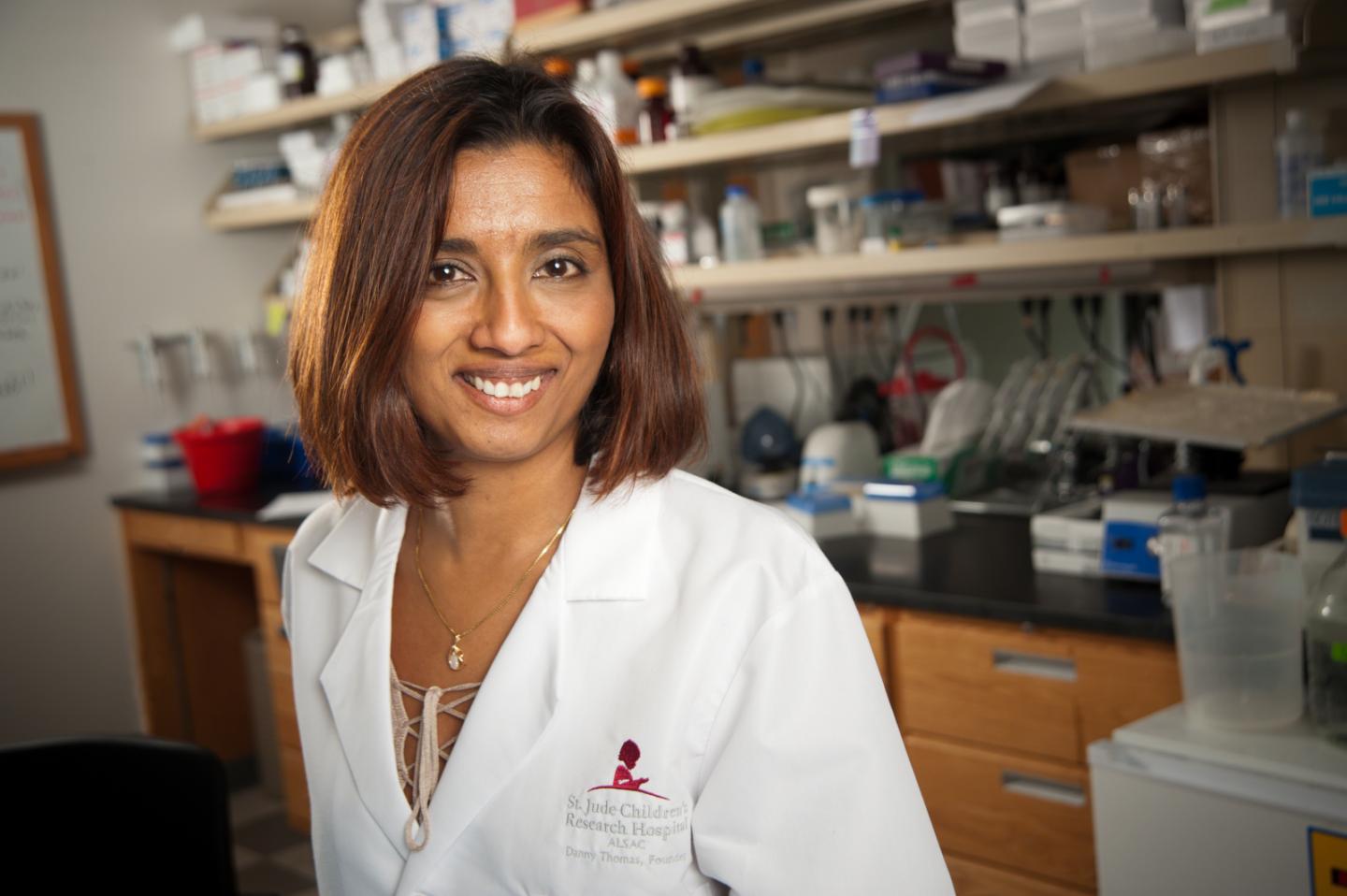
Credit: St. Jude Children’s Research Hospital

St. Jude Children’s Research Hospital scientists have found that the enzymes ULK1 and ULK2 play a key role in breaking down cell structures called stress granules, whose persistence leads to toxic buildup of proteins that kill muscle and brain cells. Such buildup is central to the pathology of three related diseases: inclusion body myopathy (IBM), amyotrophic lateral sclerosis (ALS) and frontotemporal dementia (FTD).

IBM causes weakness in arm and leg muscles. ALS, also known as Lou Gehrig’s disease, causes paralysis due to the death of nerve cells controlling voluntary muscles. FTD is a form of dementia that damages areas of the brain associated with personality, behavior and language.

Led by St. Jude researcher Mondira Kundu, M.D., Ph.D., an associate member of the St. Jude Department of Pathology, the team published their findings online in the journal Molecular Cell.

Stress granules are biological “storm shelters” that temporarily protect genetic molecules and proteins when the cell’s health is under threat from heat, chemicals or infection. Such granules normally disassemble when the stress is removed, but mutations that cause malfunction in the disassembly machinery can cause them to persist. One such mutation is in a gene called VCP, and the St. Jude researchers found that ULK1/2 is a key activator of VCP. Thus, they believe that drugs to boost those enzymes could help treat the pathology of IBM, ALS and FTD.

The other St. Jude authors are Bo Wang, Brian Maxwell, Joung Hyuck Joo, Youngdae Gwon, James Messing, Ashutosh Mishra, Timothy Shaw, Amber Ward, Honghu Quan, Sadie Miki Sakurada, Shondra Pruett-Miller, Peter Vogel, Hong Joo Kim and Junmin Peng. Co-author Tulio Bertorini is with the University of Tennessee Heath Science Center. Co-author J. Paul Taylor is a Howard Hughes Medical Institute Investigator and chair of the St. Jude Department of Cell and Molecular Biology.

The research was supported by the National Institutes of Health (R01 MH115058, HL114697, R01 GM114260, R35 NS097974), the Robert Packard Center for ALS Research and ALSAC, the fundraising and awareness organization of St. Jude.

###

Media Contact
Corey Carmichael
[email protected]

Original Source

http://www.stjude.org/ulk1-ulk2-stress-granules

Related Journal Article

http://dx.doi.org/10.1016/j.molcel.2019.03.027

Tags: BiologyCell BiologyDevelopmental/Reproductive BiologyMedicine/Health
Share14Tweet8Share2ShareShareShare2

Related Posts

AI Chatbot Beats Web Search at Helping Laypeople Diagnose Respiratory Illness

AI Chatbot Beats Web Search at Helping Laypeople Diagnose Respiratory Illness

October 5, 2026
Physics-Meets-AI Model Reads Muscle Fatigue Signals for Back Pain Rehab

Physics-Meets-AI Model Reads Muscle Fatigue Signals for Back Pain Rehab

October 5, 2026

Human Organs on Chips Recreate Body’s Niches to Predict Drug Safety

October 5, 2026

Pelvic Pain Is Far More Common Than Assumed in Transmasculine People on Testosterone, First Meta-Analysis Finds

October 5, 2026
Please login to join discussion

POPULAR NEWS

  • Alloys That Shrink Their Own Grains: New PIX Mechanism Refines Metals With Heat Alone

    Alloys That Shrink Their Own Grains: New PIX Mechanism Refines Metals With Heat Alone

    29 shares
    Share 12 Tweet 7
  • Endurance Exercise Reshapes the Liver in Males and Females Through Distinct Molecular Routes

    29 shares
    Share 12 Tweet 7
  • Single Transcription Factor PU.1 Rapidly Converts Fibroblasts into Macrophage-Lineage Cells

    29 shares
    Share 12 Tweet 7
  • New Scale Measures How Ready Nurse Educators Really Are for the AI Era

    29 shares
    Share 12 Tweet 7

About

We bring you the latest biotechnology news from best research centers and universities around the world. Check our website.

Follow us

Recent News

Alloys That Shrink Their Own Grains: New PIX Mechanism Refines Metals With Heat Alone

Endurance Exercise Reshapes the Liver in Males and Females Through Distinct Molecular Routes

Single Transcription Factor PU.1 Rapidly Converts Fibroblasts into Macrophage-Lineage Cells

Subscribe to Blog via Email

Success! An email was just sent to confirm your subscription. Please find the email now and click 'Confirm' to start subscribing.

Join 85 other subscribers
  • Contact Us

Bioengineer.org © Copyright 2023 All Rights Reserved.

Welcome Back!

Login to your account below

Forgotten Password?

Retrieve your password

Please enter your username or email address to reset your password.

Log In
No Result
View All Result
  • Homepages
    • Home Page 1
    • Home Page 2
  • News
  • National
  • Business
  • Health
  • Lifestyle
  • Science

Bioengineer.org © Copyright 2023 All Rights Reserved.