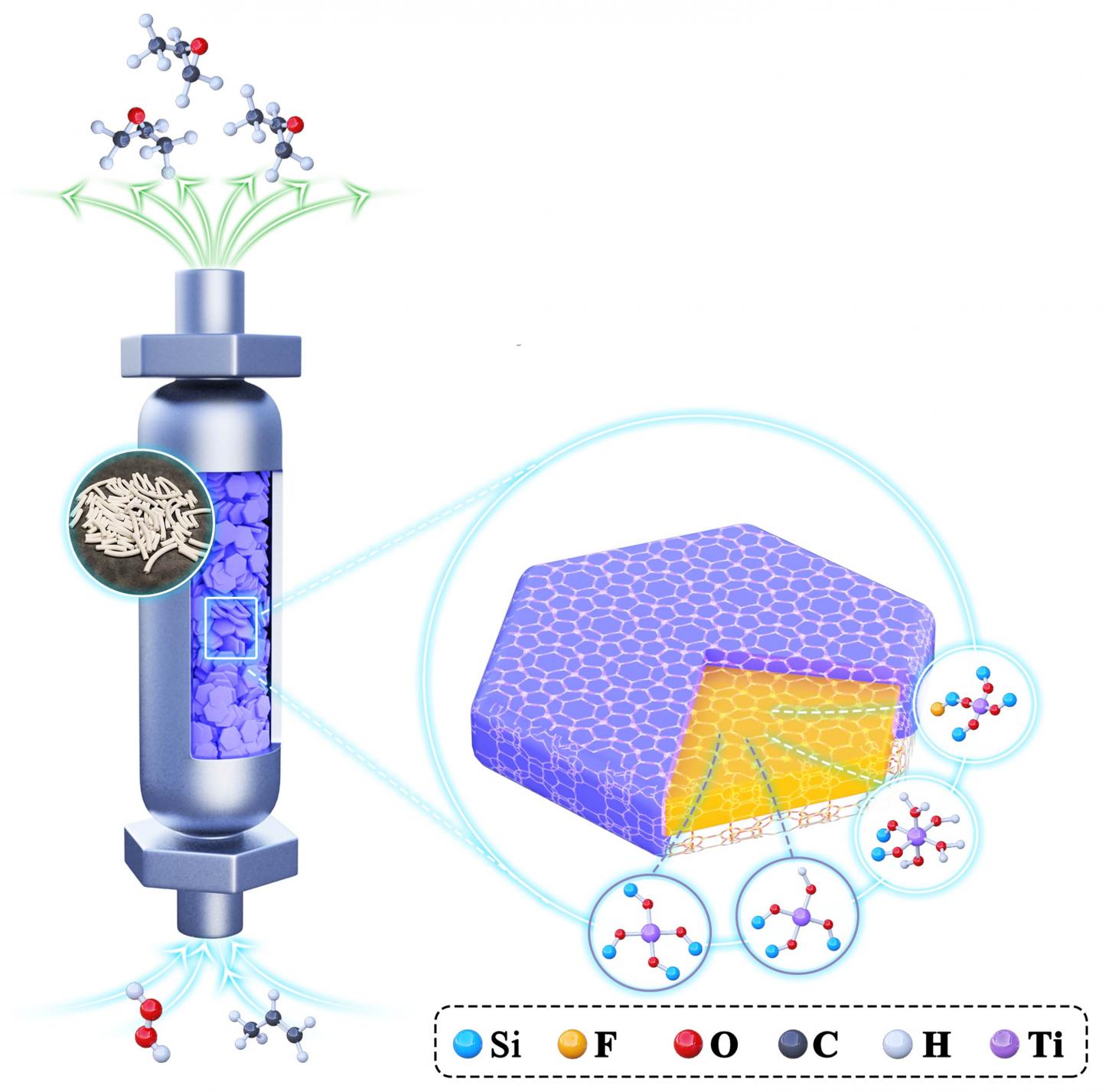
Propylene oxide (PO) is one of the important propylene derivatives with high reactivity, which is used extensively as raw material for the manufacture of numerous commercial chemicals. The titanosilicate-catalyzed hydrogen peroxide propylene oxide process (HPPO) is considered to be most advantageous because it is highly economical and ecofriendly, giving only H2O as the theoretical byproduct and achieving high PO selectivity under mild reaction conditions. The industrial HPPO process is generally carried out in a fixed-bed reactor using the shaped titanosilicate catalysts. Unfortunately, the inert and non-porous binders in shaping catalysts always negatively affect the accessibility of active sites and reaction performance in HPPO process. Moreover, for the HPPO process, in terms of catalyst cost, epoxidation reactivity and PO selectivity, the second-generation Ti-MWW/H2O2/Acetonitrile system is superior to the currently commercialized first-generation TS-1/H2O2/Methanol system. Therefore, it is of great academic and industrial significance to design and synthesize an applicable Ti-MWW catalyst and realize a highly efficient HPPO process, which should be engineered delicately and comprehensively.
Recently, a research team led by Prof. Peng Wu from East China Normal University, China designed and synthesized a structured binder-free MWW-type titanosilicate catalyst with attractive HPPO performance via a combination method of shaping, recrystallization and chemical modification of Ti sites. The controlled dual- templates-assisted hydrothermal recrystallization converted the amorphous SiO2 binders in extruded SiO2/Ti-MWW catalyst to crystalline zeolite phase. Actually, such procedure could kill two birds with one stone: mass transfer problems in the shaped catalyst and chemical modification of micro-environments of the active Ti sites were conquered simultaneously. It was found recrystallization not only released the part of Ti sites within the micropores imprisoned by binders, improving the diffusion efficiency and the accessibility of Ti sites, but also constructed more active open framework TiO6 species and abundant internal silanol nests, which promoted the accumulation and activation ability of H2O2 inside the Ti-MWW monolith.
Afterwards, successive piperidine treatment and fluoridation of the binder-free Ti-MWW further enhanced the H2O2 activation and the active O transfer ability of active Ti sites, and stabilized the Ti-OOH intermediate through H-bonding formed between the end H in Ti-OOH and adjacent Si-F species, thus achieving a more efficient epoxidation process. Additionally, the side reaction of PO hydrolysis was inhibited because the modification effectively quenched numerous acidic Si-OH groups. The lifetime of the modified binder-free Ti-MWW catalyst was 2400 h with the H2O2 conversion and PO selectivity both above 99.5% as well low solvent consumption. The outstanding catalytic performance implied the great potential of this structured binder-free Ti-MWW catalyst in industrial HPPO applications. The results were published in Chinese Journal of Catalysis (https:/
###
This work was financially supported by the National Natural Science Foundation of China (Grant Nos. 21872052, 21533002, 21972044), the Ministry of Science and Technology of the People’s Republic of China (2016YFA0202804) and the Fundamental Research Funds for the Central Universities.
About the Journal
Chinese Journal of Catalysis is co-sponsored by Dalian Institute of Chemical Physics, Chinese Academy of Sciences and Chinese Chemical Society, and it is currently published by Elsevier group. This monthly journal publishes in English timely contributions of original and rigorously reviewed manuscripts covering all areas of catalysis. The journal publishes Reviews, Accounts, Communications, Articles, Highlights, Perspectives, and Viewpoints of highly scientific values that help understanding and defining of new concepts in both fundamental issues and practical applications of catalysis. Chinese Journal of Catalysis ranks among the top six journals in Applied Chemistry with a current SCI impact factor of 6.146. The Editors-in-Chief are Profs. Can Li and Tao Zhang.
At Elsevier http://www.
Manuscript submission https:/
Media Contact
Fan He
[email protected]
Original Source
http://doi.
Related Journal Article
http://dx.