Credit: Jennifer Hoyal Cuthill
Why did life on Earth change from small to large when it did? Researchers from the University of Cambridge and the Tokyo Institute of Technology have determined how some of the first large organisms, known as rangeomorphs, were able to grow up to two metres in height, by changing their body size and shape as they extracted nutrients from their surrounding environment.
The results, reported in the journal Nature Ecology and Evolution, could also help explain how life on Earth, which once consisted only of microscopic organisms, changed so that huge organisms like dinosaurs and blue whales could ultimately evolve.
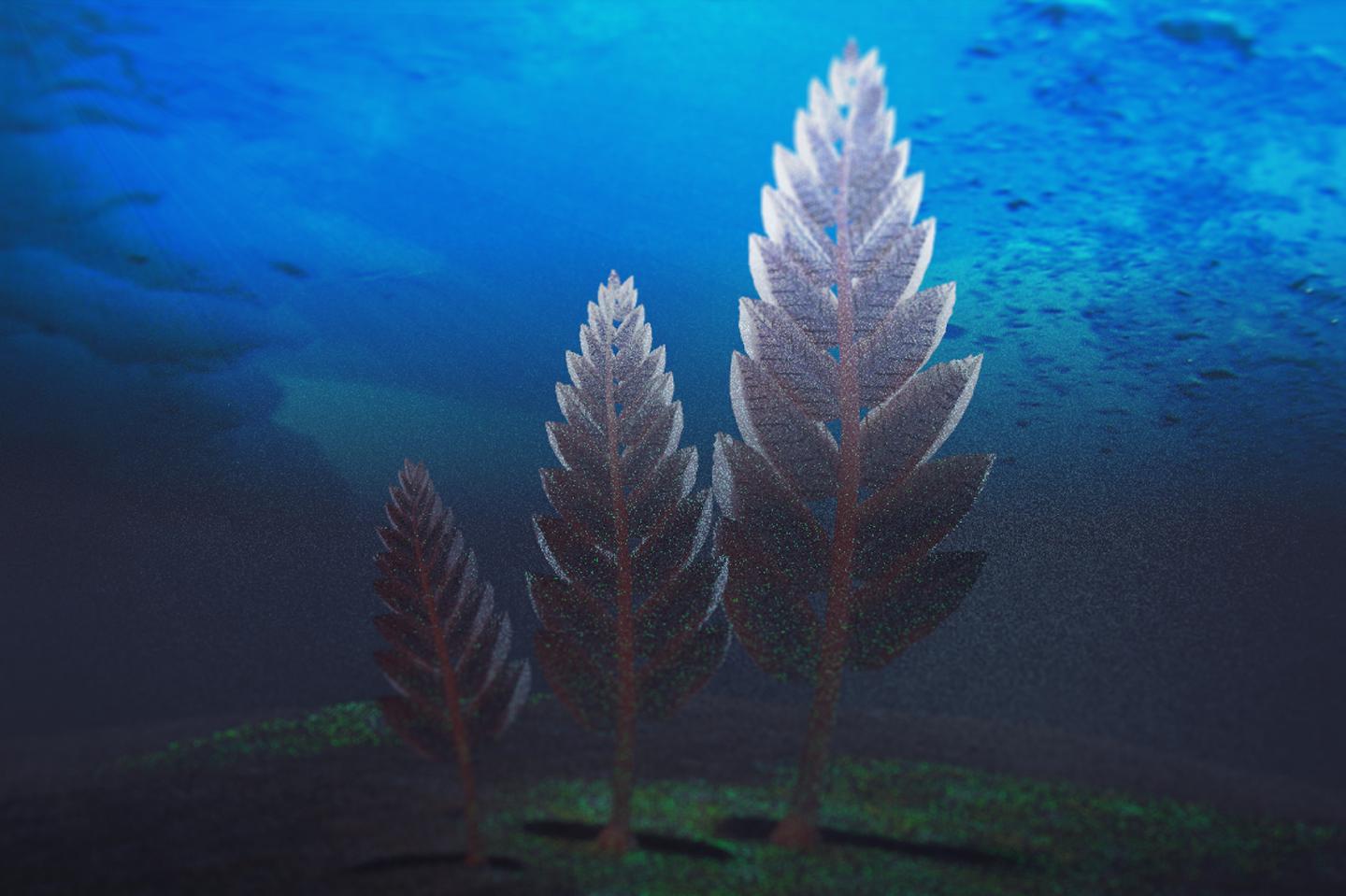
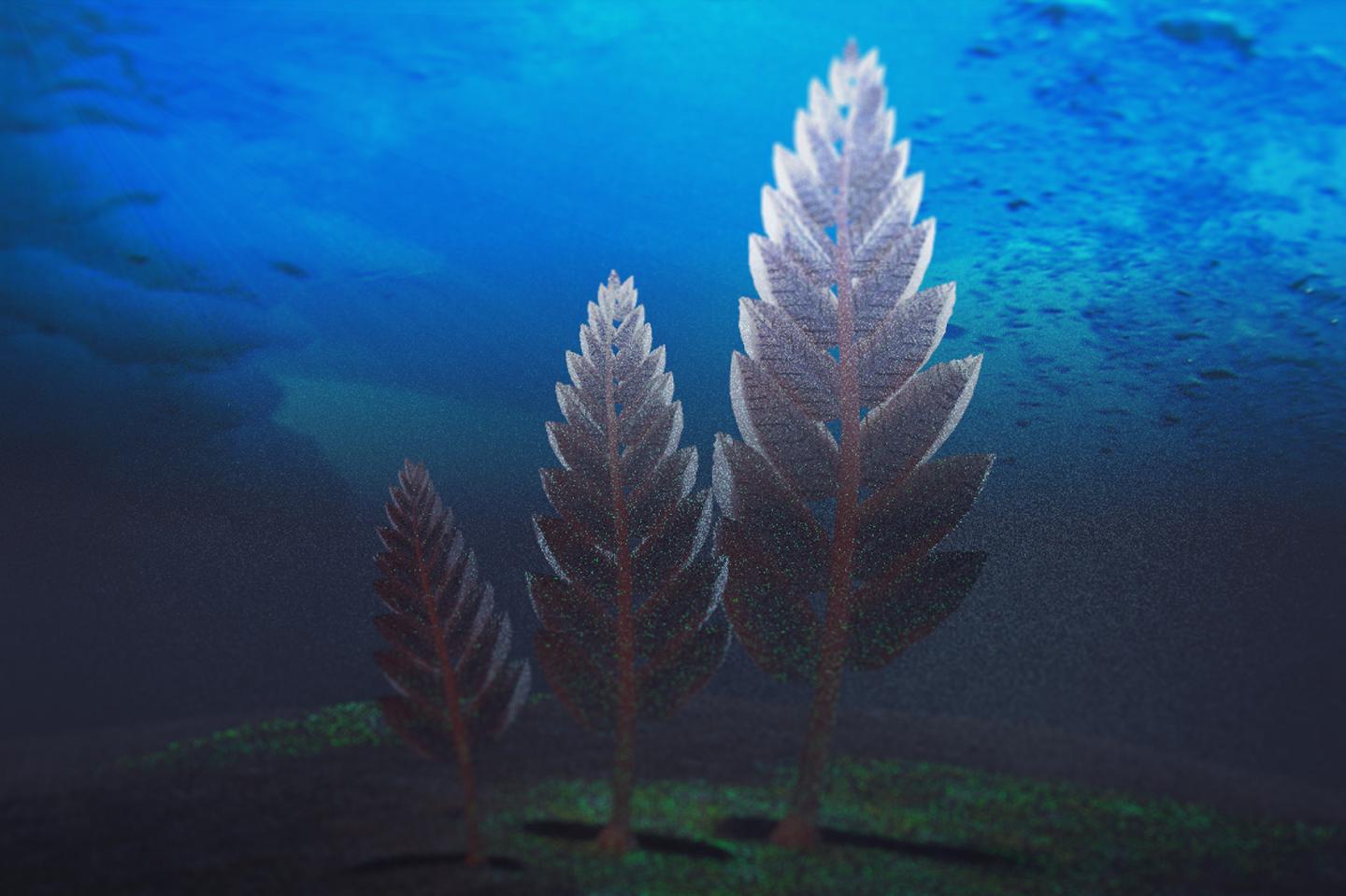
Rangeomorphs were some of the earliest large organisms on Earth, existing during a time when most other forms of life were microscopic in size. Some rangeomorphs were only a few centimetres in height, while others were up to two metres tall.
These organisms were ocean dwellers that lived during the Ediacaran period, between 635 and 541 million years ago. Their soft bodies were made up of branches, each with many smaller side branches, forming a geometric shape known as a fractal, which can be seen today in things like lungs, ferns and snowflakes.
Since rangeomorphs don't resemble any modern organism, it's difficult to understand how they fed, grew or reproduced, let alone how they might link with any modern group. However, although they look somewhat like plants, scientists believe that they may have been some of the earliest animals to live on Earth.
"What we wanted to know is why these large organisms appeared at this particular point in Earth's history," said Dr Jennifer Hoyal Cuthill of Cambridge's Department of Earth Sciences and Tokyo Tech's Earth-Life Science Institute, the paper's first author. "They show up in the fossil record with a bang, at very large size. We wondered, was this simply a coincidence or a direct result of changes in ocean chemistry?"
The researchers used micro-CT scanning, photographic measurements and mathematical and computer models to examine rangeomorph fossils from south-eastern Newfoundland, Canada, the UK and Australia.
Their analysis shows the earliest evidence for nutrient-dependent growth in the fossil record. All organisms need nutrients to survive and grow, but nutrients can also dictate body size and shape. This is known as 'ecophenotypic plasticity.' Hoyal Cuthill and her co-author Professor Simon Conway Morris suggest that rangeomorphs not only show a strong degree of ecophenotypic plasticity, but that this provided a crucial advantage in a dramatically changing world. For example, rangeomorphs could rapidly "shape-shift", growing into a long, tapered shape if the seawater above them happened to have elevated levels of oxygen.
"During the Ediacaran, there seem to have been major changes in the Earth's oceans, which may have triggered growth, so that life on Earth suddenly starts getting much bigger," said Hoyal Cuthill. "It's probably too early to conclude exactly which geochemical changes in the Ediacaran oceans were responsible for the shift to large body sizes, but there are strong contenders, especially increased oxygen, which animals need for respiration."
This change in ocean chemistry followed a large-scale ice age known as the Gaskiers glaciation. When nutrient levels in the ocean were low, they appear to have kept body sizes small. But with a geologically sudden increase in oxygen or other nutrients, much larger body sizes become possible, even in organisms with the same genetic makeup. This means that the sudden appearance of rangeomorphs at large size could have been a direct result of major changes in climate and ocean chemistry.
However, while rangeomorphs were highly suited to their Ediacaran environment, conditions in the oceans continued to change and from about 541 million years ago the 'Cambrian Explosion' began – a period of rapid evolutionary development when most major animal groups first appeared in the fossil record. When the conditions changed, the rangeomorphs were doomed and nothing quite like them has been seen since.
###
Media Contact
Sarah Collins
[email protected]
44-012-237-65542
@Cambridge_Uni
http://www.cam.ac.uk
Related Journal Article
http://dx.doi.org/10.1038/s41559-017-0222-7