Bewick’s swans fly less far during their autumn migration when the weather is warm. Climate change has therefore led to a shift in their common wintering areas. Now, for the first time, bird researchers from the University of Amsterdam (UvA) and the Netherlands Institute of Ecology (NIOO-KNAW) have been able to use long-term GPS data to pinpoint the specific choices that individual swans make. The results of their research were published today in the scientific journal Global Change Biology.
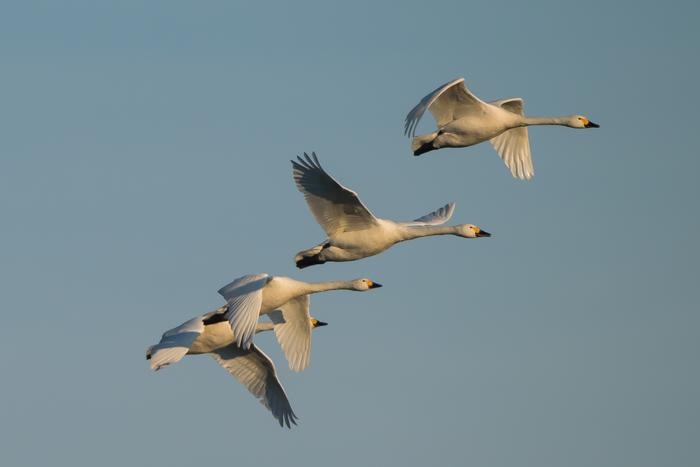
Credit: Photo: Hans-Joachim August
Bewick’s swans fly less far during their autumn migration when the weather is warm. Climate change has therefore led to a shift in their common wintering areas. Now, for the first time, bird researchers from the University of Amsterdam (UvA) and the Netherlands Institute of Ecology (NIOO-KNAW) have been able to use long-term GPS data to pinpoint the specific choices that individual swans make. The results of their research were published today in the scientific journal Global Change Biology.
Bewick’s swans, a migratory water bird that breeds south of the Barents Sea in European Russia, is now seen much less often in the Netherlands than in previous years. ‘For several decades, their wintering area has been moving hundreds of kilometers to the northeast,’ says PhD candidate Hans Linssen of the Institute for Biodiversity and Ecosystem Dynamics (IBED) at the UvA. ‘The core area used to be in southern England, now it is northern Germany. The birds now simply stop migrating earlier in the autumn.’
Until now, little was known about the mechanisms that lead to such a range shift. Linssen: ‘Is it always the younger generations that choose a different location than their predecessors, or do individual birds move up a bit every year during their lives?’
Bart Nolet, senior researcher at NIOO-KNAW and professor by special appointment at the UvA, started tracking Bewick’s swans with GPS transmitters 25 years ago. ‘Initially we were happy if we could completely map the autumn migration of the birds, but for this research it was necessary to be able to follow each bird for at least two years in a row.’
Individual flexibility
Analysis of the GPS data shows that cygnets fly further to the southwest during autumn migration on colder days. Later in the autumn, this sensitivity decreases and the animals only move deeper into their winter areas when the temperature drops below freezing. ‘When it is warm, they stay in place,’ says Linssen. ‘We now see that Bewick’s swan hibernate on average 120 km closer to their breeding areas when the winter temperatures are on average one degree Celsius warmer. When it is two degrees warmer, the average distance is 240 km, and so on.’
This shows that the birds are individually very flexible from year to year. ‘In combination with the increasingly mild winters due to climate change, this individual flexibility explains a large part of the shift in winter range, and thus the largely disappearance of the species from the Netherlands.’
Additional effects of wind and food
The GPS information also allowed the researchers to look at the effect of wind on the migratory behavior of the swans. ‘The birds flew longer distances when they had the wind at their backs, but that influence disappeared during the autumn. This shows that they only use the wind as a tool to reach their winter destination, while the temperature can determine where that destination is,’ says Linssen.
Furthermore, the question remains what influence changing food supplies has on the winter migration of the animals. Linssen: ‘It seems that Bewick’s swans in eastern Netherlands and northern Germany have started to eat more and more corn residues. In addition to the warming winters, this may also have made it possible for the birds to hibernate further in the northeast.’ Linssen will soon be researching this.
No difference in breeding area
The now published study focuses specifically on wintering areas. ‘The collective breeding area of the swans is also shifting slightly to the northeast on average, but at an individual level we see no annual differences. Once an animal has found a suitable breeding area, it returns there every year. For summer dispersal, the response to climate change appears to jump from generation to generation.’
GPS instead of ring data
Migratory birds are traditionally monitored in their winter areas based on ring data. A small number of the animals receive a ring around their legs. Every year, volunteers and researchers read the code of as many ringed birds as possible. However, this provides only a snapshot. Nowadays, GPS data is available for various bird species: they provide a much more detailed insight into the movements of birds throughout the year.
Journal
Global Change Biology
DOI
10.1111/gcb.16953
Article Title
Migratory swans individually adjust their autumn migration and winter range to a warming climate
Article Publication Date
5-Oct-2023