• HOME
  • NEWS
  • EXPLORE
    • CAREER
      • Companies
      • Jobs
    • EVENTS
    • iGEM
      • News
      • Team
    • PHOTOS
    • VIDEO
    • WIKI
  • BLOG
  • COMMUNITY
    • FACEBOOK
    • INSTAGRAM
    • TWITTER
Friday, May 15, 2026
BIOENGINEER.ORG
No Result
View All Result
  • Login
  • HOME
  • NEWS
  • EXPLORE
    • CAREER
      • Companies
      • Jobs
        • Lecturer
        • PhD Studentship
        • Postdoc
        • Research Assistant
    • EVENTS
    • iGEM
      • News
      • Team
    • PHOTOS
    • VIDEO
    • WIKI
  • BLOG
  • COMMUNITY
    • FACEBOOK
    • INSTAGRAM
    • TWITTER
  • HOME
  • NEWS
  • EXPLORE
    • CAREER
      • Companies
      • Jobs
        • Lecturer
        • PhD Studentship
        • Postdoc
        • Research Assistant
    • EVENTS
    • iGEM
      • News
      • Team
    • PHOTOS
    • VIDEO
    • WIKI
  • BLOG
  • COMMUNITY
    • FACEBOOK
    • INSTAGRAM
    • TWITTER
No Result
View All Result
Bioengineer.org
No Result
View All Result
Home NEWS Science News Biology

Better biosensor technology created for stem cells

Bioengineer by Bioengineer
November 11, 2019
in Biology
Reading Time: 2 mins read
0
IMAGE
Share on FacebookShare on TwitterShare on LinkedinShare on RedditShare on Telegram

Rutgers innovation may help guide treatment of Alzheimer’s, Parkinson’s diseases
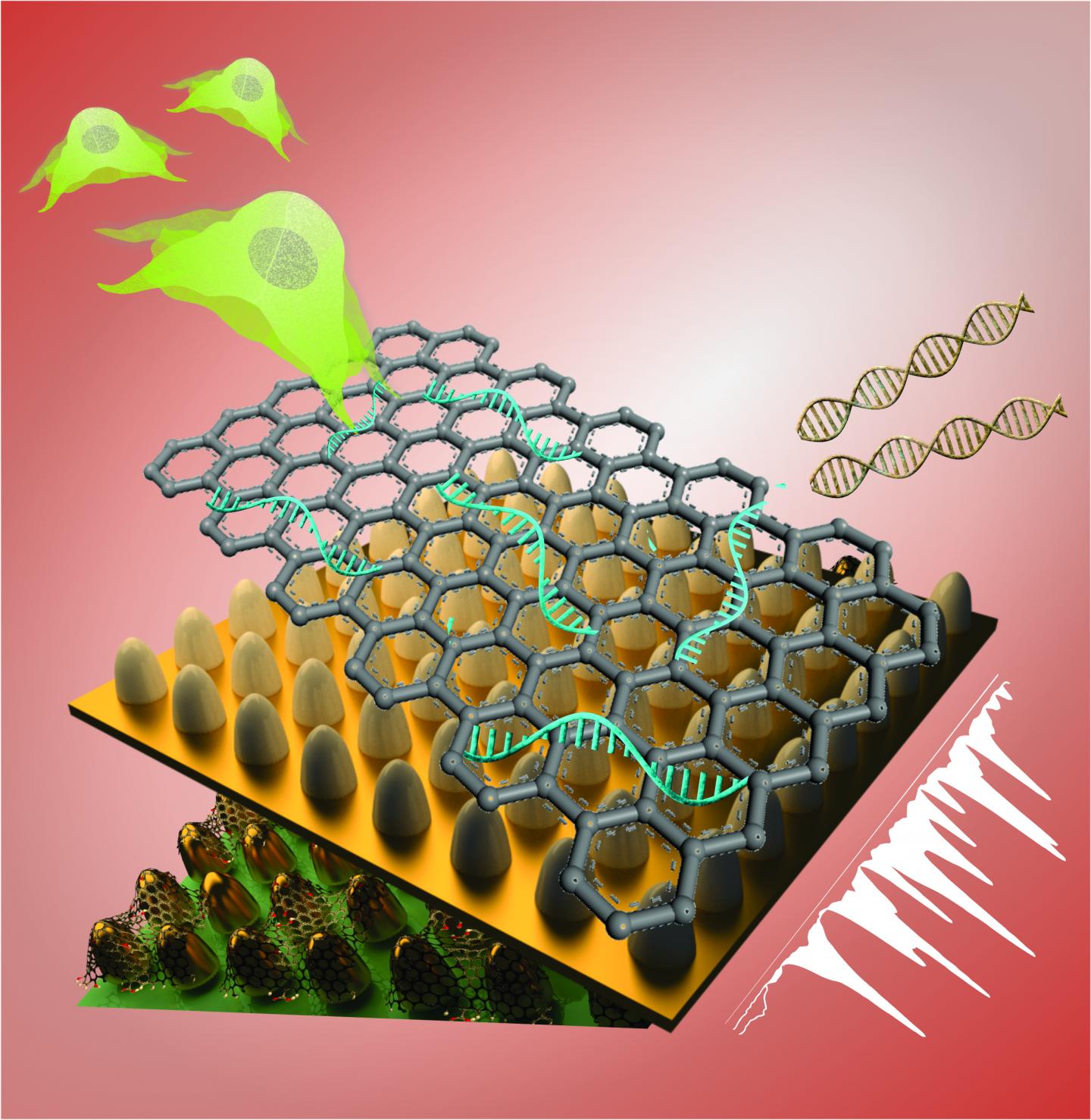
IMAGE

Credit: Letao Yang, KiBum Lee, Jin-Ho Lee and Sy-Tsong (Dean) Chueng


A Rutgers-led team has created better biosensor technology that may help lead to safe stem cell therapies for treating Alzheimer’s and Parkinson’s diseases and other neurological disorders.

The technology, which features a unique graphene and gold-based platform and high-tech imaging, monitors the fate of stem cells by detecting genetic material (RNA) involved in turning such cells into brain cells (neurons), according to a study in the journal Nano Letters.

Stem cells can become many different types of cells. As a result, stem cell therapy shows promise for regenerative treatment of neurological disorders such as Alzheimer’s, Parkinson’s, stroke and spinal cord injury, with diseased cells needing replacement or repair. But characterizing stem cells and controlling their fate must be resolved before they could be used in treatments. The formation of tumors and uncontrolled transformation of stem cells remain key barriers.

“A critical challenge is ensuring high sensitivity and accuracy in detecting biomarkers – indicators such as modified genes or proteins – within the complex stem cell microenvironment,” said senior author KiBum Lee, a professor in the Department of Chemistry and Chemical Biology in the School of Arts and Sciences at Rutgers University-New Brunswick. “Our technology, which took four years to develop, has demonstrated great potential for analyzing a variety of interactions in stem cells.”

The team’s unique biosensing platform consists of an array of ultrathin graphene layers and gold nanostructures. The platform, combined with high-tech imaging (Raman spectroscopy), detects genes and characterizes different kinds of stem cells with greater reliability, selectivity and sensitivity than today’s biosensors.

The team believes the technology can benefit a range of applications. By developing simple, rapid and accurate sensing platforms, Lee’s group aims to facilitate treatment of neurological disorders through stem cell therapy.

Stem cells may become a renewable source of replacement cells and tissues to treat diseases including macular degeneration, spinal cord injury, stroke, burns, heart disease, diabetes, osteoarthritis and rheumatoid arthritis, according to the National Institutes of Health.

###

The study’s co-lead authors are Letao Yang and Jin-Ho Lee, postdoctoral researchers in Lee’s group. Rutgers co-authors include doctoral students Christopher Rathnam and Yannan Hou. A scientist at Sogang University in South Korea contributed to the study.

Media Contact
Todd Bates
[email protected]
848-932-0550

Original Source

https://news.rutgers.edu/better-biosensor-technology-created-stem-cells/20191106#.XcQfajNKi71

Related Journal Article

http://dx.doi.org/10.1021/acs.nanolett.9b03402

Tags: AlzheimerBiotechnologyMedicine/Healthneurobiology
Share12Tweet8Share2ShareShareShare2

Related Posts

61 Newly Discovered Beetle Species Highlight How Much We Still Have to Learn About Biodiversity — Biology

61 Newly Discovered Beetle Species Highlight How Much We Still Have to Learn About Biodiversity

May 15, 2026
Supercomputer Simulations Uncover How Bacterial Enzyme Pumps Sodium Ions, Opening Doors to Novel Antibiotics — Biology

Supercomputer Simulations Uncover How Bacterial Enzyme Pumps Sodium Ions, Opening Doors to Novel Antibiotics

May 15, 2026

New Astrobiology Special Collection Highlights Emerging Evidence Supporting Land-Based Origins of Life

May 14, 2026

Revolutionizing Textiles: Engineered Protein Fibers Pave the Way for Sustainable, Recyclable Fabrics

May 14, 2026
Please login to join discussion

POPULAR NEWS

  • Research Indicates Potential Connection Between Prenatal Medication Exposure and Elevated Autism Risk

    843 shares
    Share 337 Tweet 211
  • New Study Reveals Plants Can Detect the Sound of Rain

    729 shares
    Share 291 Tweet 182
  • Salmonella Haem Blocks Macrophages, Boosts Infection

    62 shares
    Share 25 Tweet 16
  • Breastmilk Balances E. coli and Beneficial Bacteria in Infant Gut Microbiomes

    58 shares
    Share 23 Tweet 15

About

We bring you the latest biotechnology news from best research centers and universities around the world. Check our website.

Follow us

Recent News

Axonic Spine Synapses Trigger Action Potentials, Direct Signals

New Study Uncovers Why Breast Cancer Becomes More Lethal with Age

Study Reveals Heat-Based Therapy Reshapes Brain Networks in Epilepsy

Subscribe to Blog via Email

Enter your email address to subscribe to this blog and receive notifications of new posts by email.

Join 82 other subscribers
  • Contact Us

Bioengineer.org © Copyright 2023 All Rights Reserved.

Welcome Back!

Login to your account below

Forgotten Password?

Retrieve your password

Please enter your username or email address to reset your password.

Log In
No Result
View All Result
  • Homepages
    • Home Page 1
    • Home Page 2
  • News
  • National
  • Business
  • Health
  • Lifestyle
  • Science

Bioengineer.org © Copyright 2023 All Rights Reserved.