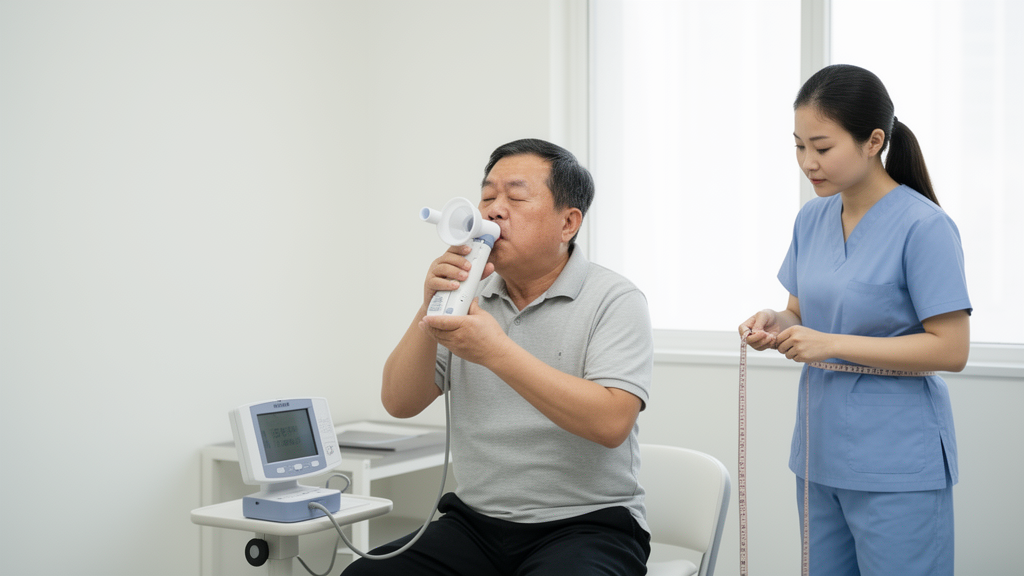
A large cross-sectional analysis of more than 14,000 middle-aged and older Chinese adults has found that a simple anthropometric measure of central obesity—the weight-adjusted waist index (WWI)—is associated with weaker expiratory airflow, and that the association is markedly stronger in men than in women. WWI is calculated by dividing waist circumference in centimetres by the square root of body weight in kilograms. The researchers also computed peak expiratory flow (PEF) as a percentage of the predicted value for Chinese adults using validated equations, allowing comparison against expected norms.
Participants were sorted into sex-specific quartiles of WWI, with the lowest quartile serving as the reference group. The team applied multivariable linear regression and generalized additive models with restricted cubic splines, stratifying all analyses by sex and adjusting for potential confounders. In the fully adjusted models, each one-unit increase in WWI was associated with a 24.10 L/min lower PEF (95% CI: −29.01 to −19.19) and a 5.01 percentage-point lower PEF%pred (95% CI: −6.15% to −3.87%) in men.
In women the associations were weaker but still statistically significant: a 10.99 L/min lower PEF (95% CI: −13.57 to −8.41) and a 3.21 percentage-point lower PEF%pred (95% CI: −4.02% to −2.41%) per unit increase in WWI. All associations were significant at P < 0.001. The difference between the sexes was itself statistically meaningful.
A formal WWI-by-sex interaction test was significant for both PEF (P < 0.001) and PEF%pred (P = 0.016), indicating that the strength of the association genuinely differs between men and women rather than differing only by chance in separate analyses. The restricted cubic spline analyses added a nonlinear dimension to the picture. In both sexes, the dose-response relationship took an inverted L-shaped form: PEF and PEF%pred remained relatively stable at lower WWI values and then declined steeply beyond a threshold.
The exploratory inflection points were similar across sexes—approximately 11.03 cm/√kg in men and 11.14–11.15 cm/√kg in women—but the inverse association above the threshold was substantially stronger in men. The authors describe these inflection points as exploratory, meaning they identify where the decline begins in this dataset but should be confirmed in other populations. Subgroup analyses revealed further effect modification by body mass index in men (P for interaction < 0.001), with stronger inverse associations among participants who were overweight or obese, defined as BMI of 24 kg/m² or higher using the threshold applied in the study.
Notably, the association did not disappear among people of normal body size. Stratified analyses showed that high WWI was associated with lower PEF even within the normal BMI stratum and within the normal waist circumference stratum, indicating that the measure captured information beyond overall body size in this dataset.
The authors emphasise that these are cross-sectional, associative findings. Because waist measurement and lung function were assessed at the same time, the data cannot establish whether higher WWI causes reduced expiratory flow, whether declining respiratory health contributes to body-composition changes, or whether unmeasured factors explain the link. Nevertheless, the study extends previous evidence linking central obesity to respiratory function by documenting sex-specific, nonlinear patterns with similar thresholds but a substantially stronger inverse association in men.
The researchers conclude that WWI may serve as an associative marker of lower peak expiratory flow and call for longitudinal and interventional studies to determine whether WWI-based strategies could help preserve respiratory health amid the global rise in obesity.
Subject of Research: Sex-specific associations between the weight-adjusted waist index and peak expiratory flow in middle-aged and older Chinese adults
Article Title: Sex-specific associations between weight-adjusted waist index and peak expiratory flow in middle-aged and older Chinese adults: a cross-sectional study from CHARLS
Article References: An, L., Fu, Z., Zhang, H., Lu, L., Xiong, X., Kang, X., Li, S., & Zhang, Z. (2026). Sex-specific associations between weight-adjusted waist index and peak expiratory flow in middle-aged and older Chinese adults: a cross-sectional study from CHARLS. BMC Public Health. https://doi.org/10.1186/s12889-026-29932-3
Image Credits: AI Generated
DOI: 10.1186/s12889-026-29932-3
Keywords: weight-adjusted waist index, peak expiratory flow, central obesity, CHARLS, cross-sectional study, lung function, sex differences, body mass index, waist circumference, older adults, China, respiratory health
News Source: Ophelia Keating. (October 28, 2026). Belly Fat Measure Linked to Weaker Breathing in Middle-Aged Chinese Adults. Scienmag.