• HOME
  • NEWS
  • EXPLORE
    • CAREER
      • Companies
      • Jobs
    • EVENTS
    • iGEM
      • News
      • Team
    • PHOTOS
    • VIDEO
    • WIKI
  • BLOG
  • COMMUNITY
    • FACEBOOK
    • INSTAGRAM
    • TWITTER
Thursday, June 25, 2026
BIOENGINEER.ORG
No Result
View All Result
  • Login
  • HOME
  • NEWS
  • EXPLORE
    • CAREER
      • Companies
      • Jobs
        • Lecturer
        • PhD Studentship
        • Postdoc
        • Research Assistant
    • EVENTS
    • iGEM
      • News
      • Team
    • PHOTOS
    • VIDEO
    • WIKI
  • BLOG
  • COMMUNITY
    • FACEBOOK
    • INSTAGRAM
    • TWITTER
  • HOME
  • NEWS
  • EXPLORE
    • CAREER
      • Companies
      • Jobs
        • Lecturer
        • PhD Studentship
        • Postdoc
        • Research Assistant
    • EVENTS
    • iGEM
      • News
      • Team
    • PHOTOS
    • VIDEO
    • WIKI
  • BLOG
  • COMMUNITY
    • FACEBOOK
    • INSTAGRAM
    • TWITTER
No Result
View All Result
Bioengineer.org
No Result
View All Result
Home NEWS Science News Biology

Bees? Please. These plants are putting ants to work

Bioengineer by Bioengineer
June 10, 2020
in Biology
Reading Time: 2 mins read
0
IMAGE
Share on FacebookShare on TwitterShare on LinkedinShare on RedditShare on Telegram

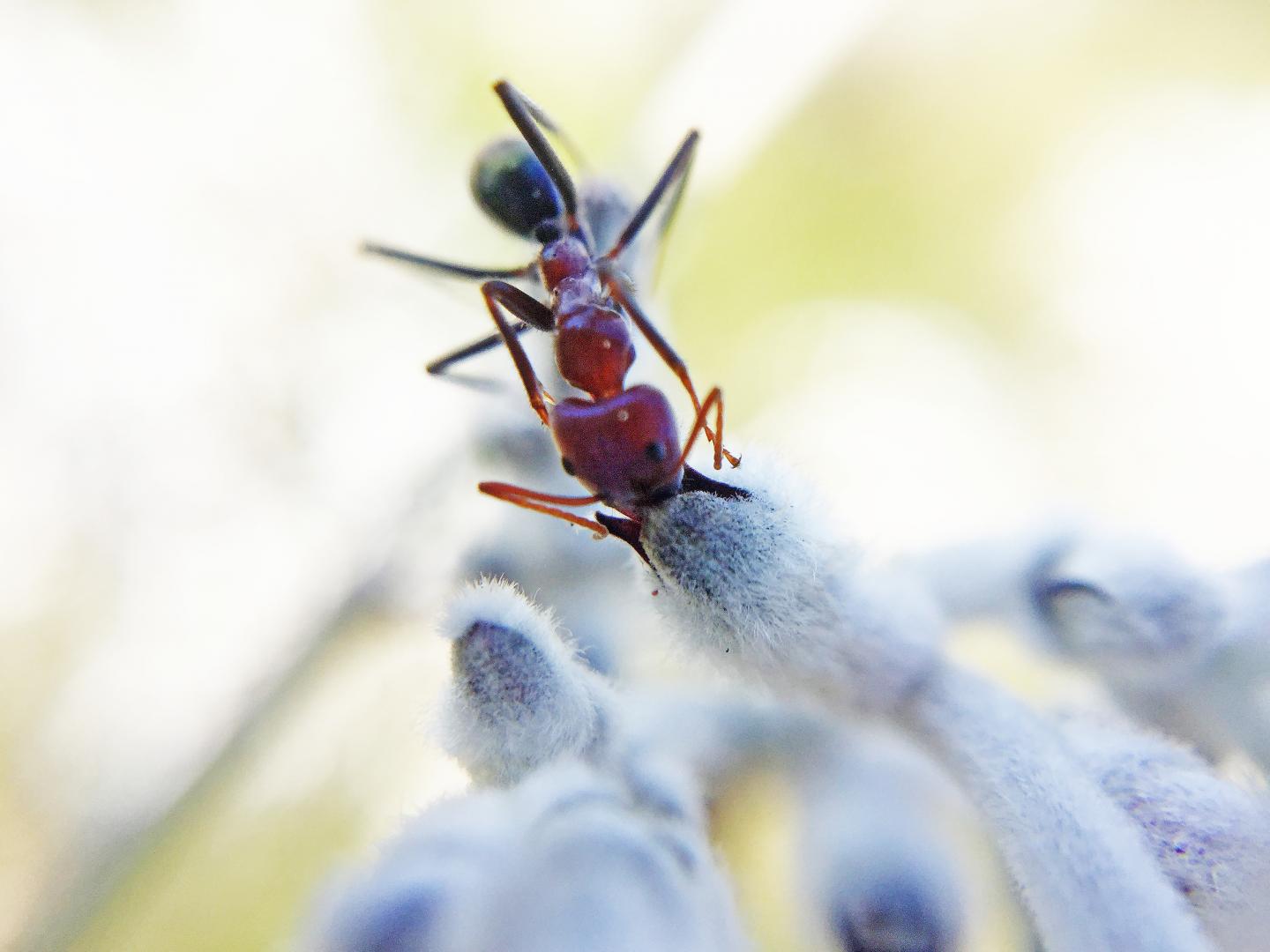
In a world first, Edith Cowan University (ECU) researchers have discovered a plant that has successfully evolved to use ants – as well as native bees – as pollinating agents by overcoming their antimicrobial defences.
IMAGE

Credit: Nicola Delnevo,Edith Cowan University

In a world first, Edith Cowan University (ECU) researchers have discovered a plant that has successfully evolved to use ants – as well as native bees – as pollinating agents by overcoming their antimicrobial defences.

ECU PhD student Nicola Delnevo discovered the trait in a group of shrubs found the Swan Coastal Plain in Western Australia.

Mr Delnevo said ant pollination of plants was incredibly rare.

“Ants secrete an antimicrobial fluid that kills pollen grain,” he said.

“So ants have traditionally been considered to be a menace — nectar thieves whose aggression keeps other potential pollinating insects at bay.

“However this group of plants in WA, commonly known as the Smokebush family (Conospermum), has evolved a way to use ants to their advantage.”

Mr Delnevo tested the effect of the antimicrobial secretion from three ant species found locally on the flowers of six WA plant species, with startling results.

“We found evidence that Conospermum plants have adapted the biochemistry of their pollen grains to cope with the antimicrobial properties of the ants.

“This is the first plant species found to have adapted traits that enables a mutually beneficial relationship with ants,” Mr Delnevo said.

“About 46 examples of ant pollination have been documented around the world, but these have been due to the ants producing less toxic secretions that allow them to pollinate.”

No help from honeybees

Mr Delnevo said the pollination by ants was particularly good news for these plants as they were unable to rely on honeybees.

“Conospermum plants have unscented tubular flowers that are too narrow for honeybees wriggle inside to pollinate,” Mr Delnevo explained.

“They rely on native insects carrying a suitable pollen load from visiting other flowers for pollination to occur.

“They have co-evolved with a native bee (Leioproctus conospermi) that has evolved as a specialist feeder of these flowers.

“This relationship is mutually beneficial, but it would be risky in an evolutionary sense for the plant to rely solely on the native bee for pollination.”

Future research will explore how common ant pollination is amongst the flora of south-western Australia and exactly how this trait of overcoming ant defences has evolved.

###

This research was published in Annals of Botany.

Media Contact
Pepita Smyth
[email protected]

Original Source

https://www.ecu.edu.au/news/latest-news/2020/06/bees-please-these-plants-are-putting-ants-to-work

Related Journal Article

http://dx.doi.org/10.1093/aob/mcaa058

Tags: BiologyEcology/EnvironmentEntomologyEvolutionPlant SciencesZoology/Veterinary Science
Share12Tweet8Share2ShareShareShare2

Related Posts

Natural Hallucinogens: Evolution’s Ecological Tools, Not Mere Chemical Byproducts

June 25, 2026

This Famous Butterfly Revealed: Three Distinct Species Hidden in One

June 25, 2026

Scientists Attack Soybean Cyst Nematode by Starving Its Food Source

June 25, 2026

Decoding the Secret Code of a Crucial Immune Sensor

June 24, 2026
Please login to join discussion

POPULAR NEWS

  • Saying Goodbye to PGY-6: Pediatric Fellowship Realities

    103 shares
    Share 41 Tweet 26
  • Multi-Hospital Study Reveals Long Covid Burden Is Twice as High as Current Estimates

    92 shares
    Share 36 Tweet 23
  • Detection of EDCs in Breast Milk and Infant Urine Up to Six Months Highlights Early Exposure Risks

    77 shares
    Share 31 Tweet 19
  • New Drug Candidate Developed at McMaster Shows Potential for Treating Brain Cancer

    58 shares
    Share 23 Tweet 15

About

We bring you the latest biotechnology news from best research centers and universities around the world. Check our website.

Follow us

Recent News

Tracking Lanthanide-Labeled Microplastics in Plants

POSTECH Researchers Slash Cost of Reconstituted Cell-Free Systems by 95%

AI and Physics Collaborate to Design Advanced Hydrogen Storage Materials

Subscribe to Blog via Email

Enter your email address to subscribe to this blog and receive notifications of new posts by email.

Join 82 other subscribers
  • Contact Us

Bioengineer.org © Copyright 2023 All Rights Reserved.

Welcome Back!

Login to your account below

Forgotten Password?

Retrieve your password

Please enter your username or email address to reset your password.

Log In
No Result
View All Result
  • Homepages
    • Home Page 1
    • Home Page 2
  • News
  • National
  • Business
  • Health
  • Lifestyle
  • Science

Bioengineer.org © Copyright 2023 All Rights Reserved.