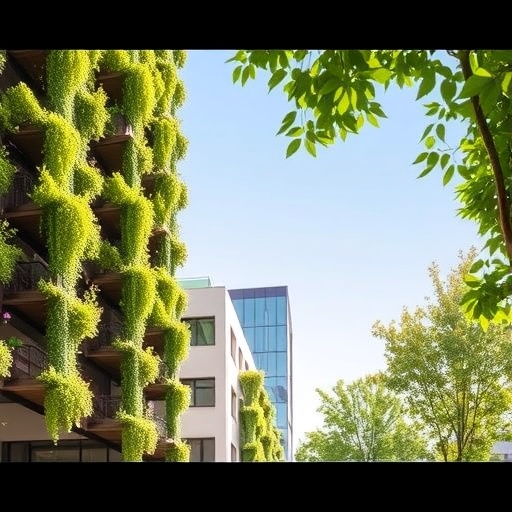
In the increasingly urbanized world, the phenomenon known as the Urban Heat Island (UHI) effect has become a pressing environmental and social issue. Urban centers, characterized by dense buildings, asphalt, and limited greenery, typically register significantly higher temperatures than surrounding rural areas. This temperature disparity is more than just a discomfort; it exacerbates the impact of climate change by amplifying extreme heat events such as heatwaves, thereby intensifying health risks and energy demands. The challenge has become clear: how can cities mitigate UHI effects not only outdoors but also within the buildings that comprise their core?
Recent research led by Associate Professor Jihui Yuan at Osaka Metropolitan University takes a groundbreaking approach by examining the interplay between outdoor urban environments and indoor thermal comfort. While past studies largely focused on outdoor cooling methods, this new study investigates how integrated UHI mitigation strategies can simultaneously improve both interior and exterior thermal conditions. Recognizing that buildings’ thermal performance is influenced dynamically by their surroundings and envelope materials, this research underscores the necessity of a holistic view to truly enhance urban resilience.
The study zeroes in on an educational building in Shahrood, Iran, a city recognized for its scorching summer temperatures. By applying an innovative integrated simulation model combining Building Energy Model (BEM) and Urban Microclimate Model (UMM), the researchers were able to capture the complex interactions between indoor thermal load and the microclimatic conditions outside. The BEM accurately simulates internal heat dynamics, including occupancy influence and energy use, while the UMM models outdoor microclimate changes influenced by urban materials, vegetation, and weather patterns. This synergy allows for a realistic appraisal of urban heat mitigation techniques under future climate stressors.
Central to the simulations were various UHI mitigation strategies including green roofs, vertical greenery (such as green walls), and adjustments to the materials used in building envelopes. Notably, the installation of a green wall on the building’s south-facing facade demonstrated an indoor temperature reduction of up to 1.7°C. This cooling effect is attributed to the combination of shading, evapotranspiration, and enhanced insulation that living green surfaces provide. Such strategies not only directly reduce indoor heat but also improve occupant comfort, potentially reducing dependency on mechanical cooling systems.
Material albedo—the capability of surfaces to reflect solar radiation—was shown to be a critical factor influencing thermal comfort. The study distinguished between the impacts of low and high albedo surfaces: low albedo exterior finishes enhanced outdoor thermal comfort by approximately 1.5°C by absorbing heat more gradually, while high albedo surfaces were more effective at reducing indoor temperatures by reflecting intense solar radiation. This sophisticated differentiation of material behaviours elucidates the nuanced role surface properties play in urban thermal management.
Interestingly, the research highlighted that the radiative properties of building surfaces exerted a stronger influence on both indoor and outdoor thermal conditions than the heat capacity of these materials. This finding challenges some traditional perspectives in urban cooling, shifting the focus toward optimizing surface reflectivity and emissivity to improve thermal environments. Future urban design can thus prioritize radiative characteristics to maximize cooling benefits in hot climates.
The study also uniquely considered compounded extreme scenarios, including the occurrence of heatwaves in tandem with power outages. Such conditions strain conventional cooling systems and exacerbate risks to vulnerable populations. Through their integrated modeling approach, the researchers demonstrated how resilient building designs, incorporating strategic UHI mitigation measures, can maintain acceptable thermal comfort even during simultaneous extreme heat events and energy interruptions. This resilience is crucial for sustainable urban living amid escalating climate uncertainties.
Thermal comfort within these integrated analyses was quantitatively assessed using the Physiologically Equivalent Temperature (PET) index, a metric that accounts for temperature, humidity, wind speed, and radiation to evaluate human thermal perception consistently across indoor and outdoor environments. The use of PET facilitated a comprehensive evaluation of mitigation strategies on occupant comfort, bridging the gap between technical data and human-centric outcomes.
Associate Professor Yuan emphasized that this research serves as a pioneering guide to developing buildings and urban spaces that are better equipped to withstand and mitigate the mounting challenges posed by climate change and urban heat. The integration of urban- and building-scale approaches marks a significant advancement over fragmented solutions, offering a pathway toward reduced energy consumption and enhanced occupant well-being.
Published in the reputable journal Energy and Buildings, this study adds to the growing body of knowledge advocating for multi-scale, interdisciplinary interventions against UHI effects. It positions green infrastructure and intelligent material use at the forefront of urban sustainable development strategies. Importantly, the findings emphasize customizing solutions for specific climatic contexts, such as the extremely hot summers in Shahrood, Iran, ensuring adaptability and effectiveness.
In an era where global urban populations continue to swell, and climate change threatens to intensify heat exposure, the implications of this research are profound. By demonstrating tangible cooling effects, especially through vertical greenery and high-albedo materials, the study offers actionable strategies that city planners, architects, and policymakers worldwide can adopt to build more resilient, comfortable, and energy-efficient urban environments.
The journey to cooler, healthier cities will require a concerted effort incorporating ecological design, material science, and climate-responsive architecture. This research distinctly highlights the importance of examining indoor and outdoor environments as an interconnected system rather than in isolation. Such integrated perspectives are essential for crafting holistic urban solutions that safeguard human health and comfort in the decades to come.
Subject of Research: Not applicable
Article Title: Assessment of UHI Mitigation Strategies on Indoor and Outdoor Thermal Comfort under Future Extreme Heat and Power Outage Conditions: Case Study of an Educational Building in Shahrood, Iran
News Publication Date: 30-Mar-2026
Web References:
https://www.omu.ac.jp/en/
References:
Published in Energy and Buildings, DOI: 10.1016/j.enbuild.2026.117411
Image Credits: Osaka Metropolitan University
Keywords
Urban Heat Island, UHI mitigation, green walls, vertical greenery, building envelope materials, thermal comfort, Physiologically Equivalent Temperature, heatwaves, power outages, integrated simulation, urban microclimate, building energy model, albedo, radiative properties
Tags: climate change adaptation in citiesenergy-efficient urban designenvironmental impact of urbanizationgreen building envelope materialsheatwave risk reductionindoor thermal comfort improvementsoutdoor and indoor temperature managementsustainable urban architecturethermal performance of educational buildingsurban heat island mitigation strategiesurban resilience through vegetationvertical greenery for urban cooling