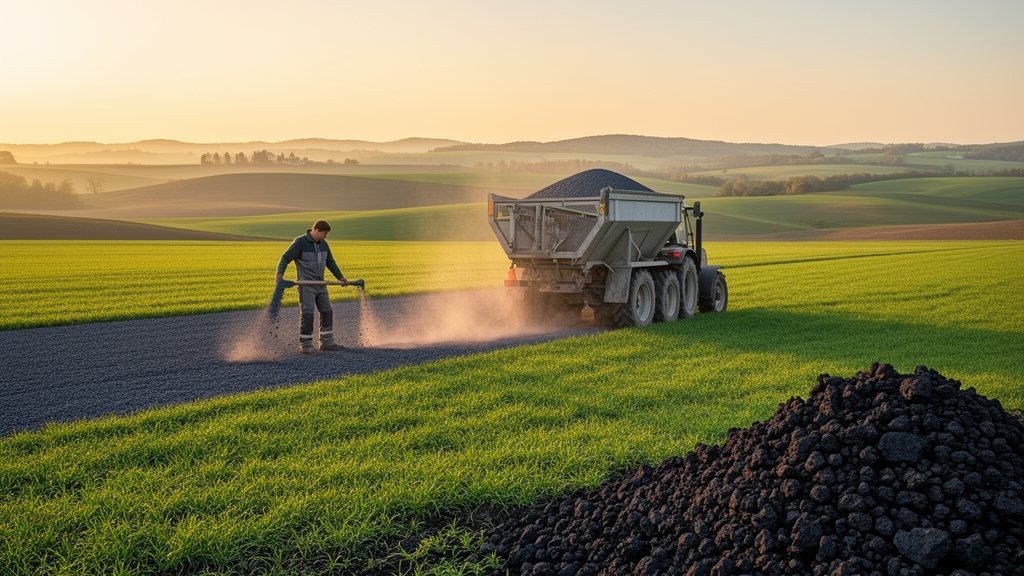
Spreading crushed basalt rock over the world’s croplands could, in theory, remove roughly 18.84 gigatonnes of carbon dioxide after complete weathering, according to a new global assessment published in Carbon Research. The study, which drew on a worldwide dataset of more than 9,000 silicate rock samples, identifies basalt as the most practical material for enhanced weathering, a carbon dioxide removal technology that accelerates the natural reaction between silicate rocks and atmospheric CO2. The researchers estimate that applying 40 tonnes of basalt per hectare across 1.57 billion hectares of suitable cropland would require about 62.8 gigatonnes of the rock.
Enhanced weathering works on a simple geochemical principle. When silicate rocks dissolve, they release calcium, magnesium, sodium and potassium cations that react with carbonic acid formed from dissolved CO2, converting the carbon into stable bicarbonate and carbonate forms that can persist for more than ten thousand years. The technology deliberately shortens a process that normally unfolds over geological timescales by grinding rock into fine powder, dramatically increasing the reactive surface area, and spreading it on farmland where warm, wet, acidic soils speed dissolution further.
Peridotite scored highest at 0.72 plus or minus 0.16, granite lowest at 0.09 plus or minus 0.05, and basalt fell in between at 0.30 plus or minus 0.08. Yet the authors argue that basalt is the most promising candidate overall, because peridotite carries substantial concentrations of nickel and chromium that pose environmental hazards, while granite weathers too slowly and shows a weak chemical weathering index.
Beyond its moderate sequestration potential, basalt has several practical advantages. It dissolves faster than neutral and acidic magmatic rocks under comparable laboratory conditions, and it is rich in phosphorus, potassium, magnesium and calcium, nutrients that allow it to double as a slow-release mineral fertilizer on cropland. Its main metal components are relatively harmless, and basalt covers about 5.2 percent of the global land surface, roughly 6.8 million square kilometres, with large exposures in India, Ethiopia, Russia, Iceland, Brazil and along the western coast of the American continent. The rock can also be sourced from industrial waste and construction material rather than new mining.
A key contribution of the study is its accounting of the carbon cost of the operation itself. Grinding basalt to 10 micrometres emits between 81.18 and 182.95 kilograms of CO2 per tonne of rock, while coarser 1000-micrometre particles emit only 16.40 to 39.07 kilograms. The analysis shows a trade-off: finer particles weather faster and sequester more carbon, but producing them consumes far more energy.
Soil acidity emerged as a decisive factor. Lower pH values enhanced sequestration efficiency, with pH 4 yielding the highest performance, but most crops suffer from aluminum toxicity below pH 5. Because the practical goal of enhanced weathering in agriculture is to ameliorate soil acidity rather than maximize dissolution speed, the authors identify acidic cropland soils with an initial pH between 4.5 and 6.0 as the most suitable deployment environment, where the technology simultaneously raises crop-relevant pH and captures carbon.
The authors stress that transport distance matters as well, since longer haulage erodes the net carbon benefit, so deployment should follow a near-source principle, though global quarry location data were unavailable for this analysis.
The theoretical figures come with important caveats. The RCO2 calculation assumes that 100 percent of released cations result in permanent carbon storage, ignoring downstream outgassing as bicarbonate enters riverine and oceanic systems, an effect other work estimates at roughly 10 to 25 percent loss. The reported potentials therefore represent an upper bound before such losses. The study also did not model biological factors, such as the acceleration of weathering by plant roots and microorganisms, or anthropogenic management practices like irrigation and tillage, and it notes that root and microbial respiration generate CO2 that partially offsets sequestration. Enhanced weathering remains listed by the IPCC as a carbon dioxide removal method, with prior estimates of its global capacity ranging from 0.5 to 95 gigatonnes of CO2 per year, reflecting how uncertain the field remains.
The authors are candid that enhanced weathering cannot replace emissions reductions, and they call for interdisciplinary research into its adverse effects and safety concerns before large-scale rollout. Current limitations include the complexity of measurement, reporting and verification, environmental risks, high energy consumption and social acceptance. Still, they argue, the assessment lays a theoretical foundation for treating enhanced weathering as one component of achieving global net-zero targets by 2050, provided that material selection, grinding intensity, local sourcing and favourable climates are balanced carefully in any deployment plan.
Subject of Research: Global assessment of enhanced weathering with basalt for carbon dioxide removal on croplands
Article Title: Enhanced weathering for CO2 removal from a global perspective
Article References: Ruan, L., Li, J., Song, Z., Liu, C.-Q., Yu, C., Han, G., Li, Z., Sun, X., Peng, B., Teng, H. H., Bolan, N. S., & Singh, B. P. (2026). Enhanced weathering for CO2 removal from a global perspective. Carbon Research, 5(1), Article 66. https://doi.org/10.1007/s44246-026-00282-4
Image Credits: AI Generated
DOI: 10.1007/s44246-026-00282-4
Keywords: enhanced weathering, basalt, carbon dioxide removal, carbon sequestration, croplands, silicate rocks, life cycle assessment, soil pH, net-zero, geochemistry, climate mitigation, Enhanced
News Source: Sloane Callahan. (October 27, 2026). Basalt Powder on Farmland Could Lock Away Billions of Tonnes of CO2. Scienmag.