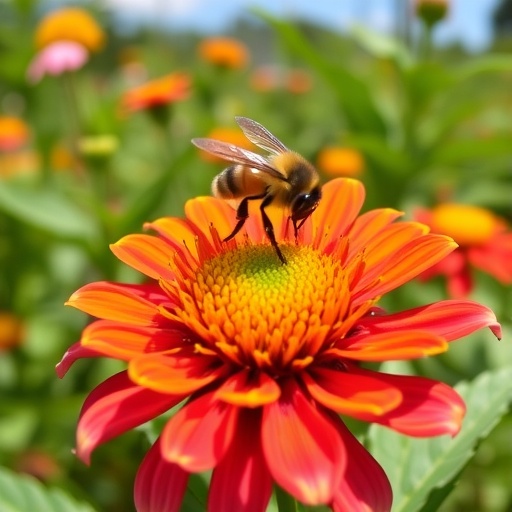
Facing the dual pressures of climate change and plunging pollinator numbers, plants may be evolving traits to attract pollinators at the expense of adapting to warming climates—a trade-off that has drastically reduced their rate of adaptation. This revelation comes from a recent University of Michigan study focused on morning glories, which observed a staggering 96% decline in adaptation rate over a nine-year span.
The team, led by doctoral graduate Sasha Bishop in collaboration with University of Toronto’s John Stinchcombe and professor Regina Baucom, analyzed morning glory populations collected at two different times, nine years apart. By examining traits like flower size, flowering time, nectar sugar concentration, and the spatial arrangement between anthers and stigmas, researchers probed how evolutionary pressures shape simultaneously linked traits, or covariants.
Using an advanced statistical measure known as R, which quantifies population adaptability by factoring in trait covariance, the study illuminated an unexpected dynamic. Originally, the morning glory populations adapted at around 76% of a theoretical ideal where traits evolve independently. Yet nine years later, this rate plummeted to just 9%. Surprisingly, despite ample genetic variation to fuel evolution, morning glories appear trapped on a trajectory favoring larger flowers to lure pollinators rather than adjusting flowering time to climate shifts.
This constraint arises because flower size and flowering time became increasingly correlated, limiting the plant’s ability to optimize either trait independently. In essence, the evolutionary “fuel” remains but is constrained by conflicting selective demands. The study illustrates how the decline in pollinators—driven by habitat loss and widespread agricultural chemicals—can indirectly inhibit plants’ ability to evolve in response to rapid environmental changes.
The findings challenge the conventional expectation that wild plants will swiftly adapt to climate change. Instead, they suggest that ecological interactions, such as pollinator declines, can create evolutionary bottlenecks. This trade-off raises profound implications not only for ecosystems but also for agriculture, where morning glories are considered weeds. Whether this locked evolutionary pathway makes them more or less problematic remains uncertain, underscoring the complexity of predicting ecological outcomes under global change.
Bishop emphasized that despite strong evidence for flowering phenology as an adaptive response to climate, the selective pressure to attract pollinators now dominates. This “evolutionary lag” might explain why many wild populations are declining or experiencing genetic bottlenecks, contrary to theoretical models expecting rapid adaptation.
Published in Evolution Letters, the study exemplifies the intricate interplay between multiple selective forces shaping evolution in a changing world. It underscores the need to consider ecological network effects—such as pollinator dynamics—when assessing the adaptive potential of organisms facing anthropogenic challenges.
Subject of Research: Evolutionary adaptation and trait covariance in morning glories under climate change and pollinator decline
Article Title: A resurrection experiment reveals reduced adaptive potential in a common agricultural weed
News Publication Date: 7-Jul-2026
Web References: http://dx.doi.org/10.1093/evlett/qrag026
Image Credits: Grace Zhang, the Baucom Lab, University of Michigan
Keywords: Evolutionary ecology, ecological adaptation, climate change, pollinator decline, morning glories, plant evolution
Tags: advanced statistical measures in evolutionary biologyClimate change adaptationeffects of climate change on plant evolutionevolutionary trade-offs in flowering plantsfloral trait evolution under environmental stressgenetic variation and adaptation ratesimpact of pollinator protection effortsmorning glory adaptation studyplant reproductive trait trade-offsplant-pollinator interactionsPollinator declinetrait covariance in plants