• HOME
  • NEWS
  • EXPLORE
    • CAREER
      • Companies
      • Jobs
    • EVENTS
    • iGEM
      • News
      • Team
    • PHOTOS
    • VIDEO
    • WIKI
  • BLOG
  • COMMUNITY
    • FACEBOOK
    • INSTAGRAM
    • TWITTER
Saturday, May 16, 2026
BIOENGINEER.ORG
No Result
View All Result
  • Login
  • HOME
  • NEWS
  • EXPLORE
    • CAREER
      • Companies
      • Jobs
        • Lecturer
        • PhD Studentship
        • Postdoc
        • Research Assistant
    • EVENTS
    • iGEM
      • News
      • Team
    • PHOTOS
    • VIDEO
    • WIKI
  • BLOG
  • COMMUNITY
    • FACEBOOK
    • INSTAGRAM
    • TWITTER
  • HOME
  • NEWS
  • EXPLORE
    • CAREER
      • Companies
      • Jobs
        • Lecturer
        • PhD Studentship
        • Postdoc
        • Research Assistant
    • EVENTS
    • iGEM
      • News
      • Team
    • PHOTOS
    • VIDEO
    • WIKI
  • BLOG
  • COMMUNITY
    • FACEBOOK
    • INSTAGRAM
    • TWITTER
No Result
View All Result
Bioengineer.org
No Result
View All Result
Home NEWS Science News Biology

Balancing brain cell activity

Bioengineer by Bioengineer
January 21, 2021
in Biology
Reading Time: 2 mins read
0
IMAGE
Share on FacebookShare on TwitterShare on LinkedinShare on RedditShare on Telegram

Specialized sites within nerve cells are responsible for a rapid balancing of the amount of activity in the brain.
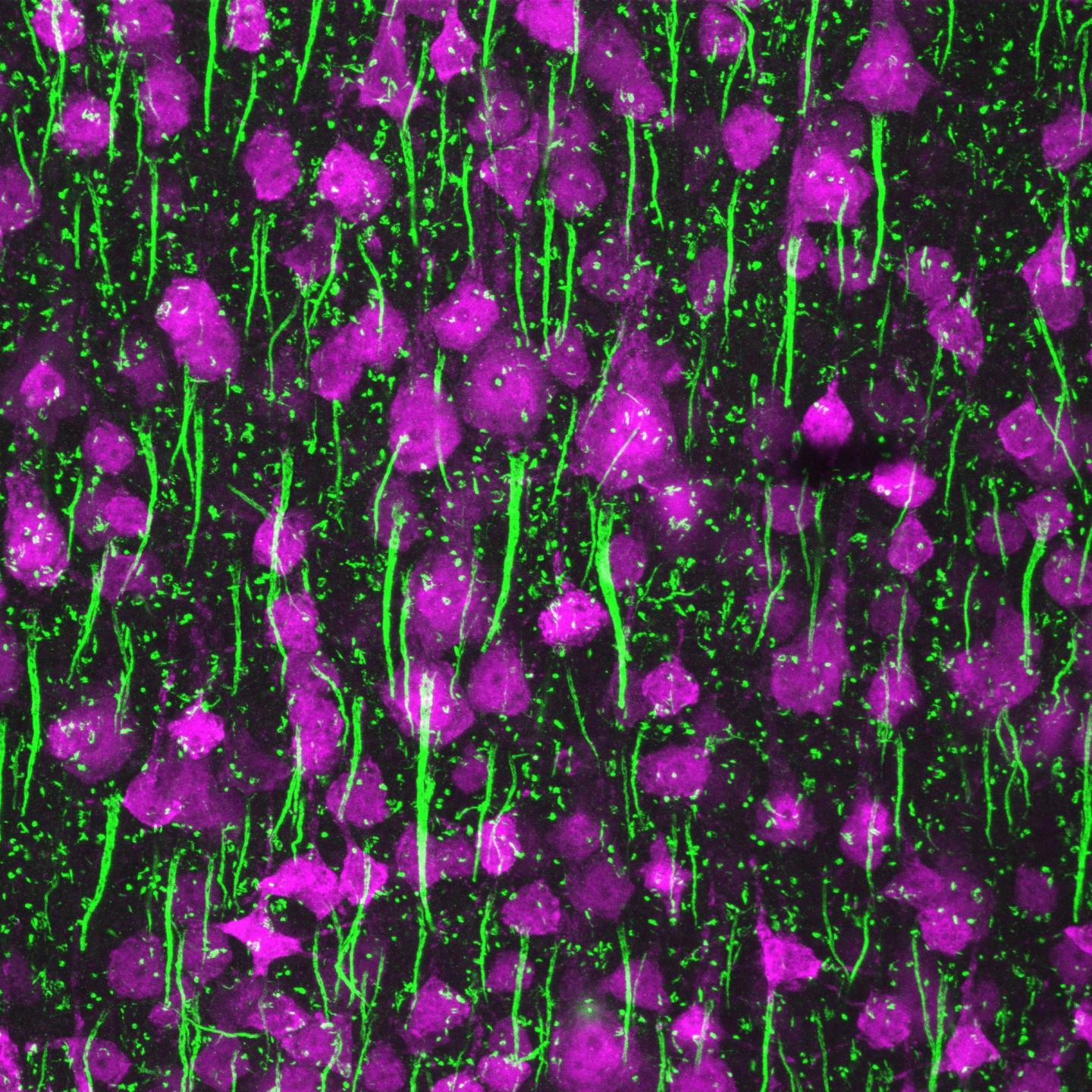
IMAGE

Credit: Netherlands Institute for Neuroscience

To process information in our brains, nerve cells produce brief electrical impulses, called action potentials, triggered from one highly specialized region. Research from the Netherlands Institute for Neuroscience, together with researchers from Heidelberg University and the University of Göttingen in Germany, now show that the electrical trigger sites surprisingly change with experience; they are either becoming smaller with increasing number of experiences and, vice versa, they grow larger when less input arrives in the brain. The results were published in Nature Communications.

Exploring the environment

Rodents learn about their environment by moving their highly sensitive whiskers, with which they touch objects and, for example, identify food sources. To examine whether brain cells change with the number of sensory experiences, researchers from the Kole group, placed mice in an environment in which many new objects were present, with variable textures, shapes, and possibilities to explore. As a result of such a rich environment, brain cells shrank the length of the trigger site. With the shortening, which occurred even within a few hours, nerve cells also showed a lower rate by which electrical impulses were generated. In contrast, when sensory stimuli were not able to reach the brain because the whiskers were impaired, the trigger sites grew longer and produced more electrical impulses.

Plasticity

Structural changes of neurons are a phenomenon that scientists call ‘plasticity’ and form the basis of why we keep learning during our entire life and can adapt to an ever-changing world. Previously, it was thought that anatomical changes in nerve cells are primarily occurring at the contact sites called ‘synapses’. However, the present study shows that plasticity also occurs at the trigger sites for electrical impulses, which may be important to balance the amount of brain cell activity and prevent overexcitation. The question also remains which molecules are producing this type of plasticity.

###

Media Contact
Maarten Kole
[email protected]

Original Source

https://nin.nl/balancing-brain-cell-activity/

Related Journal Article

http://dx.doi.org/10.1038/s41467-020-20232-x

Tags: BiologyCell Biologyneurobiology
Share13Tweet8Share2ShareShareShare2

Related Posts

Single mother must adapt swiftly — the survival of her colony depends on it — Biology

Single mother must adapt swiftly — the survival of her colony depends on it

May 15, 2026
Why Are Nearly Everyone Right-Handed? It Might Be Linked to How We Learned to Walk — Biology

Why Are Nearly Everyone Right-Handed? It Might Be Linked to How We Learned to Walk

May 15, 2026

Excessive Neuronal Activity Initiates Severe Autoimmune Brain Disorder

May 15, 2026

Precision Anti-Aging Strategies Focus on Eliminating Harmful Senescent Cells While Preserving Beneficial Ones

May 15, 2026
Please login to join discussion

POPULAR NEWS

  • Research Indicates Potential Connection Between Prenatal Medication Exposure and Elevated Autism Risk

    843 shares
    Share 337 Tweet 211
  • New Study Reveals Plants Can Detect the Sound of Rain

    730 shares
    Share 291 Tweet 182
  • Salmonella Haem Blocks Macrophages, Boosts Infection

    62 shares
    Share 25 Tweet 16
  • Breastmilk Balances E. coli and Beneficial Bacteria in Infant Gut Microbiomes

    58 shares
    Share 23 Tweet 15

About

We bring you the latest biotechnology news from best research centers and universities around the world. Check our website.

Follow us

Recent News

New Actinomycin Derivatives Target Malaria More Selectively

Mobile App Enhances Exercise for Older Adults’ Cognition

Botulinum Toxin Reduces Urinary Retention Post-Hemorrhoidopexy

Subscribe to Blog via Email

Enter your email address to subscribe to this blog and receive notifications of new posts by email.

Join 82 other subscribers
  • Contact Us

Bioengineer.org © Copyright 2023 All Rights Reserved.

Welcome Back!

Login to your account below

Forgotten Password?

Retrieve your password

Please enter your username or email address to reset your password.

Log In
No Result
View All Result
  • Homepages
    • Home Page 1
    • Home Page 2
  • News
  • National
  • Business
  • Health
  • Lifestyle
  • Science

Bioengineer.org © Copyright 2023 All Rights Reserved.