• HOME
  • NEWS
  • EXPLORE
    • CAREER
      • Companies
      • Jobs
    • EVENTS
    • iGEM
      • News
      • Team
    • PHOTOS
    • VIDEO
    • WIKI
  • BLOG
  • COMMUNITY
    • FACEBOOK
    • INSTAGRAM
    • TWITTER
Thursday, May 21, 2026
BIOENGINEER.ORG
No Result
View All Result
  • Login
  • HOME
  • NEWS
  • EXPLORE
    • CAREER
      • Companies
      • Jobs
        • Lecturer
        • PhD Studentship
        • Postdoc
        • Research Assistant
    • EVENTS
    • iGEM
      • News
      • Team
    • PHOTOS
    • VIDEO
    • WIKI
  • BLOG
  • COMMUNITY
    • FACEBOOK
    • INSTAGRAM
    • TWITTER
  • HOME
  • NEWS
  • EXPLORE
    • CAREER
      • Companies
      • Jobs
        • Lecturer
        • PhD Studentship
        • Postdoc
        • Research Assistant
    • EVENTS
    • iGEM
      • News
      • Team
    • PHOTOS
    • VIDEO
    • WIKI
  • BLOG
  • COMMUNITY
    • FACEBOOK
    • INSTAGRAM
    • TWITTER
No Result
View All Result
Bioengineer.org
No Result
View All Result
Home NEWS Science News Biology

Bacterium makes complex loops

Bioengineer by Bioengineer
February 27, 2020
in Biology
Reading Time: 3 mins read
0
IMAGE
Share on FacebookShare on TwitterShare on LinkedinShare on RedditShare on Telegram

Research team analyses flagellar locomotion
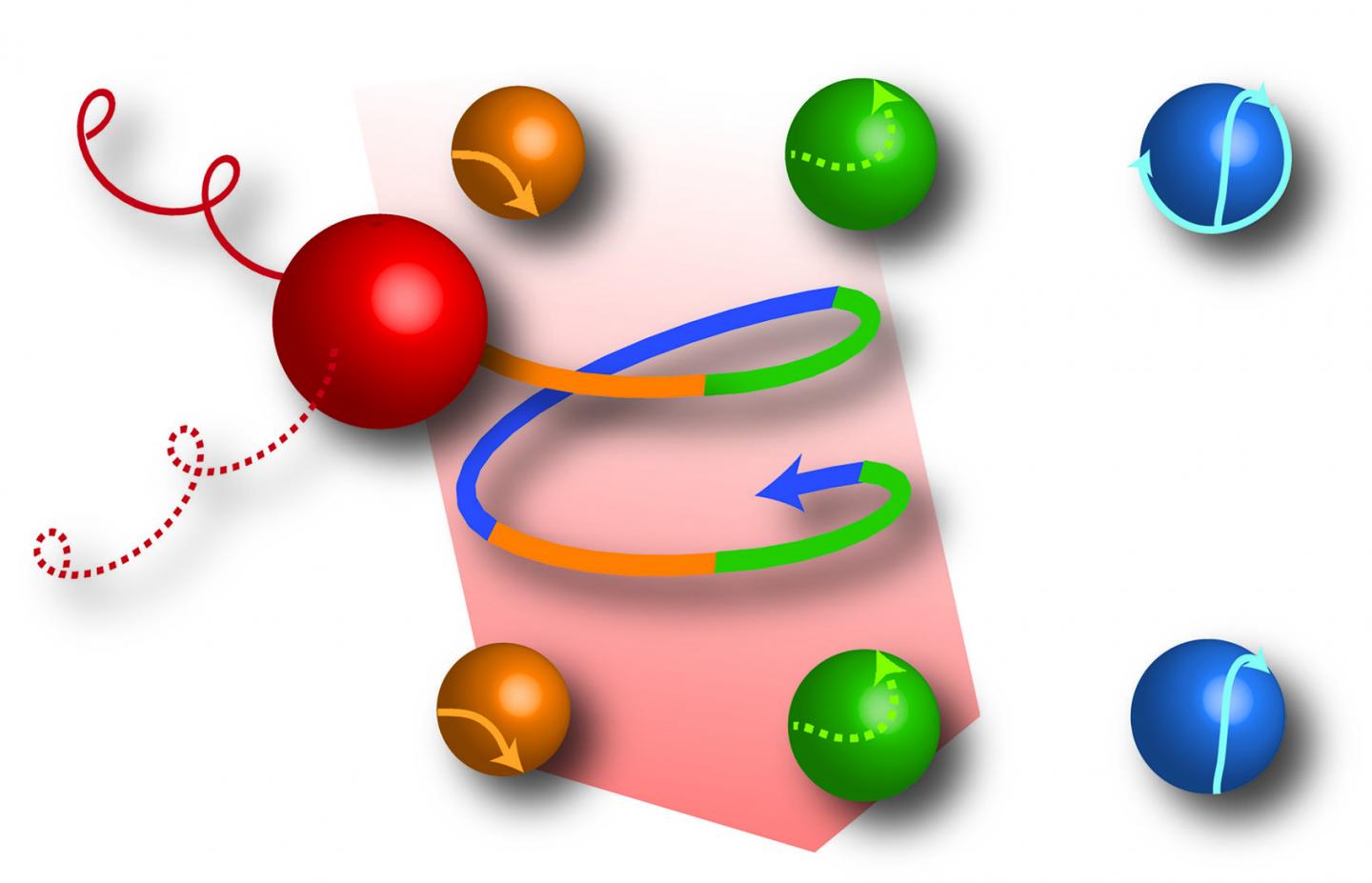
IMAGE

Credit: Max Planck Institute of Colloids and Interfaces/Klaas Bente


A scientific team from the Biosciences and Biotechnology Institute of Aix-Marseille in Saint-Paul lez Durance, in collaboration with researchers from the Max Planck Institute of Colloids and Interfaces in Potsdam and the University of Göttingen, determined the trajectory and swimming speed of the magnetotactic bacterium Magnetococcus marinus, known to move rapidly. The actual speed is 400-500 μm/s for a 1 μm bacterium, making it a swimming champion. More surprisingly, the trajectory is made up of complex spirals. The exceptional properties of this bacterium make possible to imagine its use as a micro-robot in the fields of biotechnology and the environment.

The magnetotactic bacterium Magnetococcus marinus lives in marine sediments. Its apparent swimming speed, which is very fast, was previously estimated at 100 μm/s. Spherical in shape, it has two packs of flagella on one of its hemispheres. The exact movement, supposedly helical in the presence of a magnetic field, with the head in front and the flagella at the back, however, remained hypothetical.

To answer this question and determine the real swimming speed of this bacterium, scientists from the Max Planck Institute of Colloids and Interfaces in Potsdam, the University of Göttingen and their colleagues from BIAM at CEA-Cadarache had to develop new experimental and numerical tools. The movement of these micro-swimmers was tracked by 3-dimensional microscopy and analysed by very high frequency black field imaging to decompose the movement of the flagella. This experimental work was complemented by original simulations to see which flagellum configurations could reproduce the movement observed experimentally.

The conclusion is astonishing. The flagella are arranged at 180° on either side of the head of the bacterium, with one bundle pulling and another growing, a configuration never observed before for bacteria or even for any known microorganism. The resulting movement describes double or even triple spirals! Magnetococcus marinus makes complex loops of sorts.

What about speed? The real speed is not the apparent speed, as the spirals considerably increase the travelled distance. The real speed is in the range of 400 to 500 μm/s for a bacteria measuring 1 μm. So it moves 500 times its own size, every second. This figure should be compared to the speed of movement of other known bacteria (40 to 50 μm/s), or to the swimming speed of our champions, of the order of 2 m/s, i.e. about one time its size per second for humans…

So Magnetococcus marinus is the queen of the podiums! Researchers are wondering about the origin of these performances and propose the hypothesis that this type of spiral swimming has an advantage in a sedimentary environment full of obstacles, which loops would allow to avoid. This particularity could be exploited in medical micro-robotics, to move in the blood of patients. It could also be used to sanitize areas polluted with oil or heavy metals, for example, which the bacteria could suck up and release in suitable spaces.

###

Original Publication

K. Bente, S. Mohammadinejad, et al.

High-speed motility originates from cooperatively pushing and pulling flagella bundles in bilophotrichous bacteria

eLife (2020)

https://elifesciences.org/articles/47551

Media Contact
Katja Schulze
[email protected]
49-331-567-9203

Original Source

https://www.mpg.de/14512078/0224-koll-029721-magnetococcus-marinus-the-swimming-champion-bacterium

Related Journal Article

http://dx.doi.org/10.7554/eLife.47551

Tags: BiologyMicrobiology
Share12Tweet8Share2ShareShareShare2

Related Posts

Early Delivery Improves Outcomes for Mothers and Babies in Hypertensive Pregnancies — Biology

Early Delivery Improves Outcomes for Mothers and Babies in Hypertensive Pregnancies

May 21, 2026
How Atlantic Herring Rewired Their Reproductive Strategy to Thrive in Changing Oceans — Biology

How Atlantic Herring Rewired Their Reproductive Strategy to Thrive in Changing Oceans

May 20, 2026

Study Finds Young Fraser River Chinook Salmon Swimming in Chemical Mixture

May 20, 2026

Thousands of UK Beekeepers Contribute Honey to Advance Environmental Science

May 20, 2026
Please login to join discussion

POPULAR NEWS

  • blank

    New Study Reveals Plants Can Detect the Sound of Rain

    733 shares
    Share 292 Tweet 183
  • ESMO 2025: mRNA COVID Vaccines Enhance Efficacy of Cancer Immunotherapy

    304 shares
    Share 122 Tweet 76
  • Research Indicates Potential Connection Between Prenatal Medication Exposure and Elevated Autism Risk

    846 shares
    Share 338 Tweet 212
  • Breastmilk Balances E. coli and Beneficial Bacteria in Infant Gut Microbiomes

    58 shares
    Share 23 Tweet 15

About

We bring you the latest biotechnology news from best research centers and universities around the world. Check our website.

Follow us

Recent News

Innovative Reusable Brick Walls Revolutionize Construction Industry

Nonlinear Atomic Tunneling Enhanced by Bright Squeezed Vacuum

Label-Free Super-Resolution Imaging of Live Cells

Subscribe to Blog via Email

Enter your email address to subscribe to this blog and receive notifications of new posts by email.

Join 82 other subscribers
  • Contact Us

Bioengineer.org © Copyright 2023 All Rights Reserved.

Welcome Back!

Login to your account below

Forgotten Password?

Retrieve your password

Please enter your username or email address to reset your password.

Log In
No Result
View All Result
  • Homepages
    • Home Page 1
    • Home Page 2
  • News
  • National
  • Business
  • Health
  • Lifestyle
  • Science

Bioengineer.org © Copyright 2023 All Rights Reserved.