• HOME
  • NEWS
  • EXPLORE
    • CAREER
      • Companies
      • Jobs
    • EVENTS
    • iGEM
      • News
      • Team
    • PHOTOS
    • VIDEO
    • WIKI
  • BLOG
  • COMMUNITY
    • FACEBOOK
    • INSTAGRAM
    • TWITTER
Wednesday, May 13, 2026
BIOENGINEER.ORG
No Result
View All Result
  • Login
  • HOME
  • NEWS
  • EXPLORE
    • CAREER
      • Companies
      • Jobs
        • Lecturer
        • PhD Studentship
        • Postdoc
        • Research Assistant
    • EVENTS
    • iGEM
      • News
      • Team
    • PHOTOS
    • VIDEO
    • WIKI
  • BLOG
  • COMMUNITY
    • FACEBOOK
    • INSTAGRAM
    • TWITTER
  • HOME
  • NEWS
  • EXPLORE
    • CAREER
      • Companies
      • Jobs
        • Lecturer
        • PhD Studentship
        • Postdoc
        • Research Assistant
    • EVENTS
    • iGEM
      • News
      • Team
    • PHOTOS
    • VIDEO
    • WIKI
  • BLOG
  • COMMUNITY
    • FACEBOOK
    • INSTAGRAM
    • TWITTER
No Result
View All Result
Bioengineer.org
No Result
View All Result
Home NEWS Science News Biology

Bacterial mix helps predict future change

Bioengineer by Bioengineer
April 16, 2019
in Biology
Reading Time: 3 mins read
0
IMAGE
Share on FacebookShare on TwitterShare on LinkedinShare on RedditShare on Telegram

IMAGE

Credit: © 2019 KAUST
Reproduced under a Creative Commons license 4.0 from reference 1

A controlled, laboratory approach, along with computer simulations, has helped KAUST researchers to show that bacterial communities can homogenously disperse within aquatic ecosystems even with slow flowing water and the persistence of their preferred, localized conditions.

“Bacterial communities are a fundamental part of water-based ecosystems, such as oceans, lakes and rivers,” explains microbial ecologist Stilianos Fodelianakis. “They represent most of an ecosystem’s biomass, and drive carbon and nutrient cycles. If we can understand how these communities change, we might be able to predict changes in the whole ecosystem in light of climate change.”

Diverse metacommunities of multiple strains of bacteria exist within an ecosystem, localizing and/or mixing according to the conditions that encourage their growth. These conditions include specific temperature ranges or degrees of acidity or salinity; and the natural movement of the system, such as water flow.

Ecologists have long questioned what exactly causes these metacommunities to homogenize: a state in which bacterial communities across the ecosystem have similar compositions and structures. The assumption was that homogenization occurs when the physical movement within the system is very high, as in fast-flowing rivers, causing high rates of bacterial dispersal and physical mixing of the mediums in which they live. But what favors bacterial metacommunity homogenization more: high rates of bacterial dispersal or homogenizing environments? And how fast does a system need to move for homogenization to occur?

“We found that homogenization occurs at the high dispersal rates expected in the literature, the so-called ‘mass transfer’ events, but that it can also happen even at low dispersal rates,” says Fodelianakis.

Led by bioscientist Daniele Daffonchio, the team developed a laboratory experiment that enabled them to overcome the challenge of studying changes over time in bacterial communities in their natural environments.

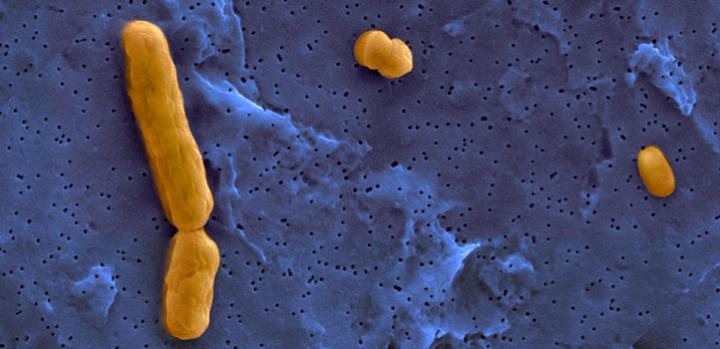
They chose three strains of bacteria that look quite different, making them easy to distinguish from one another, and that grow best at different temperatures. They mixed similar numbers of each strain together, creating multiple, identical communities. One of these communities was placed in each of three linked flasks: the medium could flow between the flasks at four different speeds. The medium in each flask was set at a temperature that favored the growth of one of the three strains.

They found that homogenization of the bacterial communities occurred at all but the slowest speed, even when the temperatures in the flasks changed only slightly. They then conducted 100 different flow rate computer simulations based on their data, focusing particularly on the changes with the two slowest flow rates. This allowed them to identify the precise flow rate (3.85 microlitres per second) at which homogenization occurred within each of the three flasks.

The team is now working on a similar experimental approach to answer other questions in microbial ecology, such as how to quantify the effects of random changes on bacterial populations over time.

###

Media Contact
Carolyn Unck
[email protected]

Original Source

https://discovery.kaust.edu.sa/en/article/824/bacterial-mix-helps-predict-future-change

Related Journal Article

http://dx.doi.org/10.1038/s41467-019-09306-7

Tags: BacteriologyBiodiversityBiologyClimate ChangeEcology/EnvironmentGeology/SoilHydrology/Water ResourcesMicrobiology
Share12Tweet8Share2ShareShareShare2

Related Posts

Cutting-Edge Genomic Techniques Reveal Unexpected Cellular Changes in the Aging Brain — Biology

Cutting-Edge Genomic Techniques Reveal Unexpected Cellular Changes in the Aging Brain

May 12, 2026
USC Researchers Initiate Study on the Most Advanced Lab-Grown Kidney Structures — Biology

USC Researchers Initiate Study on the Most Advanced Lab-Grown Kidney Structures

May 12, 2026

Childbirth in Humans Is Not Uniquely Challenging Among Mammals, New Research Shows

May 12, 2026

From Complexity to Clarity: Unraveling the “Topological Laws” Governing Cell Death

May 11, 2026
Please login to join discussion

POPULAR NEWS

  • Research Indicates Potential Connection Between Prenatal Medication Exposure and Elevated Autism Risk

    842 shares
    Share 337 Tweet 211
  • New Study Reveals Plants Can Detect the Sound of Rain

    728 shares
    Share 290 Tweet 182
  • Salmonella Haem Blocks Macrophages, Boosts Infection

    62 shares
    Share 25 Tweet 16
  • Breastmilk Balances E. coli and Beneficial Bacteria in Infant Gut Microbiomes

    57 shares
    Share 23 Tweet 14

About

We bring you the latest biotechnology news from best research centers and universities around the world. Check our website.

Follow us

Recent News

Enhancing Carbon Capture Efficiency Using Laser-Engineered MOFs!

E-cadherin Loss Drives Tumor Environment in Lobular Cancer

Endothelial SPARC Drives Astrocyte Damage in NMOSD

Subscribe to Blog via Email

Enter your email address to subscribe to this blog and receive notifications of new posts by email.

Join 82 other subscribers
  • Contact Us

Bioengineer.org © Copyright 2023 All Rights Reserved.

Welcome Back!

Login to your account below

Forgotten Password?

Retrieve your password

Please enter your username or email address to reset your password.

Log In
No Result
View All Result
  • Homepages
    • Home Page 1
    • Home Page 2
  • News
  • National
  • Business
  • Health
  • Lifestyle
  • Science

Bioengineer.org © Copyright 2023 All Rights Reserved.