


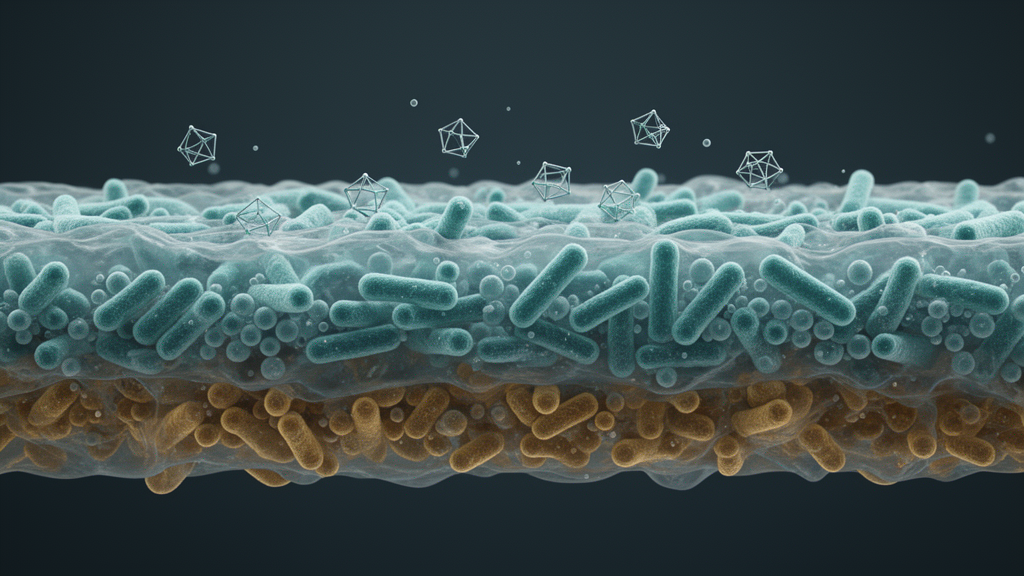
Bacteria living inside biofilms, the slimy communities that coat medical devices, wounds and human tissue, can resist antibiotics up to 1,000 times more strongly than the same bacteria floating freely, according to a review published on 29 May 2026 in the journal Discover Bacteria. The article, written by Lucy Musa Yaki, argues that the role of biofilms in antimicrobial resistance is routinely overlooked in the clinical management of bacterial infections, even though the World Health Organization has ranked antimicrobial resistance among the top ten global public health threats facing humanity, with projections that it will cause more than ten million deaths by 2050 if current trends continue.
Biofilms are complex bacterial communities that adhere to living and non-living surfaces and enclose themselves in a self-produced matrix of extracellular polymeric substances. The review describes them as a universal survival strategy: although planktonic, free-floating cells grow and reproduce quickly, the biofilm state is the bacteria’s preferred and most common form. According to the paper, biofilms are associated with roughly 80 percent of bacterial infections and are responsible for more than 65 percent of all bacterial infections and up to 80 percent of chronic infections in medical settings. These infections are persistent and recurrent and respond poorly to antibiotic treatment, frequently being tied to medical devices such as catheters, implants, contact lenses, prosthetic valves and joints, screws and pins.
The historical arc of biofilm science stretches back further than many clinicians might expect. The review notes that in 1683 the Dutch researcher Antoni van Leeuwenhoek recorded the first observation of a biofilm, discovering an ‘animalcule’ on the surfaces of teeth. In 1973, Characklis found that microbial slimes in industrial water systems were tenacious and showed higher resistance to disinfectants such as chlorine, and in 1978 Bill Costerton formally introduced the term biofilm, deriving the concept from his studies of sessile communities in mountain streams and dental plaque. By 2002, Donlan and Costerton had defined the biofilm as a surface-attached microbial community surrounded by extracellular polymeric molecules, a three-dimensional, gel-like, hydrated environment in which bacteria are immobilised and separated by water channels that circulate nutrients.
Formation proceeds in four stages: bacterial attachment, microcolony formation, maturation and dispersion. During the reversible attachment stage, planktonic cells adhere to surfaces through electrostatic and hydrophobic forces, strengthened by flagella, fimbriae and pili, with bacteria adhering more readily to hydrophobic surfaces such as plastics than to hydrophilic ones like metals and glass. As cells multiply and produce extracellular polymeric substances, attachment becomes irreversible. Biofilms then grow from thin layers into mushroom- or tower-shaped structures, with anaerobic bacteria preferring deeper layers to avoid oxygen exposure. In mature biofilms, quorum sensing, the communication system built on small signalling molecules called autoinducers, coordinates gene expression, biofilm development and toxin production, converting an innocuous population into an aversive phenotype once cell density reaches a critical threshold.
The resistance mechanisms packed into these communities are diverse and, crucially, not captured by conventional antibiotic-resistance explanations. The extracellular polymeric substance matrix acts as a physical barrier, and its anionic polysaccharides and extracellular DNA bind cationic antibiotics such as aminoglycosides, including gentamicin and tobramycin, severely impairing their diffusion. Fluoroquinolones such as ciprofloxacin penetrate Klebsiella pneumoniae and Pseudomonas aeruginosa biofilms deeply, yet bacteria still survive because of nutrient limitation, altered metabolism and stress-induced molecular changes. Vancomycin can reach deeper regions of Staphylococcus epidermidis biofilms but fails to attain therapeutic concentrations in the involved bacterial cells. Waste accumulation inside microcolonies further alters the microenvironment, and aminoglycosides acting on the 30S ribosomal subunit become poorly effective when oxygen is exhausted.
Biofilms also serve as hubs for horizontal gene transfer. Plasmid-mediated resistance is facilitated by tightly packed cells, and evidence reviewed in the article indicates that plasmid transfer is significantly increased within biofilms, including spread of carbapenemase genes between Escherichia coli and Enterobacter cloacae in healthcare settings. Extracellular DNA can be incorporated into bacterial genomes, and bacteriophage-mediated transduction has been linked to Staphylococcus aureus biofilms acquiring vancomycin resistance genes. Enzymatic degradation adds another layer: Klebsiella pneumoniae biofilms produce beta-lactamases that hydrolyse ampicillin and cephalosporins, Pseudomonas aeruginosa biofilms produce metallo-beta-lactamases that hydrolyse carbapenems, and S. aureus biofilms secrete proteolytic enzymes that modify aminoglycosides.
Metabolic state matters as much as barrier function. Biofilm-embedded bacteria largely remain in a stationary phase, and oxygen and nutrient gradients leave deeper-layer cells with slow metabolic activity, making antibiotics that target actively dividing cells comparatively ineffective. Within this heterogeneous population sit persister cells, a small fraction of dormant, slow-growing bacteria that enter a protected phenotypic state and avoid antibiotics without acquiring genetic resistance. When treatment stops, persisters reactivate and regenerate biofilms, acting as reservoirs for persistent infection. Persister cells of S. aureus survived exposure to ciprofloxacin in biofilms, and Pseudomonas aeruginosa biofilms harbour high numbers of persisters that resist aminoglycosides such as gentamicin and tobramycin. Efflux pumps add a further defence: Pseudomonas aeruginosa uses MexAB-OprM and MexEF-OprN pumps associated with fluoroquinolone and carbapenem resistance, while S. aureus biofilms rely on NorA and NorB pumps, and Klebsiella pneumoniae activates AcrAB-TolC pumps that hinder beta-lactam penetration.
The clinical picture drawn by the review is stark. Catheter-associated urinary tract infections, the most common healthcare-associated infection, arise when uropathogenic E. coli colonises catheter surfaces and forms intracellular bacterial communities within the bladder epithelium, and removal of contaminated catheters is often the only way out of the infection. Biofilm presence in chronic wounds such as diabetic foot ulcers is estimated at 60 percent, explaining their poor response to conventional antibiotics. Prosthetic joint infections caused by Staphylococcus epidermidis and S. aureus biofilms often require surgical removal of the implant, and in cystic fibrosis patients mucoid Pseudomonas aeruginosa biofilms shield bacteria from immune attacks, rendering conventional bactericidal drugs virtually ineffective. Device infection estimates cited include roughly 40 percent for ventricular-assisted devices, 10 percent for ventricular shunts, 4 percent for mechanical heart valves and pacemakers or defibrillators, and 2 percent for joint prostheses and breast implants.
Emerging therapies aim to dismantle the biofilm rather than simply kill floating bacteria. Bacteriophages can penetrate the extracellular matrix, multiply within bacterial cells and degrade the matrix with enzymes; the phage Sb-1 has been reported to destroy S. aureus persister cells in biofilms. Antimicrobial peptides disrupt bacterial membranes, degrade matrix components and interfere with quorum sensing, and one study reported a significant decrease in biofilm thickness that enhanced antibiotic penetration in Pseudomonas aeruginosa infections of cystic fibrosis patients. DNase I was reported to dissociate up to 92 percent of S. aureus biofilm in chronic wound infections, enhancing antibiotic effects. Nanoparticle systems, hydrogel formulations that deliver antibiotics continuously, aptamer-functionalised liposomes and antibody-conjugated nanocarriers are being developed to improve drug penetration and retention, while synthetic quorum-sensing inhibitors have inhibited biofilm formation in P. aeruginosa and lowered resistance to established antibiotics. The review also highlights artificial intelligence, with machine learning models used to predict biofilm responses to antimicrobial treatment and to discover new antimicrobial peptides, although the authors caution that most evidence for phage therapy so far comes from in vitro investigations, with large clinical trials and real-world applications limited so far.
The review closes with a policy plea. While 93 percent of countries have developed antimicrobial resistance national action plans and 68 percent are implementing aspects of them, only 27 percent have a costed and budgeted plan with a monitoring and evaluation framework, and just 11 percent have allocated national budget funds to support these plans. The author argues that antimicrobial interventions must prioritise biofilms as a line of prevention within antimicrobial stewardship programmes, that healthcare professionals need comprehensive training in biofilm-associated infections, and that raising awareness of the role biofilms play in fostering antibiotic resistance among healthcare professionals and related industries is critical to addressing a threat that conventional antibiotics alone cannot resolve.
Subject of Research: The role of bacterial biofilms in the emergence, persistence and treatment failure of antimicrobial resistance
Article Title: Bacterial biofilms and antimicrobial resistance: a global threat
Article References: Yaki, L. M. (2026). Bacterial biofilms and antimicrobial resistance: a global threat. Discover Bacteria, 3(1), Article 15. https://doi.org/10.1007/s44351-025-00035-5
Image Credits: AI Generated
DOI: 10.1007/s44351-025-00035-5
Keywords: biofilms, antimicrobial resistance, antibiotic tolerance, persister cells, quorum sensing, horizontal gene transfer, efflux pumps, bacteriophage therapy, antimicrobial peptides, medical devices, WHO, drug delivery
News Source: Kristina Jarvis. (October 29, 2026). Bacterial Biofilms Emerge as Hidden Engine of the Antimicrobial Resistance Crisis. Scienmag.



