• HOME
  • NEWS
  • EXPLORE
    • CAREER
      • Companies
      • Jobs
    • EVENTS
    • iGEM
      • News
      • Team
    • PHOTOS
    • VIDEO
    • WIKI
  • BLOG
  • COMMUNITY
    • FACEBOOK
    • INSTAGRAM
    • TWITTER
Wednesday, May 13, 2026
BIOENGINEER.ORG
No Result
View All Result
  • Login
  • HOME
  • NEWS
  • EXPLORE
    • CAREER
      • Companies
      • Jobs
        • Lecturer
        • PhD Studentship
        • Postdoc
        • Research Assistant
    • EVENTS
    • iGEM
      • News
      • Team
    • PHOTOS
    • VIDEO
    • WIKI
  • BLOG
  • COMMUNITY
    • FACEBOOK
    • INSTAGRAM
    • TWITTER
  • HOME
  • NEWS
  • EXPLORE
    • CAREER
      • Companies
      • Jobs
        • Lecturer
        • PhD Studentship
        • Postdoc
        • Research Assistant
    • EVENTS
    • iGEM
      • News
      • Team
    • PHOTOS
    • VIDEO
    • WIKI
  • BLOG
  • COMMUNITY
    • FACEBOOK
    • INSTAGRAM
    • TWITTER
No Result
View All Result
Bioengineer.org
No Result
View All Result
Home NEWS Science News Biology

Bacteria make pearl chains

Bioengineer by Bioengineer
September 25, 2019
in Biology
Reading Time: 2 mins read
0
IMAGE
Share on FacebookShare on TwitterShare on LinkedinShare on RedditShare on Telegram

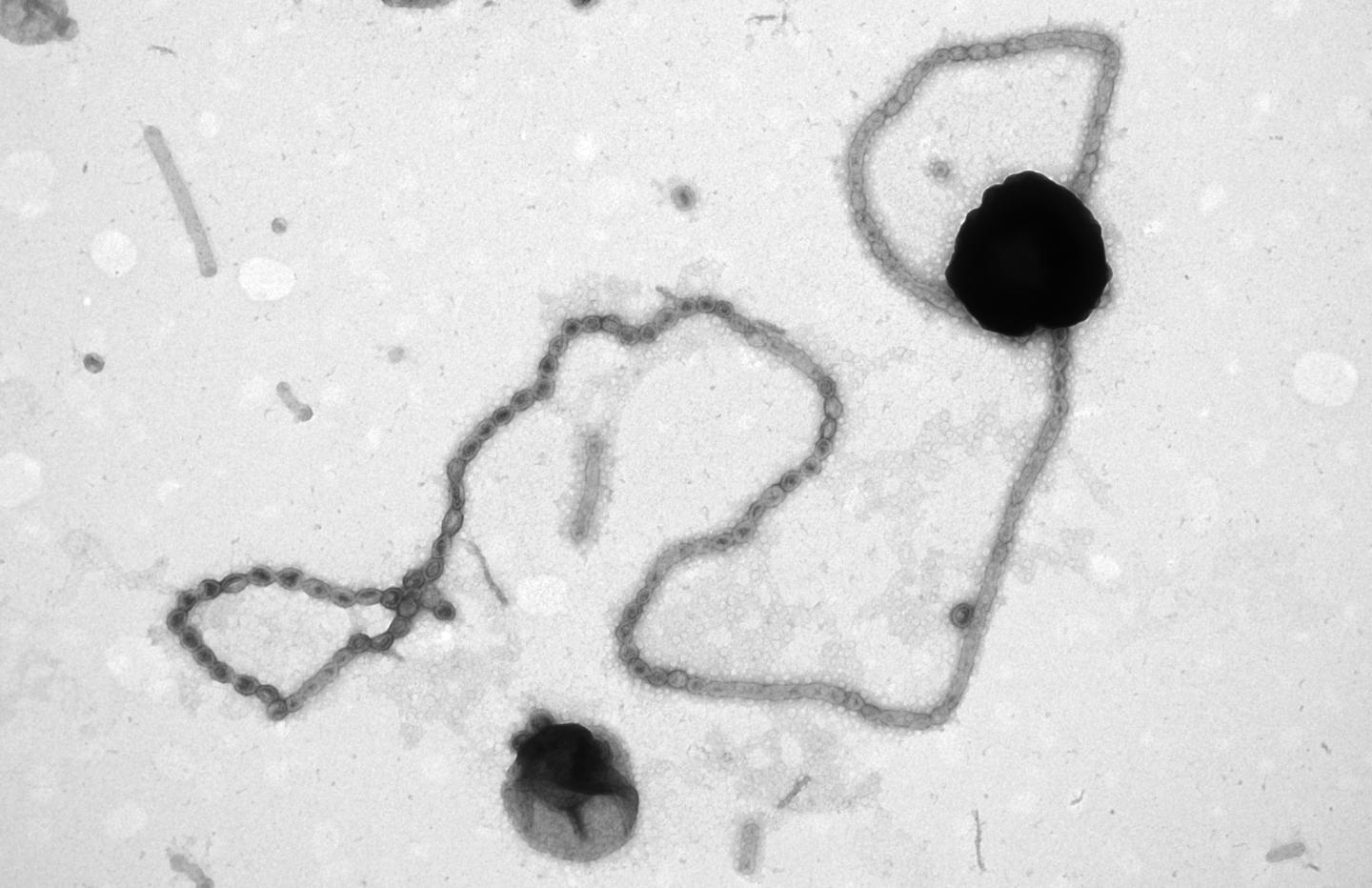
With elegant appendages, the bacteria increase their surface area and thus improve their food intake
IMAGE

Credit: Max Planck Institute for Marine Microbiology / Tanja Fischer

Bacteria have no mouth. They eat by absorbing substances from their environment via their cell wall. However, there are natural physical limits to this way of “eating”. To bypass these limits, some bacteria enlarge their cell surface. For example, they form tubular extensions or small bubbles, so called vesicles. A group of researchers led by Jens Harder from the Max Planck Institute for Marine Microbiology in Bremen, Germany, has now observed for the first time that bacteria initially form tubes and then vesicles.

North Sea bacteria with pearl chains

„We have investigated a flavobacterium that is widespread in the North Sea,” says Harder. These bacteria live in a nutrient-poor, so-called oligotrophic, environment. It is therefore advantageous for them to enlarge their cell surface and thus have more space to hold and absorb sugar and other food with enzymes on the surface. „Bacteria that have vesicles or tubes for this purpose have already been observed,” Harder continues. “The flavobacteria we studied have one after the other: First we observed tubes, then regular strings of pearls. The formation of pearls probably results from a twisting of the fatty acid molecules in the cell wall.”

Ecologically successful strategy

The flavobacteria examined in this study appear in large numbers in so-called bacterial blooms in the North Sea, which occur after the annual algae spring blooms. They have a special set of enzymes to use laminarin, the storage sugar of the algae. Harder and his colleagues fed the bacteria coloured laminarin to check whether there was an exchange between the pearl chains and the „main cell”. And indeed, the dye also appeared in the pearl chains. „We think that enzymes on the surface of the pearl chains capture, hold and break up the laminarin sugar and then deliver it to the cell,” Harder explains. It seems to pay. „The mass occurrence of flavobacteria after algal blooms clearly reveals their ecological success.”

###

Media Contact
Dr. Fanni Aspetsberger
[email protected]

Original Source

https://www.mpi-bremen.de/en/Page3906.html

Related Journal Article

http://dx.doi.org/10.1128/AEM.00829-19

Tags: BacteriologyBiologyCell BiologyEcology/EnvironmentMarine/Freshwater BiologyMicrobiologyMolecular Biology
Share13Tweet8Share2ShareShareShare2

Related Posts

NAD(P)H Dehydrogenase Diversity Drives Clofazimine Resistance — Biology

NAD(P)H Dehydrogenase Diversity Drives Clofazimine Resistance

May 13, 2026
Rhein Alleviates Intestinal Damage in Severe Acute Pancreatitis by Modulating Macrophage Activation via PPARγ — Biology

Rhein Alleviates Intestinal Damage in Severe Acute Pancreatitis by Modulating Macrophage Activation via PPARγ

May 13, 2026

Using Real-Time Brain Signals to Forecast and Prevent Attention Lapses in Children

May 13, 2026

Cutting-Edge Genomic Techniques Reveal Unexpected Cellular Changes in the Aging Brain

May 12, 2026
Please login to join discussion

POPULAR NEWS

  • Research Indicates Potential Connection Between Prenatal Medication Exposure and Elevated Autism Risk

    842 shares
    Share 337 Tweet 211
  • New Study Reveals Plants Can Detect the Sound of Rain

    728 shares
    Share 290 Tweet 182
  • Salmonella Haem Blocks Macrophages, Boosts Infection

    62 shares
    Share 25 Tweet 16
  • Breastmilk Balances E. coli and Beneficial Bacteria in Infant Gut Microbiomes

    57 shares
    Share 23 Tweet 14

About

We bring you the latest biotechnology news from best research centers and universities around the world. Check our website.

Follow us

Recent News

Bronchiectasis and NTM Care Center Network Grows to 62 Centers

Successful Launch of the Largest BL3 and ABL3 Special Laboratories for Domestic Universities Accompanied by a Symposium

Groundbreaking Heart Study Promises to Save Lives and Cut Unnecessary Implants

Subscribe to Blog via Email

Enter your email address to subscribe to this blog and receive notifications of new posts by email.

Join 82 other subscribers
  • Contact Us

Bioengineer.org © Copyright 2023 All Rights Reserved.

Welcome Back!

Login to your account below

Forgotten Password?

Retrieve your password

Please enter your username or email address to reset your password.

Log In
No Result
View All Result
  • Homepages
    • Home Page 1
    • Home Page 2
  • News
  • National
  • Business
  • Health
  • Lifestyle
  • Science

Bioengineer.org © Copyright 2023 All Rights Reserved.