• HOME
  • NEWS
  • EXPLORE
    • CAREER
      • Companies
      • Jobs
    • EVENTS
    • iGEM
      • News
      • Team
    • PHOTOS
    • VIDEO
    • WIKI
  • BLOG
  • COMMUNITY
    • FACEBOOK
    • INSTAGRAM
    • TWITTER
Sunday, May 10, 2026
BIOENGINEER.ORG
No Result
View All Result
  • Login
  • HOME
  • NEWS
  • EXPLORE
    • CAREER
      • Companies
      • Jobs
        • Lecturer
        • PhD Studentship
        • Postdoc
        • Research Assistant
    • EVENTS
    • iGEM
      • News
      • Team
    • PHOTOS
    • VIDEO
    • WIKI
  • BLOG
  • COMMUNITY
    • FACEBOOK
    • INSTAGRAM
    • TWITTER
  • HOME
  • NEWS
  • EXPLORE
    • CAREER
      • Companies
      • Jobs
        • Lecturer
        • PhD Studentship
        • Postdoc
        • Research Assistant
    • EVENTS
    • iGEM
      • News
      • Team
    • PHOTOS
    • VIDEO
    • WIKI
  • BLOG
  • COMMUNITY
    • FACEBOOK
    • INSTAGRAM
    • TWITTER
No Result
View All Result
Bioengineer.org
No Result
View All Result
Home NEWS Science News Chemistry

Australian researchers create quantum microscope that can see the impossible

Bioengineer by Bioengineer
September 6, 2025
in Chemistry
Reading Time: 2 mins read
0
IMAGE
Share on FacebookShare on TwitterShare on LinkedinShare on RedditShare on Telegram

In a major scientific leap, University of Queensland researchers have created a quantum microscope that can reveal biological structures that would otherwise be impossible to see.

This paves the way for applications in biotechnology, and could extend far beyond this into areas ranging from navigation to medical imaging.

The microscope is powered by the science of quantum entanglement, an effect Einstein described as “spooky interactions at a distance”.

Professor Warwick Bowen, from UQ’s Quantum Optics Lab and the ARC Centre of Excellence for Engineered Quantum Systems (EQUS), said it was the first entanglement-based sensor with performance beyond the best possible existing technology.

“This breakthrough will spark all sorts of new technologies – from better navigation systems to better MRI machines, you name it,” Professor Bowen said.

“Entanglement is thought to lie at the heart of a quantum revolution.

“We’ve finally demonstrated that sensors that use it can supersede existing, non-quantum technology.

“This is exciting – it’s the first proof of the paradigm-changing potential of entanglement for sensing.”

Australia’s Quantum Technologies Roadmap sees quantum sensors spurring a new wave of technological innovation in healthcare, engineering, transport and resources.

A major success of the team’s quantum microscope was its ability to catapult over a ‘hard barrier’ in traditional light-based microscopy.

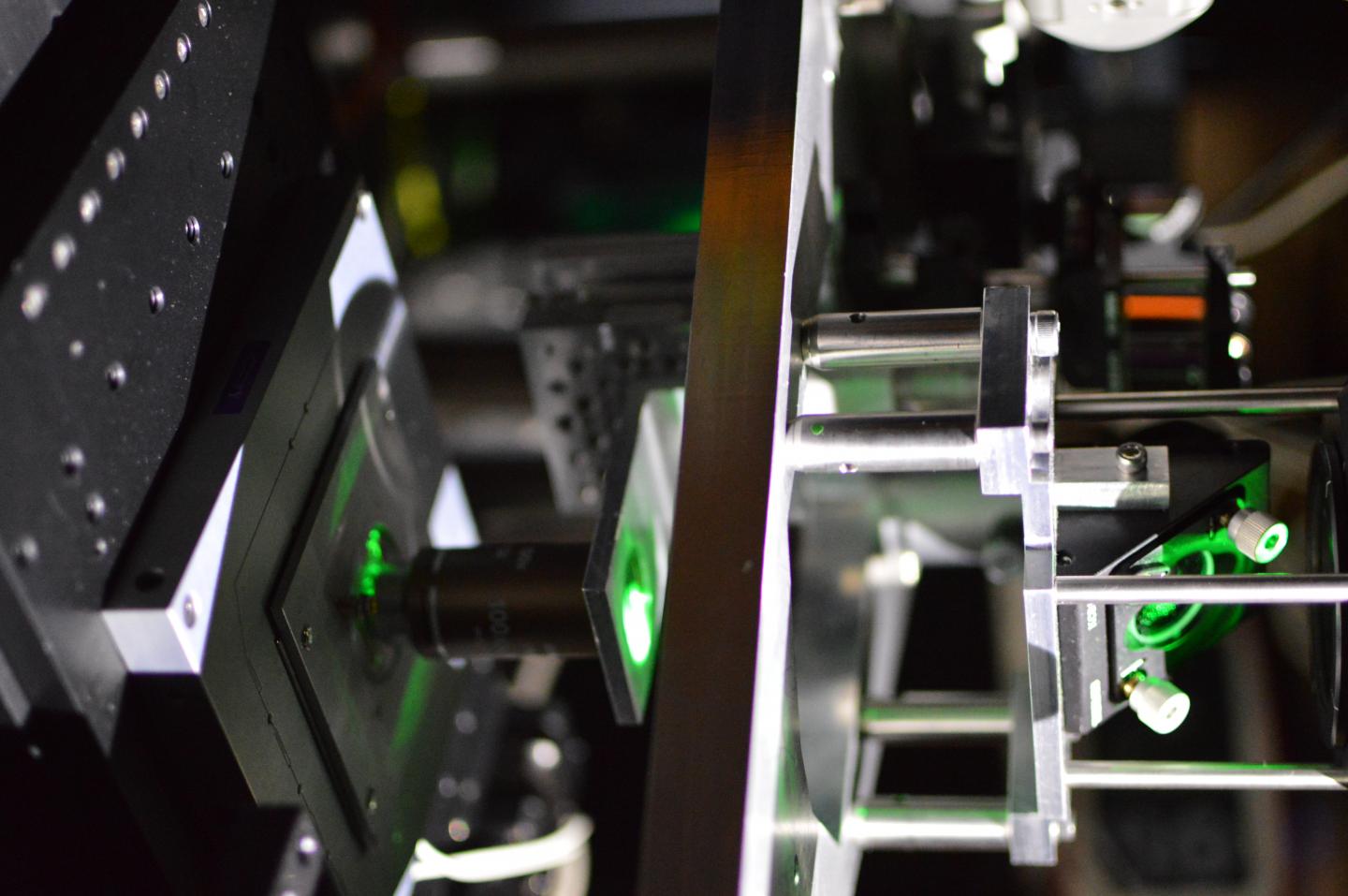
UQ team researchers (counter-clockwise from bottom-left) Caxtere Casacio, Warwick Bowen, Lars Madsen and Waleed Muhammad aligning the quantum microscope.

“The best light microscopes use bright lasers that are billions of times brighter than the sun,” Professor Bowen said.

“Fragile biological systems like a human cell can only survive a short time in them and this is a major roadblock.

“The quantum entanglement in our microscope provides 35 per cent improved clarity without destroying the cell, allowing us to see minute biological structures that would otherwise be invisible.

“The benefits are obvious – from a better understanding of living systems, to improved diagnostic technologies.”

Professor Bowen said there were potentially boundless opportunities for quantum entanglement in technology.

“Entanglement is set to revolutionise computing, communication and sensing,” he said.

“Absolutely secure communication was demonstrated some decades ago as the first demonstration of absolute quantum advantage over conventional technologies.

“Computing faster than any possible conventional computer was demonstrated by Google two years ago, as the first demonstration of absolute advantage in computing.

“The last piece in the puzzle was sensing, and we’ve now closed that gap.

“This opens the door for some wide-ranging technological revolutions.”

###

The research was supported by the United States Air Force Office of Scientific Research and the Australian Research Council. It is published in Nature (DOI: 10.1038/s41586-021-03528-w).

Media Contact
Professor Warwick Bowen
[email protected]

Related Journal Article

http://dx.doi.org/10.1038/s41586-021-03528-w

Tags: Atomic/Molecular/Particle PhysicsBiochemistryChemistry/Physics/Materials SciencesMaterialsMedicine/HealthNanotechnology/MicromachinesNuclear PhysicsOptics
Share13Tweet8Share2ShareShareShare2

Related Posts

Miniature Sensor Uses Light to Detect Touch — Chemistry

Miniature Sensor Uses Light to Detect Touch

May 8, 2026
Iron Minerals Determine Whether Dissolved Organic Matter Fuels Microbes or Becomes Long-Term Carbon Storage — Chemistry

Iron Minerals Determine Whether Dissolved Organic Matter Fuels Microbes or Becomes Long-Term Carbon Storage

May 8, 2026

Kate Evans Appointed Associate Lab Director for Biological and Environmental Systems Science at ORNL

May 8, 2026

Advancing Multiscale Modeling and Overcoming Operational Challenges in Autothermal COâ‚‚-to-Methanol Reactors

May 8, 2026
Please login to join discussion

POPULAR NEWS

  • Research Indicates Potential Connection Between Prenatal Medication Exposure and Elevated Autism Risk

    840 shares
    Share 336 Tweet 210
  • New Study Reveals Plants Can Detect the Sound of Rain

    727 shares
    Share 290 Tweet 181
  • Scientists Investigate Possible Connection Between COVID-19 and Increased Lung Cancer Risk

    68 shares
    Share 27 Tweet 17
  • Salmonella Haem Blocks Macrophages, Boosts Infection

    61 shares
    Share 24 Tweet 15

About

We bring you the latest biotechnology news from best research centers and universities around the world. Check our website.

Follow us

Recent News

Urdu Fall Risk Questionnaire Adapted for Elderly

Key Pharmacological Markers for HIV Prevention in MSM

Taking 8,500 Steps Daily May Aid Long-Term Weight Management, Study Finds

Subscribe to Blog via Email

Success! An email was just sent to confirm your subscription. Please find the email now and click 'Confirm' to start subscribing.

Join 82 other subscribers
  • Contact Us

Bioengineer.org © Copyright 2023 All Rights Reserved.

Welcome Back!

Login to your account below

Forgotten Password?

Retrieve your password

Please enter your username or email address to reset your password.

Log In
No Result
View All Result
  • Homepages
    • Home Page 1
    • Home Page 2
  • News
  • National
  • Business
  • Health
  • Lifestyle
  • Science

Bioengineer.org © Copyright 2023 All Rights Reserved.