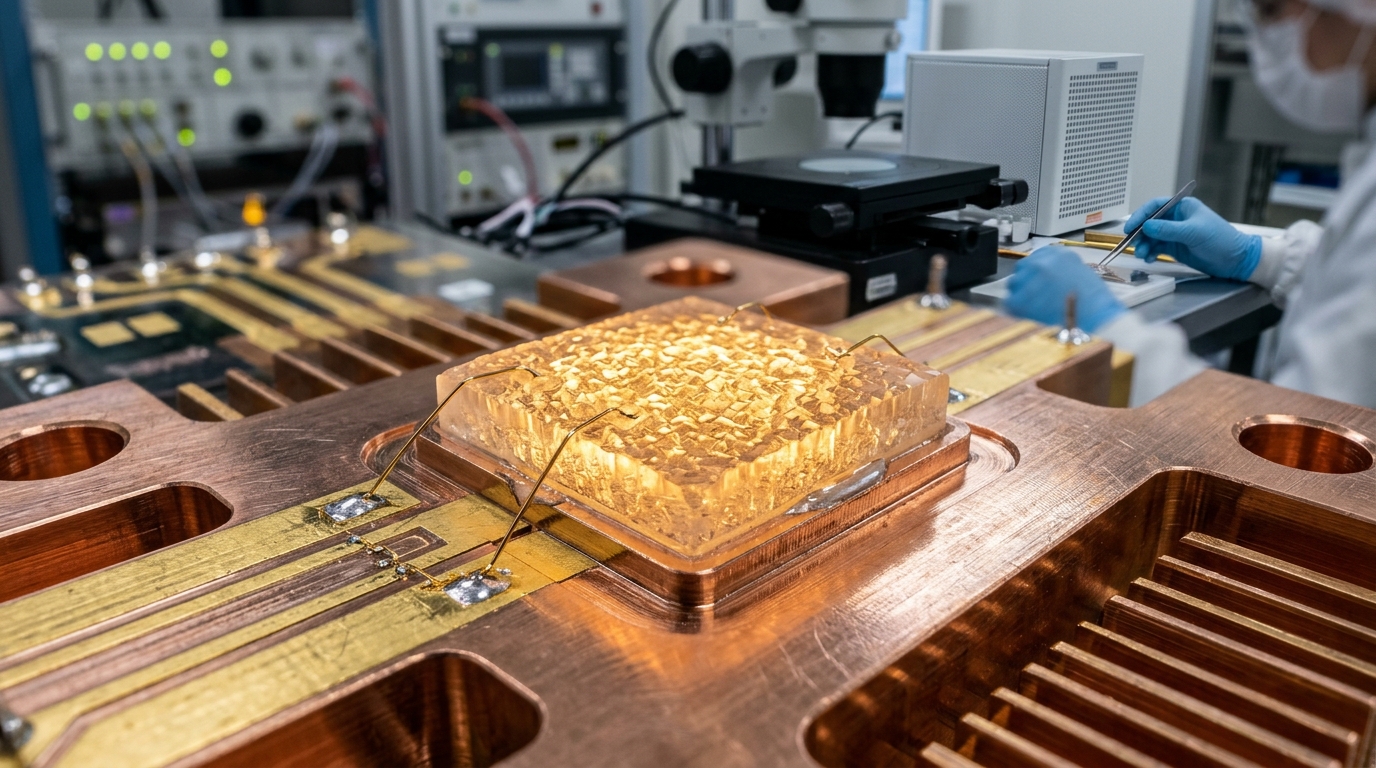
Garnet phosphors have anchored solid-state lighting for nearly three decades, ever since cerium-doped yttrium aluminum garnet, known as YAG:Ce3+, became the yellow converter inside the first commercial white light-emitting diodes in the 1990s. The same family of compounds, with the general formula A3B2C3O12, now underpins emerging near-infrared emitters for spectroscopy, bioimaging and plant-growth lighting. Yet a stubborn physical problem has shadowed the technology throughout: thermal quenching, the loss of emission intensity as the material heats up under intense electrical drive. A new mini review in Frontiers in Chemistry argues that the most promising answer lies not in external protection layers but in the deliberate manipulation of individual atomic sites within the garnet lattice.
The stakes are considerable. According to the review, commercial YAG:Ce3+ typically loses more than 20 percent of its room-temperature emission intensity at 150 degrees Celsius, the standard operating temperature of phosphor-converted LEDs driven at 1 ampere. Above that current level, junction temperatures can climb to 200 to 250 degrees Celsius, where non-radiative transition rates increase exponentially. The consequences cascade through the device: efficiency rolls off, the color point drifts, and the operating lifetime shortens. For laser-diode excitation and integrated short-wave infrared sources, which push far higher flux densities through the converter, the demands on thermal stability become even more severe.
Existing strategies to fight this degradation are largely passive. Surface coatings, glass ceramic encapsulation, defect engineering and bandgap engineering all add or modify something outside the luminescent center itself. Site engineering takes a different approach: it adjusts the local coordination environment of the activator ion at the atomic scale, changing the intrinsic properties of the lattice rather than wrapping it in protective layers. The authors, a team from Zhaoqing University led by Jiajun Feng, Liyuan Huang and Xiang Li, position this as an intrinsic route to better thermal stability that does not sacrifice quantum efficiency, and one that remains compatible with conventional ceramic synthesis and large-scale manufacturing.
The review first lays out the mechanistic groundwork. Thermal quenching in doped garnets arises from four primary mechanisms whose relative contributions vary with activator type, doping concentration and lattice structure. The most widely cited is thermal crossover, in which excited electrons gain enough thermal energy to surmount an activation barrier between the excited-state and ground-state parabolas in the configurational coordinate diagram, relaxing non-radiatively instead of emitting a photon. A second, physically distinct channel is thermal ionization: the excited electron is promoted into the host conduction band, migrates through the lattice, and is captured non-radiatively by defects or traps. Because ionization depends on the energy gap between the emitting level and the conduction-band minimum rather than on the crossover barrier, the two mechanisms respond differently to composition and cannot be separated by intensity-versus-temperature curves alone; temperature-dependent photoconductivity, thermoluminescence or excited-state lifetime measurements are needed.
Which channel dominates depends strongly on the activator and the host. For Ce3+ in aluminate garnets, early work blamed configurational crossover, but photoconductivity, thermoluminescence and first-principles studies now point to thermal ionization from the lowest 5d level as the dominant pathway in YAG:Ce3+, because that level sits comparatively close to the conduction-band minimum. Substituting gallium lowers the conduction band and further facilitates ionization, sometimes to the point of athermal ionization in gallium-rich garnets. The authors stress that this ionization-centered interpretation is increasingly, though not universally, accepted, and the crossover-to-ionization balance shifts continuously with bandgap and 5d-level position. For Cr3+, whose 3d levels lie deep inside a wide bandgap, ionization is energetically costly and quenching instead follows configurational crossover between the 4T2 and 4A2 states, modulated by population redistribution between the spin-forbidden 2E and spin-allowed 4T2 levels, which in rigid hosts can produce near-zero or even anti-thermal quenching. For f-f activators such as Eu3+, the large protective energy gap suppresses both crossover and ionization, leaving multiphonon relaxation and energy migration to defects as the rate-limiting steps.
Three structural parameters then connect local site properties to thermal stability. First, site symmetry and crystal field splitting set the activation energy for crossover: lower site symmetry increases crystal field splitting, reducing the crossover barrier and lowering the quenching temperature. Second, lattice rigidity and bond strength govern electron-phonon coupling. Shorter, stronger metal-oxygen bonds stiffen the polyhedra, reduce phonon energy and weaken multi-phonon non-radiative transitions, which is why rigid hosts such as Lu3Al5O12 consistently outperform softer gallium or germanium garnets. Third, site isolation modulates long-range energy migration: when non-luminescent cations or structural barriers separate activator ions, the critical energy transfer distance increases, suppressing migration to quenching centers and improving both concentration and thermal quenching thresholds. The garnet structure helps here, offering three distinct cation sites, an eight-coordinated dodecahedral A-site that hosts Ce3+ and Eu3+, a six-coordinated octahedral B-site favored by Cr3+ and Mn4+, and a four-coordinated tetrahedral C-site that shapes lattice connectivity, all with wide solid-solution ranges.
Against this backdrop the review evaluates three mainstream strategies. Isovalent substitution, replacing a host cation with another of the same charge and similar radius, is the industrial workhorse because it introduces minimal charge defects. Replacing larger A-site cations such as Y3+ or Gd3+ with smaller Lu3+ shortens metal-oxygen bonds and stiffens the lattice; in one reported YLuAG:Ce ceramic, the optimally doped material lost only 8.9 percent of its luminescence intensity at 250 degrees Celsius, compared with 11.1 percent for undoped YAG:Ce. The authors note the limitation candidly: gains from A-site substitution typically range from just 10 to 20 percent. B-site substitution, relevant to Cr3+ near-infrared phosphors, trades crystal field strength against lattice softness, since expanding the octahedron with Ga3+ or In3+ broadens emission but usually softens vibrations. Co-substitution can balance the two, as in Lu2CaGa4SnO12:Cr3+, where simultaneous A- and B-site tuning produced anti-thermal quenching with 142 percent emission retention at 425 kelvin, and Lu2BaAl4SiO12:Cr3+, which reached 126 percent retention at 498 kelvin through a chemical-unit co-substitution scheme.
Aliovalent charge-compensated co-doping goes further by introducing ions of different charge, paired to preserve charge neutrality. Monovalent alkali ions such as Li+, Na+ and K+ compensate higher-valence substituents and eliminate oxygen vacancies that would otherwise act as non-radiative quenching centers. In Na2CaZr2Ge3O12:Cr3+ and NaY2Ga2InGe2O12:Cr3+, Na+ co-doping both compensates Cr3+ incorporation at the B-site and introduces local distortion that increases rigidity, yielding materials with more than 90 percent emission retention at 150 degrees Celsius and internal quantum efficiencies above 90 percent. Aliovalent dopants can also isolate activators: in YAG:Ce3+, Na+-Ge4+ co-substitution raised the quenching concentration from 3 to 7 mole percent and improved 200-degree emission retention by 22 percent. The price is manufacturing precision, since insufficient compensation leaves harmful vacancies while excess co-dopant forms impurity phases, and batch-to-batch reproducibility often suffers relative to isovalent materials.
The third strategy, multi-site occupancy design, exploits the fact that activators can occupy several crystallographic sites at once, creating luminescent centers with different crystal fields and thermal responses. In Ca3Sc2Si3O12, Cr3+ occupies both octahedral scandium sites and dodecahedral calcium sites, and tuning the calcium-to-scandium ratio to steer energy transfer toward the more stable center improved overall thermal stability by roughly 18 percent. Dual-site designs have delivered some of the strongest broadband near-infrared performance on record: Gd3Zn2GaGe3O12:Cr3+ uses octahedral and dodecahedral Cr3+ occupancy to cover 700 to 1100 nanometers while retaining 81 percent emission at 150 degrees Celsius, and A/C-site co-substitution in YAG:Cr3+ produced broad emission with 90 percent thermal stability at 423 kelvin. The review is careful to flag an unresolved problem: literature reports on exact site occupancy ratios in multi-site garnets frequently conflict, because different characterization techniques yield contradictory results, and small variations in sintering temperature or atmosphere can shift activator distribution between batches.
Looking ahead, the authors identify three gaps that must close before site engineering becomes fully rational. Quantitative site occupancy determination remains elusive, with most studies inferring dopant location indirectly from luminescence spectra or Rietveld refinement of diffraction data; the combination of aberration-corrected scanning transmission electron microscopy, solid-state nuclear magnetic resonance and X-ray absorption spectroscopy with first-principles calculation will be needed to resolve occupancy directly. High-temperature in situ structural evolution is barely studied, even though thermal expansion, polyhedral rotation and defect migration reshape local coordination at operating temperatures. And composition design remains largely trial-and-error across the vast garnet solid-solution space, with machine learning so far applied to predicting emission wavelength but rarely thermal stability. Promising directions include high-entropy garnets with five or more cations per site, combined defect-site co-engineering that pairs lattice modification with shallow trap design, and application-specific targets, since luminescence thermometry actually requires predictable, linear quenching rather than maximum stability. The review concludes that site engineering remains the most promising route to intrinsically thermally stable garnet phosphors for the next generation of high-power optoelectronic devices.
Subject of Research: Site engineering strategies in garnet phosphors for suppressing thermal quenching in high-power visible and near-infrared light-emitting materials
Article Title: Atomic site engineering in garnet phosphors taming thermal quenching for high-power visible and NIR luminescence
Article References: Feng, J., Chen, P., Chen, Y., Fang, K., Chen, S., Li, X., Wu, Y., Huang, L., & Li, X. (2026). Atomic site engineering in garnet phosphors taming thermal quenching for high-power visible and NIR luminescence. Frontiers in Chemistry, 14, Article 1986069. https://doi.org/10.3389/fchem.2026.1986069
Image Credits: AI Generated
DOI: 10.3389/fchem.2026.1986069
Keywords: garnet phosphors, thermal quenching, site engineering, white LEDs, near-infrared emission, isovalent substitution, charge-compensated co-doping, multi-site occupancy, crystal field engineering, lattice rigidity, anti-thermal quenching, solid-state lighting
News Source: Denise Maddox. (November 6, 2026). Atomic site engineering tames heat loss in garnet phosphors for LEDs and NIR light. Scienmag.