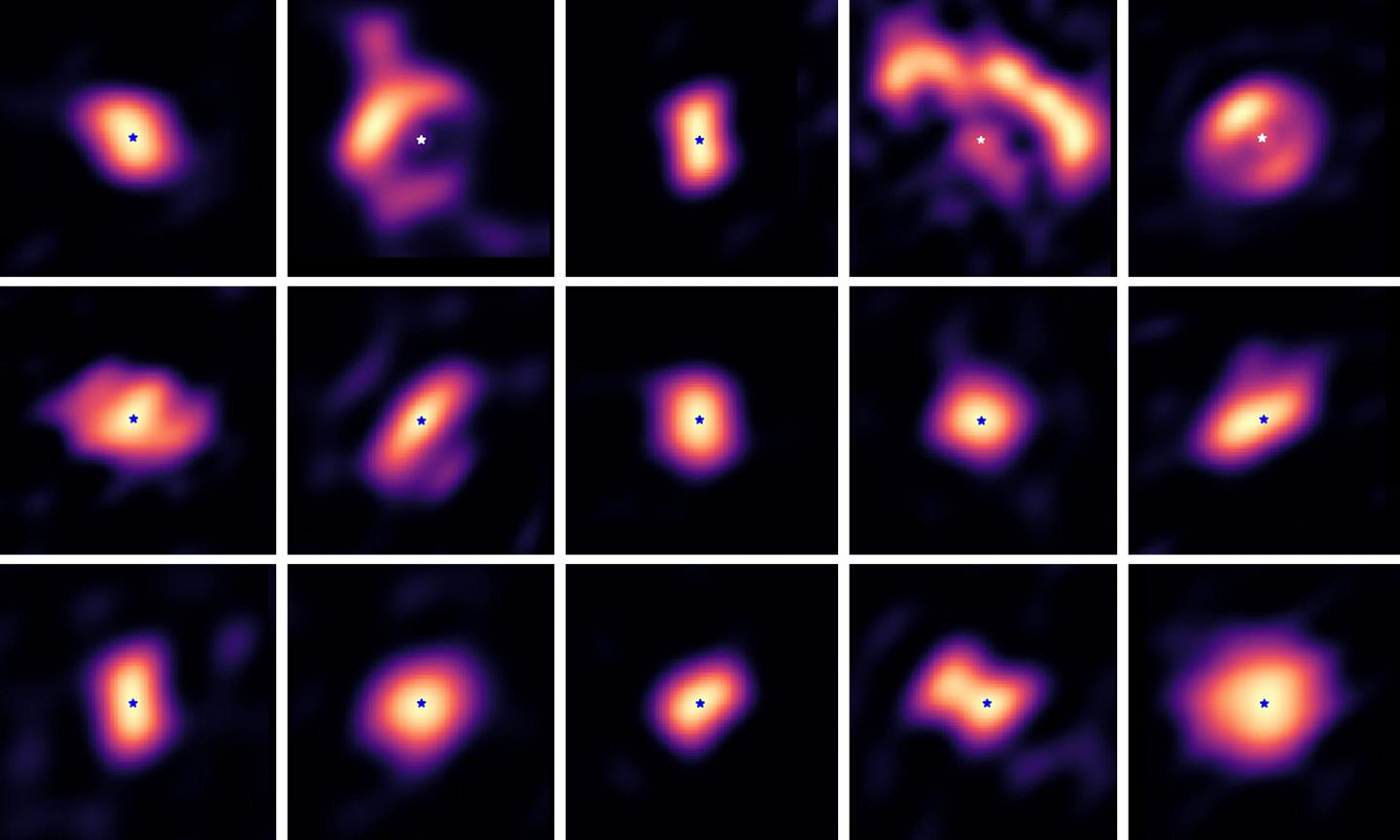
Credit: Jacques Kluska et al.
An international team of astronomers has captured fifteen images of the inner rims of planet-forming disks located hundreds of light years away. These disks of dust and gas, similar in shape to a music record, form around young stars. The images shed new light on how planetary systems are formed. They were published in the journal Astronomy & Astrophysics.
To understand how planetary systems, including our own, take shape, you have to study their origins. Planet-forming or protoplanetary disks are formed in unison with the star they surround. The dust grains in the disks can grow into larger bodies, which eventually leads to the formation of planets. Rocky planets like the Earth are believed to form in the inner regions of protoplanetary disks, less than five astronomical units (five times the Earth-Sun distance) from the star around which the disk has formed.
Before this new study, several pictures of these disks had been taken with the largest single-mirror telescopes, but these cannot capture their finest details. “In these pictures, the regions close to the star, where rocky planets form, are covered by only few pixels,” says lead author Jacques Kluska from KU Leuven in Belgium. “We needed to visualize these details to be able to identify patterns that might betray planet formation and to characterize the properties of the disks.” This required a completely different observation technique. “I’m thrilled that we now for the first time have fifteen of these images,” Kluska continued.
Image reconstruction
Kluska and his colleagues created the images at the European Southern Observatory (ESO) in Chile by using a technique called infrared interferometry. Using ESO’s PIONIER instrument, they combined the light collected by four telescopes at the Very Large Telescope observatory to capture the disks in detail. However, this technique does not deliver an image of the observed source. The details of the disks needed to be recovered with a mathematical reconstruction technique. This technique is similar to how the first image of a black hole was captured. “We had to remove the light of the star, as it hindered the level of detail we could see in the disks”, Kluska explains.
“Distinguishing details at the scale of the orbits of rocky planets like Earth or Jupiter (as you can see in the images) — a fraction of the Earth-Sun distance — is equivalent to being able to see a human on the Moon, or to distinguish a hair at a 10 km distance,” notes Jean-Philippe Berger of the Université Grenoble-Alpes, who as principal investigator was in charge of the work with the PIONIER instrument. “Infrared interferometry is becoming routinely used to uncover the tiniest details of astronomical objects. Combining this technique with advanced mathematics finally allows us to turn the results of these observations into images.”
Irregularities
Some findings immediately stand out from the images. “You can see that some spots are brighter or less bright, like in the images above: this hints at processes that can lead to planet formation. For example: there could be instabilities in the disk that can lead to vortices where the disk accumulates grains of space dust that can grow and evolve into a planet.”
The team will do additional research to identify what might lie behind these irregularities. Kluska will also do new observations to get even more detail and to directly witness planet formation in the regions within the disks that lie close to the star. Additionally, Kluska is heading a team that has started to study 11 disks around other, older types of stars also surrounded by disks of dust, since it is thought these might also sprout planets.
###
Media Contact
Jacques Kluska
[email protected]
Related Journal Article
http://dx.