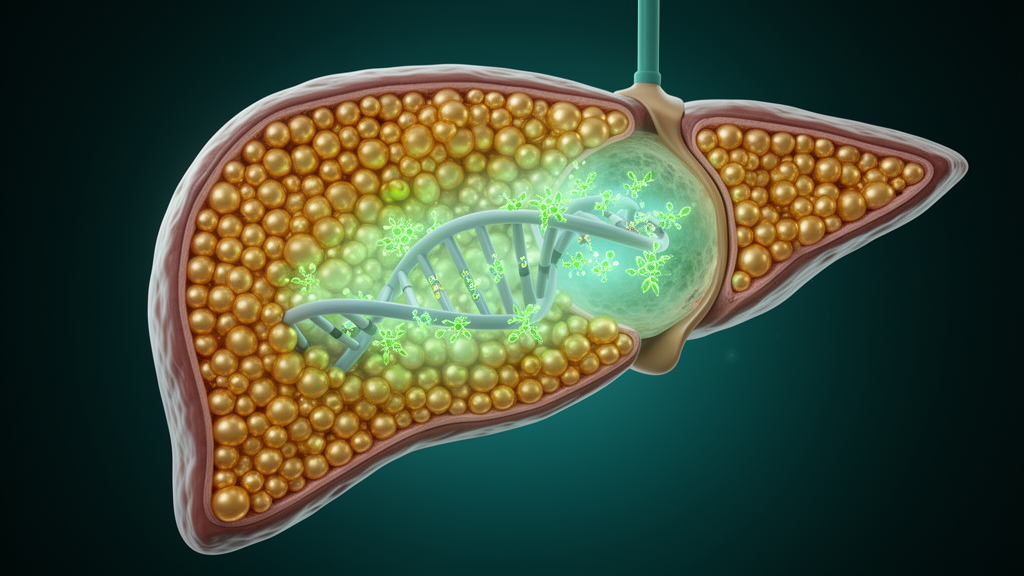
Astragaloside IV, a saponin drawn from the root of Astragalus membranaceus, has emerged in a new preclinical study as an unexpected kind of metabolic regulator: one that does not simply block a fat-making enzyme, but reaches into the chromatin of liver cells and switches off the epigenetic machinery that keeps fat synthesis running. In a paper published in the journal Chinese Medicine, researchers report that the compound eased hepatic steatosis in high-fat-diet-fed mice and in lipid-overloaded human liver cells by transcriptionally downregulating the histone acetyltransferase GCN5, thereby collapsing the epigenetic support that the lipid-synthesis transcription factor SREBP-1c depends on.
The disease in question, metabolic dysfunction-associated steatotic liver disease, or MASLD, is defined by fat accumulation in the liver in the absence of excessive alcohol consumption and travels with obesity, insulin resistance and type 2 diabetes. By the authors’ account it affects roughly a quarter of the world’s population, and its prevalence is rising fastest in Asia as urbanization and dietary change reshape metabolic risk. No pharmacological therapy is currently approved for MASLD itself; vitamin E and pioglitazone offer limited efficacy with safety concerns, lifestyle intervention remains the cornerstone but suffers from poor long-term adherence, and only in 2024 did the FDA approve resmetirom, a thyroid hormone receptor-beta agonist, specifically for MASH with liver fibrosis. The field, the authors argue, urgently needs agents aimed at the disease’s core mechanisms rather than its symptoms.
One such mechanism is de novo lipogenesis, the process by which hepatocytes synthesize fat from scratch. In MASLD, this pathway can account for up to 30 percent of hepatic triglycerides, driven by elevated expression of enzymes such as acetyl-CoA carboxylase and fatty acid synthase. Insulin resistance and hyperinsulinemia amplify the process by activating lipogenic transcription factors, and the resulting flood of free fatty acids promotes lipotoxicity, mitochondrial dysfunction and oxidative stress. SREBP-1c sits near the top of this program, activating ACC, FAS and SCD1, and is itself hyperactivated in MASLD through insulin signaling and the liver X receptor alpha pathway. Clinical studies have found elevated precursor and mature forms of SREBP-1c in MASLD patients, correlating with disease severity, and genetic or pharmacological inhibition of the factor reduces hepatic steatosis in preclinical models.
The new work adds a chromatin-level layer to that picture. GCN5, encoded by the KAT2A gene, is a histone acetyltransferase that decorates histone H3 at lysines 9 and 14, loosening chromatin so that transcription factors such as LXRalpha can reach the SREBP-1c promoter. Prior work cited by the team had shown that GCN5 enhances LXRalpha-mediated SREBP-1c transcription and that its pharmacological inhibition ameliorates hepatic steatosis, marking GCN5 as a potential epigenetic checkpoint in lipid metabolism. What remained underexplored was how the GCN5, LXRalpha and SREBP-1c nodes interact in MASLD, and whether a natural product could intervene at that junction.
To test the compound, the researchers fed male C57BL/6J mice a high-fat diet of 60 percent fat for ten weeks and gave daily oral gavage of AS-IV at 30 or 60 milligrams per kilogram, suspended in carboxymethylcellulose, alongside ob/ob mice and littermate controls in other experiments. Body weight and food intake did not differ between treated and untreated animals, but AS-IV significantly lowered the liver-weight-to-body-weight ratio, improved serum triglycerides, total cholesterol and the LDL-c/HDL-c ratio, reduced lipid droplets on H&E and oil red O staining of liver sections, and cut hepatic triglyceride and total cholesterol content. Serum ALT and AST, markers of liver injury, also fell. At the high dose, the authors note, AS-IV’s effects on diet-induced metabolic disorders were comparable to lovastatin.
The cellular experiments pointed to a specific mechanism. In HL-7702 human liver cells exposed to palmitic and oleic acids with AS-IV at 25 or 50 micromolar for 16 hours, Nile Red and BODIPY staining showed fewer and smaller lipid droplets, and cellular triglyceride and cholesterol levels dropped, without significant cytotoxicity. Notably, AS-IV did not change fatty acid uptake or beta-oxidation, nor the expression of genes involved in lipid transport or oxidation. What it did reduce was de novo lipogenesis itself, measured by radiolabeled acetate incorporation, along with the precursor and mature protein forms of SREBP1 and the expression of its target genes SREBF1, ACC, FASN, SCD1, SCD2 and FADS2, and SRE-dependent transcriptional activity.
Rescue experiments then established that SREBP-1c is required for the drug’s effect. When the researchers overexpressed either the precursor or the mature form of SREBP-1c in hepatocytes, the overexpression reversed AS-IV’s suppression of cellular triglyceride and cholesterol, restored lipogenic gene expression, and brought back lipid droplet accumulation. Conversely, when SREBP-1c was knocked down, AS-IV’s inhibitory effects on triglyceride and cholesterol content disappeared entirely, and lipid droplets stayed low regardless of treatment. Together these manipulations position SREBP-1c as the pivotal node through which AS-IV acts.
The epigenetic story centered on GCN5. In livers of high-fat-diet-fed mice, GCN5 protein rose 3.2-fold and mRNA 4.4-fold compared with chow-fed controls; AS-IV treatment cut protein and mRNA expression by 58 and 65 percent respectively. In lipid-overloaded HL-7702 cells, 25 micromolar AS-IV reduced GCN5 protein by 52 percent and mRNA by 60 percent. When the team overexpressed wild-type GCN5, AS-IV lost its ability to lower lipid droplets, triglycerides, cholesterol, SREBP-1c protein or downstream lipogenic genes. But when they used an acetyltransferase-deficient GCN5 mutant, E575Q, AS-IV retained full efficacy, and in KAT2A-knockout cells generated with CRISPR-Cas9, AS-IV no longer suppressed SREBP-1c or lipid accumulation at all. The effect, in other words, depends on GCN5’s acetyltransferase activity.
Chromatin immunoprecipitation tied the mechanism to the SREBF1c promoter. GCN5 and H3K9ac were recruited to the promoter in HL-7702 cells and in MASLD liver tissue, and AS-IV significantly inhibited that recruitment. Reporter assays showed that GCN5 enhanced LXRalpha’s transcriptional activity on synthetic and native LXRE-containing promoters in a ligand-dependent manner with T0901317 or GW3965, and that mutation of the LXRE abolished this coactivation. Co-immunoprecipitation confirmed a physical interaction between GCN5 and LXRalpha, and, under normalized GCN5 input conditions, AS-IV still markedly reduced the co-immunoprecipitated LXRalpha, indicating a direct disruption of the complex independent of GCN5 protein abundance. AS-IV also eliminated agonist-induced recruitment of LXRalpha and H3K9ac to the promoter and suppressed the agonist-driven rise in SREBF1c transcription, effects that were largely abrogated in KAT2A-knockout cells.
Importantly, the authors stress that GCN5 is not a direct binding target of AS-IV; the compound downregulates GCN5 at the transcriptional level, making GCN5 a downstream effector necessary for the anti-lipogenic effect rather than an enzyme directly inhibited. The team also points to a parallel study from their group examining 117 human MASLD liver tissues and 11 healthy controls, in which GCN5 expression and H3K9ac/H3K14ac levels were elevated and correlated with disease severity, though the present study did not re-measure these markers in human samples. The limitations are explicit: the work rests on rodent and cell models, lacks pharmacokinetic and chronic toxicity data for AS-IV, and leaves open questions about pathway selectivity, the full substrate profile of GCN5, and the long-term consequences of GCN5 inhibition in extrahepatic tissues. Human validation in primary hepatocytes and clinical cohorts, the authors conclude, is the necessary next step before this epigenetic axis can be considered a therapeutic strategy rather than a mechanistic insight.
Subject of Research: Epigenetic regulation of hepatic de novo lipogenesis by astragaloside IV in MASLD models
Article Title: Astragaloside IV improves MASLD via GCN5-LXRα/SREBP1c signaling pathway-mediated hepatic de novo lipogenesis
Article References: Liang, H.-M., Xu, Y.-Y., Miao, K., Xiao, H.-T., Wang, Y.-D., Jin, J., Wu, H., Chen, B.-Y., Xu, L.-J., Zhu, J.-P., Lai, L.-N., & Zheng, Z.-G. (2026). Astragaloside IV improves MASLD via GCN5-LXRα/SREBP1c signaling pathway-mediated hepatic de novo lipogenesis. Chinese Medicine, 21(1), Article 223. https://doi.org/10.1186/s13020-026-01491-0
Image Credits: AI Generated
DOI: 10.1186/s13020-026-01491-0
Keywords: astragaloside IV, MASLD, hepatic steatosis, GCN5, SREBP-1c, LXRalpha, de novo lipogenesis, histone acetylation, H3K9ac, Astragalus membranaceus, epigenetics, preclinical study
News Source: Ophelia Keating. (October 28, 2026). Astragaloside IV Eases Fatty Liver by Epigenetically Silencing a Lipogenesis Switch. Scienmag.