UC Davis Health researchers lead the way toward sex-specific hypertension treatment
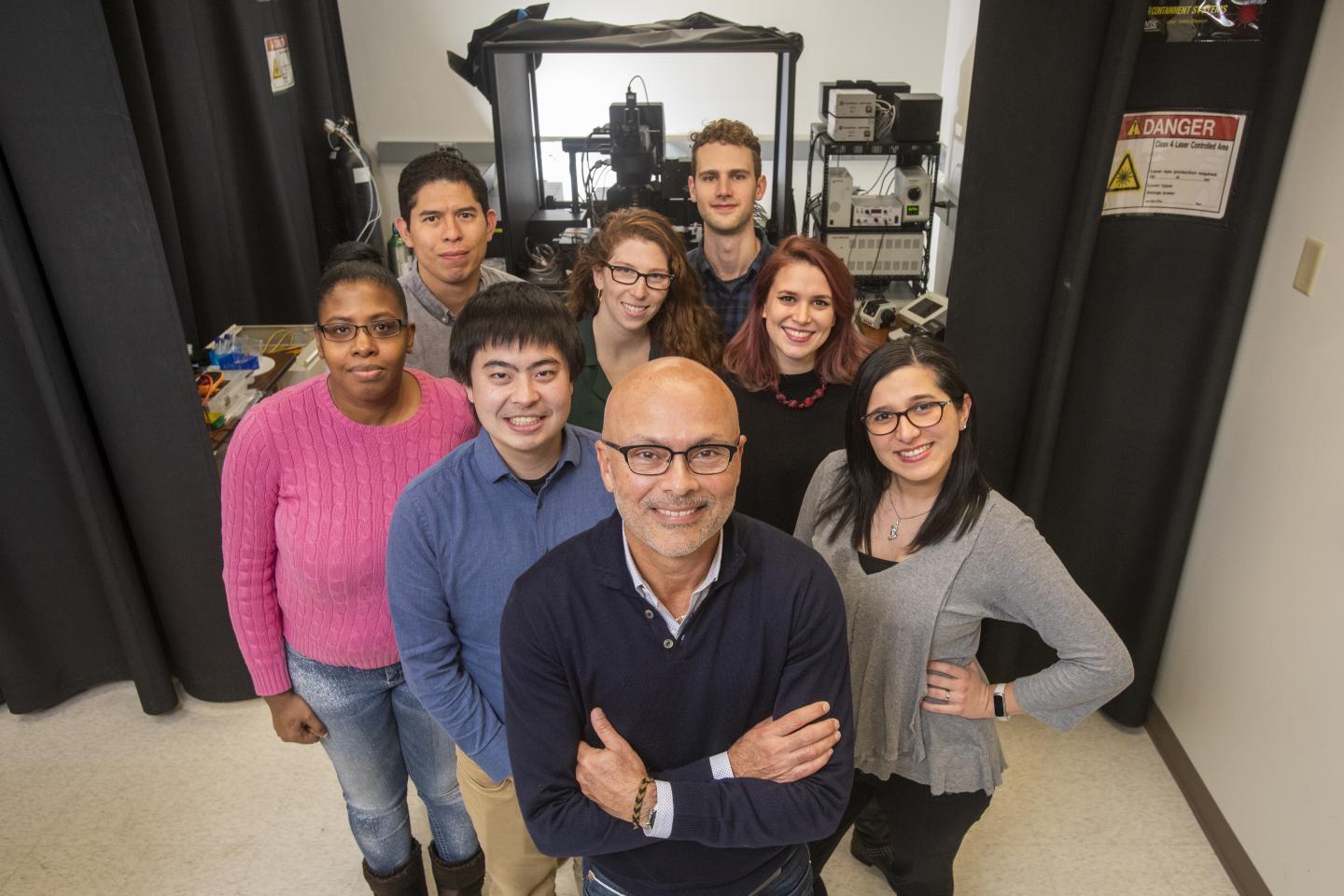
Credit: Copyright UC Regents/UC Davis Health
A protein known to expand blood vessels — key to controlling conditions like high blood pressure — actually has different functions in males and females, new UC Davis Health research shows.
Conducted using arterial cells from mice, the study is the first to identify sex-based distinctions in how the protein –Kv2.1 — works.
Kv2.1 is generally known to form calcium channels that dilate blood vessels. In arterial cells from female mice, however, it contracted blood vessels.
The research was led by Luis Fernando Santana, professor and chair of physiology and membrane biology, and graduate student Samantha O’Dwyer. It is published in the Proceedings of the National Academy of Sciences.
“We were shocked at the difference and the strength of that difference,” Santana said. “We think we’ve found the physiological explanation for what some of our clinical colleagues are seeing in patients ? some high blood pressure medications tend to work better for men, while others work better for women.”
Santana and his team study calcium channels, their effects on heart muscle cells and how to alter that process to improve treatments for cardiovascular disease. They are especially interested in finding new treatments for hypertension, because it affects 45% of adults in the U.S. and is linked with serious conditions such as stroke, heart failure and aneurysm.
The current study focused on how Kv2.1 changes calcium channel organization and function. The investigators found that Kv2.1 promotes tight clustering of calcium channels. Kv2.1 expression is higher in cells from female mice, leading to larger clusters. This caused higher calcium levels in arterial cells and vasoconstriction. In arterial cells from male mice, Kv2.1 expression was not as high and calcium channel clusters were much smaller, causing vasodilation.
“This difference can only be attributed to the sex of the research mice,” Santana said.
The next step, Santana said, is to determine what causes the different roles of Kv2.1. He plans to investigate the potential that sex hormones regulate the protein in arterial cells. His ultimate goal is tailored treatment strategies for hypertension for men and women.
“Until recently, the research community only used male mice to investigate heart disease,” Santana said. “Our study proves what a major oversight that has been.”
###
Other researchers on the study were Stephanie Palacio, Collin Matsumoto, Laura Guarina, Nicholas Klug, Sendoa Tajada, Barbara Rosati, David McKinnon and James Trimmer, all of UC Davis. Rosati also is affiliated with the State University of New York.
The study was supported by grants from the National Institutes of Health (grant numbers 5R01HL085686, 1R01HL144071, 1OT2OD026580 and T32HL086350) and the American Heart Association.
“Kv2.1 Channels Play Opposing Roles in Regulating Membrane Potential, Ca2+ Channel Function, and Myogenic Tone in Arterial Smooth Muscle” is available online.
More information about UC Davis Health, including its Department of Physiology and Membrane Biology,” is available at health.ucdavis.edu.
Media Contact
Karen Finney
[email protected]
Original Source
https:/
Related Journal Article
http://dx.