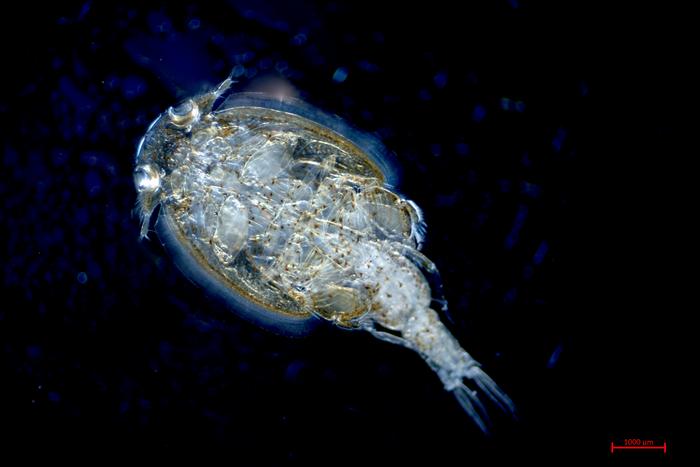
More than 30 previously unknown RNA viruses in sea lice have been identified by University of British Columbia (UBC) researchers. Sea lice are parasitic copepods (small crustaceans) found in many fresh and saltwater habitats, and have been implicated in the decline of wild salmon populations. The research sheds greater light on the types of viruses being carried by sea lice, and how the viruses and host are interacting.
“We found many more types of viruses than are known in sea lice or their distant relatives; the lice are mounting an immune defense response to many of these viruses indicating that they are replicating,” says UBC marine microbiologist Dr. Curtis Suttle, senior author of the paper published this week in PLOS Pathogens.
As part of his PhD research with Dr. Suttle’s group, co-author Dr. Tianyi Chang analyzed RNA from three species of sea lice (Lepeophtheirus salmonis, Caligus clemensi and Caligus rogercresseyi) that have a large ecological and economic impact on fish and fisheries. The data were obtained from sea lice removed from out-migrating juvenile salmon collected in the waters surrounding the Discovery Islands and Broughton Archipelago on the northeastern side of Vancouver Island, as well as from farmed salmon in Chile.
Sea lice are a big problem for the fish aquaculture industry worldwide due to their proliferation among dense populations of farmed fish. Chemical treatments have failed to solve the problem.
Viruses tend to kill species that flourish, so populations that might otherwise take over an ecosystem are often controlled by viruses. By infecting and weakening their hosts, viruses maintain balance in nature.
“In a natural system, viruses may prevent explosions in sea-lice populations by rapidly replicating when densities become high, and so might form a natural biological control agent for a parasite of salmon,” says Dr. Suttle.
The viruses encompassed all the major groups of RNA viruses, with many likely representing new families and genera. Surprisingly, the closest relatives of some of the newly discovered viruses are only known to infect plants or fungi. This implies that over evolutionary time, viruses jumped between fungi and arthropods, a group of animals that includes crustaceans such as sea lice and crabs, as well as spiders and insects, the researchers said.
Credit: Hakai Institute
More than 30 previously unknown RNA viruses in sea lice have been identified by University of British Columbia (UBC) researchers. Sea lice are parasitic copepods (small crustaceans) found in many fresh and saltwater habitats, and have been implicated in the decline of wild salmon populations. The research sheds greater light on the types of viruses being carried by sea lice, and how the viruses and host are interacting.
“We found many more types of viruses than are known in sea lice or their distant relatives; the lice are mounting an immune defense response to many of these viruses indicating that they are replicating,” says UBC marine microbiologist Dr. Curtis Suttle, senior author of the paper published this week in PLOS Pathogens.
As part of his PhD research with Dr. Suttle’s group, co-author Dr. Tianyi Chang analyzed RNA from three species of sea lice (Lepeophtheirus salmonis, Caligus clemensi and Caligus rogercresseyi) that have a large ecological and economic impact on fish and fisheries. The data were obtained from sea lice removed from out-migrating juvenile salmon collected in the waters surrounding the Discovery Islands and Broughton Archipelago on the northeastern side of Vancouver Island, as well as from farmed salmon in Chile.
Sea lice are a big problem for the fish aquaculture industry worldwide due to their proliferation among dense populations of farmed fish. Chemical treatments have failed to solve the problem.
Viruses tend to kill species that flourish, so populations that might otherwise take over an ecosystem are often controlled by viruses. By infecting and weakening their hosts, viruses maintain balance in nature.
“In a natural system, viruses may prevent explosions in sea-lice populations by rapidly replicating when densities become high, and so might form a natural biological control agent for a parasite of salmon,” says Dr. Suttle.
The viruses encompassed all the major groups of RNA viruses, with many likely representing new families and genera. Surprisingly, the closest relatives of some of the newly discovered viruses are only known to infect plants or fungi. This implies that over evolutionary time, viruses jumped between fungi and arthropods, a group of animals that includes crustaceans such as sea lice and crabs, as well as spiders and insects, the researchers said.
Journal
PLoS Pathogens
DOI
10.1371/journal.ppat.1011386
Method of Research
Observational study
Subject of Research
Animals
Article Title
Divergent RNA viruses infecting sea lice, major ectoparasites of fish
Article Publication Date
22-Jun-2023