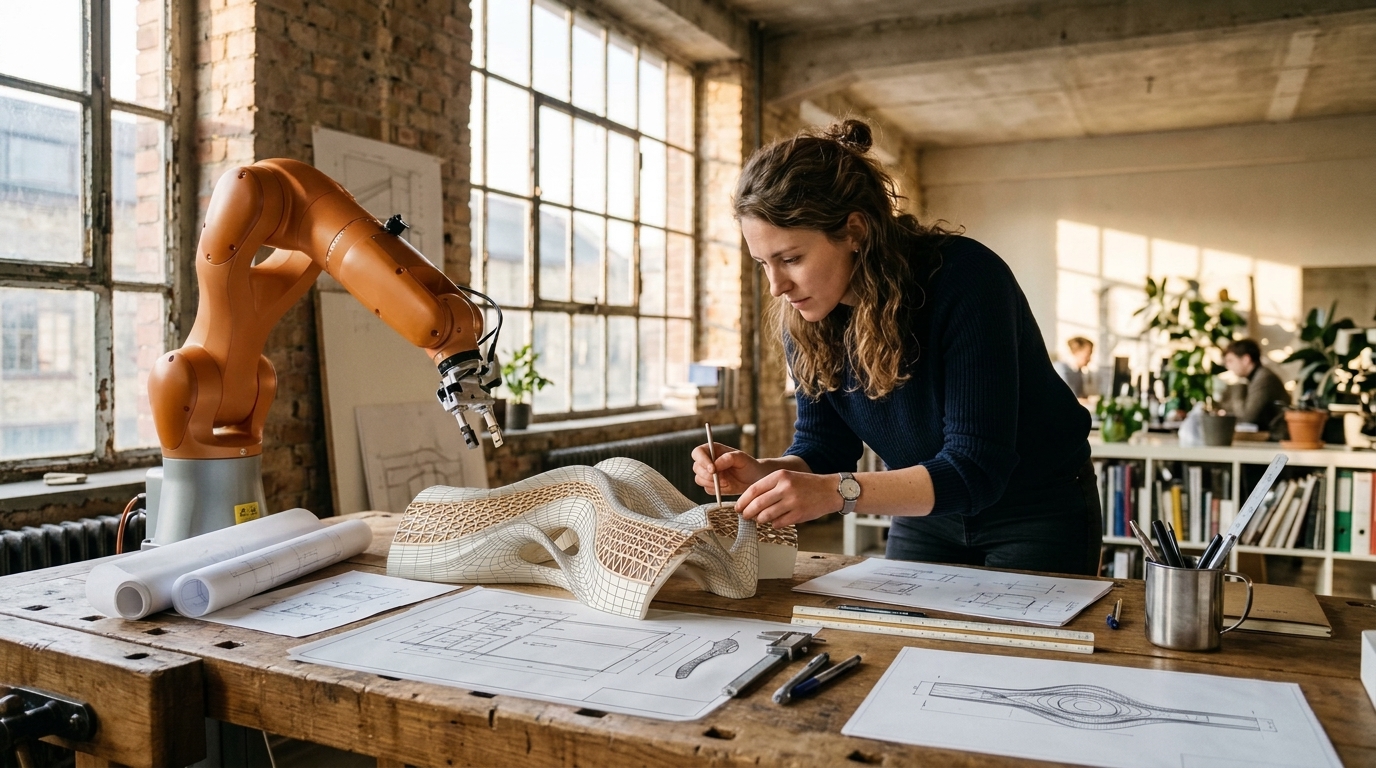
Architecture is entering a phase in which machines no longer simply follow instructions but participate in decisions. A new editorial in the journal Architectural Intelligence argues that the discipline is moving beyond treating technology as a passive instrument and toward what the authors call symbiotic intelligence: a partnership in which human and machine agency are deliberately entangled in the design and construction of the built environment.
The editorial, written by Hua Chai and Philip F. Yuan and published on 25 March 2026, frames this shift against a history that stretches back to 1960. That year, the American psychologist and computer scientist J.C.R. Licklider proposed the concept of Man-Computer Symbiosis, drawing a parallel between the mutual dependencies seen in biological ecosystems and the potential partnership between humans and computers. According to the authors, decades later, as technological systems reach unprecedented levels of autonomy and intelligence, that vision has evolved from a theoretical ideal into a critical imperative, compelling a shift beyond simple interaction toward a profound symbiotic partnership.
The philosophical grounding comes from Dutch philosopher Peter-Paul Verbeek, whose 2008 work the editorial cites. Verbeek describes the need to move beyond traditional mediated intentionality, the classic paradigm in which technology serves merely as a bridge between the user and the world. In his view, that model is insufficient to capture modern conditions. Instead, the relationship between people and machines is manifesting diverse and complex attributes, increasingly characterized by hybrid and composite intentionality, where the agency of the human and the machine are inextricably entangled.
Applied to architecture, this fusion of intentionality is reshaping both the production paradigm and the epistemological landscape of the discipline. The editorial points to advanced tools ranging from machine learning and collaborative robotics to Brain-Computer Interfaces. These technologies, the authors argue, do more than augment efficiency; they actively reconfigure the decision-making hierarchy in design and fabrication. Machines are no longer silent tools but active participants in the creative process. The generative autonomy of artificial intelligence poses a provocative challenge to the architect’s traditional claim to sole authorship, yet the authors present this as an opportunity rather than a threat.
The urgency, in their framing, comes from planetary crises. To address escalating complexities that include climate emergencies, pandemic resilience and resource depletion, the architectural profession should embrace this complex interdependence. By evolving into a more intricate symbiotic state, architects and technologies can leverage their collective intelligence to generate the innovative, systemic solutions necessary for a sustainable future, the editorial argues.
The argument is not purely theoretical. The editorial introduces a special issue compiled from selected papers of CDRF 2024, the 6th Conference on Computational Design and Robotic Fabrication, held under the theme of symbiotic intelligence. The gathered studies show the concept operating at multiple scales, from the hands of a bricklayer to the hydrodynamics of an artificial reef.
At the physical interface between builder and material, Zhang and Ruttico investigated in 2025 how augmented reality can facilitate complex masonry tasks. Their research on interactive bricklaying establishes a collaborative workflow in which human dexterity is augmented by digital spatial intelligence. In a related vein, Han and colleagues proposed in 2025 an immersive augmented reality framework for self-building with prefabricated timber, giving users real-time digital guidance that bridges the cognitive gap between complex assembly logic and manual execution.
At the scale of inhabitation, Tang and colleagues examined in 2025 the interplay between crowd dynamics and the physical environment through location-based sensing, using data-driven methods to decipher behavioral patterns within educational campuses and inform more adaptive spatial planning. Zou and colleagues took a different route, using a serious game to investigate passenger wayfinding behavior and showing how immersive technologies can serve as a cost-effective medium to anticipate human responses and optimize the spatial organization of complex public infrastructure. Ng and colleagues added the social dimension, investigating how virtual reality can bridge generational divides in the co-design of urban spaces.
Symbiosis also extends to the integration of artificial systems with the natural world. Jin and colleagues addressed in 2025 the synthesis of digital fabrication and ecological infrastructure by integrating 3D-printed clay formwork into thin-vaulted green roofs, exemplifying how robotic processes can facilitate a sustainable dialogue between structural geometry and living plants. Bao and colleagues presented in 2026 a generative workflow for artificial reefs that couples computational fluid dynamics with topological optimization, demonstrating how the iterative interplay between fluid forces and material distribution can yield bio-inspired geometries that enhance hydrodynamic stability and foster complex underwater habitats.
Collectively, the editorial concludes, these studies reveal a discipline in transformation, one in which digital systems act as active partners in creation: extending physical capabilities through robotics, augmenting cognition through immersive interfaces, and deepening social engagement through data-driven insights. The most profound architectural innovations, the authors suggest, will emerge not from automation alone but from the seamless and empathetic entanglement of human intent and machine intelligence.
Subject of Research: Human-technology co-agency and symbiotic intelligence in architectural design, fabrication and the built environment
Article Title: Symbiotic intelligence: human-technology co-agency in the built environment
Article References: Chai, H., & Yuan, P. F. (2026). Symbiotic intelligence: human-technology co-agency in the built environment. Architectural Intelligence, 5(1), Article 7. https://doi.org/10.1007/s44223-026-00116-8
Image Credits: AI Generated
DOI: 10.1007/s44223-026-00116-8
Keywords: symbiotic intelligence, human-technology co-agency, architecture, augmented reality, robotic fabrication, machine learning, brain-computer interfaces, artificial reefs, green roofs, virtual reality, spatial planning, computational design
News Source: Denise Maddox. (November 5, 2026). Architects and machines are becoming creative partners, not rivals. Scienmag.