• HOME
  • NEWS
  • EXPLORE
    • CAREER
      • Companies
      • Jobs
    • EVENTS
    • iGEM
      • News
      • Team
    • PHOTOS
    • VIDEO
    • WIKI
  • BLOG
  • COMMUNITY
    • FACEBOOK
    • INSTAGRAM
    • TWITTER
Saturday, February 7, 2026
BIOENGINEER.ORG
No Result
View All Result
  • Login
  • HOME
  • NEWS
  • EXPLORE
    • CAREER
      • Companies
      • Jobs
        • Lecturer
        • PhD Studentship
        • Postdoc
        • Research Assistant
    • EVENTS
    • iGEM
      • News
      • Team
    • PHOTOS
    • VIDEO
    • WIKI
  • BLOG
  • COMMUNITY
    • FACEBOOK
    • INSTAGRAM
    • TWITTER
  • HOME
  • NEWS
  • EXPLORE
    • CAREER
      • Companies
      • Jobs
        • Lecturer
        • PhD Studentship
        • Postdoc
        • Research Assistant
    • EVENTS
    • iGEM
      • News
      • Team
    • PHOTOS
    • VIDEO
    • WIKI
  • BLOG
  • COMMUNITY
    • FACEBOOK
    • INSTAGRAM
    • TWITTER
No Result
View All Result
Bioengineer.org
No Result
View All Result
Home NEWS Science News

Antiferromagnetic material’s giant stride towards application

Bioengineer by Bioengineer
November 12, 2020
in Science News
Reading Time: 2 mins read
0
IMAGE
Share on FacebookShare on TwitterShare on LinkedinShare on RedditShare on Telegram

IMAGE

Credit: Samik DuttaGupta and Shunsuke Fukami

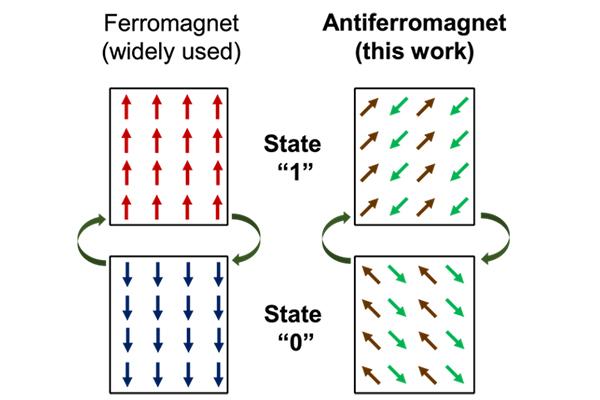
The quest for high throughput intelligent computing paradigms – for big data and artificial intelligence – and the ever-increasing volume of digital information has led to an intensified demand for high-speed and low-power consuming next-generation electronic devices. The “forgotten” world of antiferromagnets (AFM), a class of magnetic materials, offers promise in future electronic device development and complements present-day ferromagnet-based spintronic technologies (Fig. 1).

Formidable challenges for AFM-based functional spintronic device development are high-speed electrical manipulation (recording), detection (retrieval), and ensuring the stability of the recorded information – all in a semiconductor industry-friendly material system.

Researchers at Tohoku University, University of New South Wales (Australia), ETH Zürich (Switzerland), and Diamond Light Source (United Kingdom) successfully demonstrated current-induced switching in a polycrystalline metallic antiferromagnetic heterostructure with high thermal stability. The established findings show potential for information storage and processing technologies.

The research group used a Mn-based metallic AFM (PtMn)/heavy metal (HM) heterostructure – attractive because of its significant antiferromagnetic anisotropy and its compatibility with PtMn Silicon-based electronics (Fig. 2(a)). Electrical recording of resistance states (1 or 0) was obtained through the spin-orbit interaction of the HM layer; a charge current in the adjacent HM resulted in spin-orbit torques acting on the AFM, leading to a change in the resistance level down to a microsecond regime (Fig. 2(b)).

“Interestingly, the switching degree is controllable by the strength of the current in the HM layer and shows long-term data retention capabilities,” said Samik DuttaGupta, corresponding author of the study (Fig. 2(c)). “The experimental results from electrical measurements were supplemented by a magnetic X-ray imaging, helping to clarify the reversible nature of switching dynamics localized within nm-sized AFM domains.” (Fig. 2(d),(e)).

The results are the first demonstration of current-induced switching of an industry-compatible AFM down to the microsecond regime within the field of metallic antiferromagnetic spintronics. These findings are expected to initiate new avenues for research and encourage further investigations towards the realization of functional devices using metallic AFMs for information storage and processing technologies.

###

Media Contact
Samik DuttaGupta
[email protected]

Original Source

https://www.tohoku.ac.jp/en/press/antiferromagnets_giant_stride_towards_application.html

Related Journal Article

http://dx.doi.org/10.1038/s41467-020-19511-4

Tags: Technology/Engineering/Computer Science
Share12Tweet8Share2ShareShareShare2

Related Posts

Decoding Prostate Cancer Origins via snFLARE-seq, mxFRIZNGRND

February 7, 2026

Digital Health Perspectives from Baltic Sea Experts

February 7, 2026

Florida Cane Toad: Complex Spread and Selective Evolution

February 7, 2026

Exploring Decision-Making in Dementia Caregivers’ Mobility

February 7, 2026
Please login to join discussion

POPULAR NEWS

  • Robotic Ureteral Reconstruction: A Novel Approach

    Robotic Ureteral Reconstruction: A Novel Approach

    82 shares
    Share 33 Tweet 21
  • Digital Privacy: Health Data Control in Incarceration

    63 shares
    Share 25 Tweet 16
  • Study Reveals Lipid Accumulation in ME/CFS Cells

    57 shares
    Share 23 Tweet 14
  • Breakthrough in RNA Research Accelerates Medical Innovations Timeline

    53 shares
    Share 21 Tweet 13

About

We bring you the latest biotechnology news from best research centers and universities around the world. Check our website.

Follow us

Recent News

Decoding Prostate Cancer Origins via snFLARE-seq, mxFRIZNGRND

Digital Health Perspectives from Baltic Sea Experts

Florida Cane Toad: Complex Spread and Selective Evolution

Subscribe to Blog via Email

Enter your email address to subscribe to this blog and receive notifications of new posts by email.

Join 73 other subscribers
  • Contact Us

Bioengineer.org © Copyright 2023 All Rights Reserved.

Welcome Back!

Login to your account below

Forgotten Password?

Retrieve your password

Please enter your username or email address to reset your password.

Log In
No Result
View All Result
  • Homepages
    • Home Page 1
    • Home Page 2
  • News
  • National
  • Business
  • Health
  • Lifestyle
  • Science

Bioengineer.org © Copyright 2023 All Rights Reserved.