• HOME
  • NEWS
  • EXPLORE
    • CAREER
      • Companies
      • Jobs
    • EVENTS
    • iGEM
      • News
      • Team
    • PHOTOS
    • VIDEO
    • WIKI
  • BLOG
  • COMMUNITY
    • FACEBOOK
    • INSTAGRAM
    • TWITTER
Wednesday, May 13, 2026
BIOENGINEER.ORG
No Result
View All Result
  • Login
  • HOME
  • NEWS
  • EXPLORE
    • CAREER
      • Companies
      • Jobs
        • Lecturer
        • PhD Studentship
        • Postdoc
        • Research Assistant
    • EVENTS
    • iGEM
      • News
      • Team
    • PHOTOS
    • VIDEO
    • WIKI
  • BLOG
  • COMMUNITY
    • FACEBOOK
    • INSTAGRAM
    • TWITTER
  • HOME
  • NEWS
  • EXPLORE
    • CAREER
      • Companies
      • Jobs
        • Lecturer
        • PhD Studentship
        • Postdoc
        • Research Assistant
    • EVENTS
    • iGEM
      • News
      • Team
    • PHOTOS
    • VIDEO
    • WIKI
  • BLOG
  • COMMUNITY
    • FACEBOOK
    • INSTAGRAM
    • TWITTER
No Result
View All Result
Bioengineer.org
No Result
View All Result
Home NEWS Science News Cancer

Anticancer drug candidate inhibits lethal aggregation of mutant tumor suppressor protein

Bioengineer by Bioengineer
January 15, 2019
in Cancer
Reading Time: 2 mins read
0
IMAGE
Share on FacebookShare on TwitterShare on LinkedinShare on RedditShare on Telegram

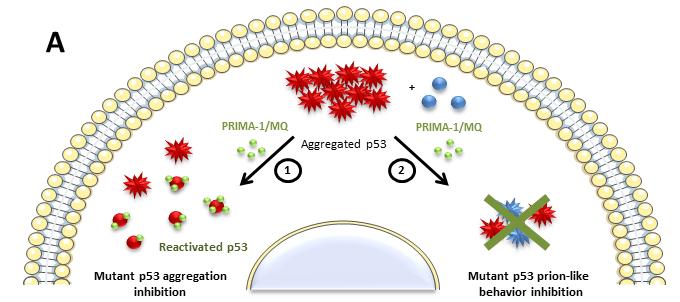
Brazilian researchers are the first to demonstrate the action of PRIMA-1 against amyloid aggregates of mutant p53 protein, structure found in more than half of malignant tumors
IMAGE

Credit: Luciana P. Rangel and Giulia D. S. Ferretti


Cancer is a multidisciplinary disease, with different mutations leading to different prognoses and treatment necessities. Among the most important mutation targets in cancers, affecting more than 50% of all cancer cases, is TP53. This gene gives rise to a protein that is a key regulator in the cell, called p53. When mutated, this protein forms amyloid structures that accumulate in the cell, causing cancers that tend to have a worse prognosis. A group of Brazilian researchers has shown that a synthetic compound, PRIMA-1, reverses mutant p53 aggregate accumulation. The novel study is the first to demonstrate the action of PRIMA-1 on the inhibition of aggregates of the mutant p53 protein. The results are published in the Journal of Biological Chemistry.

Mutations in the TP53 gene will kill hundreds of million people alive today if new therapies are not developed. Mutant p53 not only undergoes misfolding but also aggregation, similar to that observed with amyloids, playing a crucial role in the development of cancer through loss of function, negative dominance and gain of function. In earlier studies, researchers led by Jerson Silva at the Federal University of Rio de Janeiro (UFRJ) have pointed out that mutant p53 aggregation is an excellent target for development of therapeutic drugs against cancer.

Now, the same group shows that PRIMA-1 (p53 reactivation with induction of massive apoptosis-1) and its primary active metabolite, 2-methylene-3-quinuclidinone (MQ), can restore aggregated mutant p53 to a native form. PRIMA-1 and MQ had been previously shown to convert unfolded p53 mutants to a native conformation that induces apoptosis and activates several p53 target genes. This study provides the first demonstration that PRIMA-1 can rescue amyloid-state p53 mutants, a strategy that could be further explored as a cancer treatment. Its derivative PRIMA-1MET is now in Phase II clinical trials and the Brazilian results may contribute to the development of a new anticancer drug. The research was conducted in vitro and in tumor cell lines of breast cancer and ovarian carcinoma.

“The findings are crucial in establishing the mutant p53 aggregation as a highly promising target for cancer therapy and we are working hard on this subject”, states Luciana P. Rangel, first author of the study, from the Faculty of Pharmacy of UFRJ and a member of the National Institute of Science and Technology of Structural Biology and Bioimaging (INBEB).

###

The paper entitled “p53 reactivation with induction of massive apoptosis-1 (PRIMA-1) inhibits amyloid aggregation of mutant p53 in cancer cells” is available online in the Journal of Biological Chemistry website, at http://www.jbc.org/content/early/2019/01/02/jbc.RA118.004671.abstract.

Media Contact
Jerson L. Silva
[email protected]
55-219-993-90502

Related Journal Article

http://dx.doi.org/10.1074/jbc.RA118.004671

Tags: BiochemistryBiologycancerCell BiologyMedicine/HealthMolecular Biology
Share12Tweet8Share2ShareShareShare2

Related Posts

UC Irvine Researchers Develop Wearable Sweat Sensor for Continuous Health Monitoring

May 13, 2026

OICR Launches Four New Studies Leveraging Existing Patient Samples and Data to Advance Cancer Research

May 13, 2026

Diabetes Impact on Quality of Life in Cancer Survivors

May 13, 2026

Evaluating the Real-World Efficacy and Safety of Coblopasvir Plus Sofosbuvir for Chronic Hepatitis C Treatment in Wenzhou, Eastern China

May 13, 2026
Please login to join discussion

POPULAR NEWS

  • Research Indicates Potential Connection Between Prenatal Medication Exposure and Elevated Autism Risk

    842 shares
    Share 337 Tweet 211
  • New Study Reveals Plants Can Detect the Sound of Rain

    729 shares
    Share 291 Tweet 182
  • Salmonella Haem Blocks Macrophages, Boosts Infection

    62 shares
    Share 25 Tweet 16
  • Breastmilk Balances E. coli and Beneficial Bacteria in Infant Gut Microbiomes

    57 shares
    Share 23 Tweet 14

About

We bring you the latest biotechnology news from best research centers and universities around the world. Check our website.

Follow us

Recent News

Researchers Develop High-Efficiency Hydrogen Separation Membranes Using Innovative ‘Mortar-and-Brick’ Design

Breakthrough in Treating Hereditary Epilepsy Achieved in Mouse Model

How Water Fleas Sense Their Predators: A Scientific Insight

Subscribe to Blog via Email

Enter your email address to subscribe to this blog and receive notifications of new posts by email.

Join 82 other subscribers
  • Contact Us

Bioengineer.org © Copyright 2023 All Rights Reserved.

Welcome Back!

Login to your account below

Forgotten Password?

Retrieve your password

Please enter your username or email address to reset your password.

Log In
No Result
View All Result
  • Homepages
    • Home Page 1
    • Home Page 2
  • News
  • National
  • Business
  • Health
  • Lifestyle
  • Science

Bioengineer.org © Copyright 2023 All Rights Reserved.