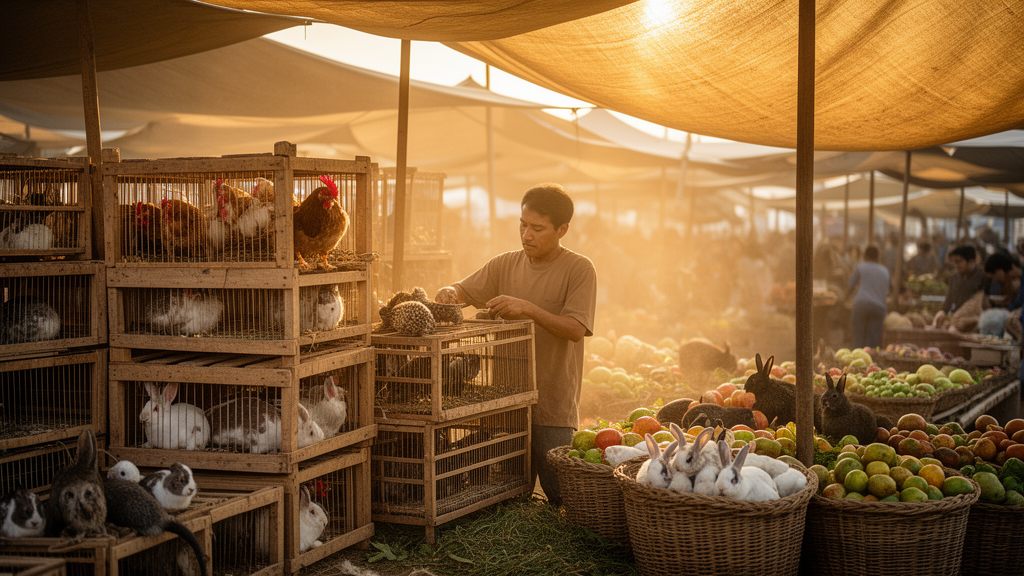
Animal markets may act as ecological hubs where viruses from wildlife, farmed animals and humans come into closer contact than in either wild or agricultural settings alone. A metatranscriptomic study conducted in Guangdong Province, China, compared viral communities across wild, farm and market-associated environments and found that market-linked samples carried noticeably richer viral diversity and a distinct virome structure, according to a paper published in the journal Microbiome.
The research team analysed 279 samples collected across the three ecological settings, with animal-derived samples spanning 15 host orders. From this material they identified 106 vertebrate-associated viral lineages represented by 259 viral strains. Among these, 19 putative novel viruses belonging to 13 putative viral lineages were detected, underscoring how much of the viral diversity at these interfaces remains undocumented.
The central comparison concerned viral diversity and community composition across settings. Both measures differed significantly among wild, farm and market-associated samples, and market-associated samples generally showed higher viral richness as well as virome structures that were distinct from those seen in wild and farm samples. Because sampling designs can distort such comparisons, the authors ran sensitivity analyses addressing pooled sampling, host composition and unequal sampling effort. The elevated richness in market-associated samples remained evident after these checks.
Beyond diversity, the study examined viral sharing and connectivity. Viruses were detected across wild, farm and market-associated settings, indicating sharing among the three environments, but market-associated host groups stood out for particularly extensive virus–host connectivity. Network analyses reinforced this pattern: host groups in market-associated settings showed higher degree and betweenness centrality, meaning they were connected to more viruses and occupied more influential positions in the virus–host association networks.
The researchers also assessed pathogenic relevance. In total, 38 viral sequences representing 13 viral lineages had documented disease associations in humans or other vertebrate hosts based on previously reported evidence. Importantly, the authors stress that zoonotic relevance varied among viral lineages and depended on lineage-, subtype- or genotype-specific evidence, so disease-associated viruses should be distinguished from those with demonstrated zoonotic potential rather than treated as a single risk category.
The authors are careful about what these cross-setting detections do and do not show. Shared detections of viruses across wild, farm and market settings do not establish the direction or frequency of viral movement between hosts or locations, and temporal heterogeneity in sampling remains an important consideration when interpreting the patterns. The study is therefore an observational characterisation of viral communities at these interfaces, not a demonstration of transmission routes or rates.
Within those limits, the findings support the idea that animal markets function as ecological interfaces linking wildlife trade and agricultural systems, associated with greater viral diversity, distinct community composition and broader viral sharing and connectivity. The authors argue that this highlights the value of integrated One Health surveillance spanning wildlife trade and agricultural systems, combined with lineage-specific assessment of viruses that may have human-health relevance.
For virologists and public-health planners, the work offers a quantitative baseline: metatranscriptomic sampling across paired ecological settings, network metrics that quantify which host groups are most connected, and sensitivity analyses that test whether market-associated richness survives corrections for sampling design. As an open-access, peer-reviewed publication in Microbiome, the study provides a framework that future surveillance efforts at wildlife–farm interfaces can replicate and extend.
Subject of Research: Viral diversity and virus–host connectivity at animal markets compared with wild and farm settings in Guangdong, China
Article Title: Animal markets are associated with elevated viral diversity and virus–host connectivity across wildlife–farm interfaces
Article References: Liu, P., Li, L.-M., Zhou, J., Ren, Z., Zhou, J.-B., Chen, J., Jiang, H.-Y., Yu, Y.-P., Guo, Y.-D., Deng, Z., Zhang, P., Wang, X.-H., Wang, D., & Chen, J.-P. (2026). Animal markets are associated with elevated viral diversity and virus–host connectivity across wildlife–farm interfaces. Microbiome. https://doi.org/10.1186/s40168-026-02558-8
Image Credits: AI Generated
DOI: 10.1186/s40168-026-02558-8
Keywords: animal markets, viral diversity, metatranscriptomics, virus–host connectivity, wildlife–farm interface, zoonotic potential, One Health surveillance, viral lineages, network analysis, Guangdong, Microbiome, novel viruses
News Source: Kristina Jarvis. (October 28, 2026). Animal markets linked to higher viral diversity and virus–host connectivity. Scienmag.