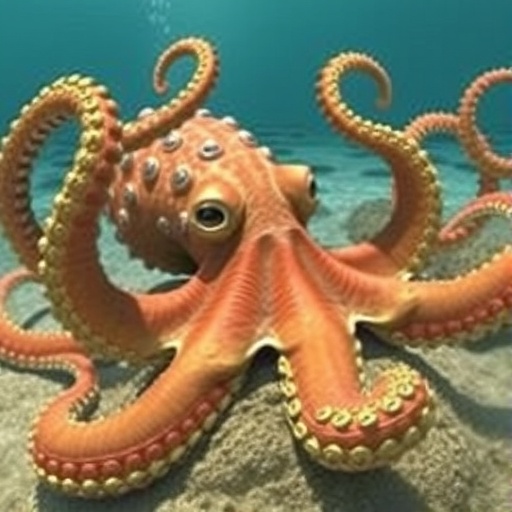
Octopuses have long fascinated scientists and marine enthusiasts alike due to their remarkable intelligence, agility, and adaptability within modern oceanic ecosystems. Yet, new cutting-edge research from Hokkaido University reveals a startling image of their ancient ancestors—giant apex predators that dominated the oceans during the Late Cretaceous period nearly 100 million years ago. This groundbreaking study, published in the journal Science on April 23, 2026, challenges longstanding assumptions about early cephalopod ecology by unveiling these ancient octopuses as powerful hunters rivaling large marine vertebrates in size and predatory prowess.
The evolutionary history of octopuses is notoriously difficult to reconstruct, as soft-bodied invertebrates rarely fossilize well. Unlike creatures with bones or shells, octopuses left behind scant physical evidence. However, the research team circumvented this limitation by focusing on a high-fossilization-potential organ: the beak-like fossil jaws. These jaws, composed of chitin, endure sedimentary processes far better than soft tissue, offering a preserved window into the feeding mechanisms of their extinct bearers.
Employing state-of-the-art technologies, including high-resolution grinding tomography combined with advanced artificial intelligence analytics, the scientists meticulously scanned rock samples from fossil-rich Late Cretaceous marine deposits in Japan and Vancouver Island. This integrative approach enabled them to extract subtle jaw fossils embedded within the rock matrix, revealing intricate wear patterns and morphological details with unprecedented clarity. Such fine preservation affords not only anatomical knowledge but insights into the feeding behaviors and ecological roles these ancient cephalopods played.
The fossils analyzed belong to Cirrata, an extinct subgroup of finned octopuses. This lineage was characterized by morphological traits distinct from modern octopuses but retained complex predatory adaptations. Through comparative size and shape analysis of the jaw specimens, coupled with detailed examinations of surface wear—chipping, scratching, and polished textures—the researchers inferred that these were formidable crushers of hard-shelled prey, pointing to a highly active and aggressive predation strategy.
One of the study’s most striking revelations is the colossal size these animals attained. Professor Yasuhiro Iba explains that fossil evidence indicates total body lengths nearing 20 meters, significantly larger than nearly all contemporary marine reptiles from the same geologic timeframe. This implies these ancient giant octopuses were true titans of their ecosystems, occupying the apex predator niche and exerting considerable influence on marine food webs.
The wear patterns on the jaws provide further surprising information. Exceptional tip wear—amounting up to 10% of the jaw length—suggests continuous, powerful biting forces far exceeding those observed in living cephalopods that consume hard-shelled prey. The abrasions, cracks, and polished regions are consistent with repeated high-stress interactions with prey, emphasizing that these creatures were not passive feeders but relentless hunters with mechanically optimized biting capabilities.
This study also documents a remarkable aspect of ancient cephalopod behavior: lateralization. Unequal wear on the left and right sides of the biting structures implies a preference for one side, indicative of specialized motor control and possibly advanced neural processing. Such behavioral asymmetry hints that cognitive complexity and neural sophistication emerged in octopods far earlier than currently appreciated, reshaping how scientists view intelligence evolution in marine invertebrates.
For decades, marine paleontology has portrayed ancient seas as dominantly vertebrate-controlled realms, with giant fishes and marine reptiles reigning supreme while invertebrates remained confined to lower trophic levels. The discovery that extinct octopuses ascended to apex predator status overturns this paradigm, illustrating that invertebrate lineages were capable of convergent evolution toward gigantism, intelligence, and ecological dominance analogous to vertebrates.
Key to this evolutionary success was the development of powerful jaws coupled with the progressive loss of external skeletons, which allowed these animals to grow larger and become more maneuverable and intelligent. This shared evolutionary strategy between cephalopods and large vertebrate predators underscores the role of anatomical innovation and selective pressure in driving the emergence of giant marine hunters.
Beyond expanding our understanding of cephalopod evolution, the research offers a promising new methodological framework. The synthesis of digital fossil mining with artificial intelligence provides a transformative toolset for discovering and analyzing cryptic or hidden fossils, potentially revolutionizing paleontological efforts by uncovering myriad unknown organisms and reconstructing ancient ecosystems with unprecedented resolution.
As this interdisciplinary approach matures, scientists anticipate dramatic expansions in the fossil record for soft-bodied organisms long thought unattainable for study. This not only enriches evolutionary narratives but can illuminate ancient food web dynamics, providing critical context for how marine ecosystems have responded to environmental changes over geologic timescales.
The implications of these findings are profound. They highlight the evolutionary versatility of octopuses and challenge entrenched ideas about the exclusivity of vertebrates as apex predators. By illuminating the rise of giant, intelligent invertebrate predators in the Cretaceous, this work calls for a reexamination of predator-prey dynamics and cognitive evolution within marine environments over hundreds of millions of years.
In conclusion, this meticulously detailed study from Hokkaido University establishes that the earliest octopuses were not the small, elusive creatures we observe today but gargantuan, dominant predators with sophisticated feeding strategies and behaviors. This refines our understanding of marine evolutionary history and paves the way for future discoveries illuminating life’s deep past beneath the waves.
Subject of Research: Animals
Article Title: Earliest octopuses were giant top predators in Cretaceous oceans
News Publication Date: 23-Apr-2026
Web References: http://dx.doi.org/10.1126/science.aea6285
Image Credits: Image: Yohei Utsuki, Department of Earth and Planetary Sciences, Hokkaido University
Keywords: Cretaceous, octopus evolution, apex predator, fossil jaws, cephalopod, artificial intelligence, grinding tomography, marine paleoecology, lateralization, gigantism, predatory behavior, fossil preservation
Tags: AI fossil analysis in paleontologyancient giant octopusesapex marine predators 100 million years agocephalopod evolutionary historychitin beak fossilsextinct cephalopod feeding mechanismsfossilized octopus jawshigh-resolution grinding tomographyHokkaido University cephalopod researchLate Cretaceous marine predatorsLate Cretaceous ocean ecosystemssoft-bodied invertebrate fossilization