• HOME
  • NEWS
  • EXPLORE
    • CAREER
      • Companies
      • Jobs
    • EVENTS
    • iGEM
      • News
      • Team
    • PHOTOS
    • VIDEO
    • WIKI
  • BLOG
  • COMMUNITY
    • FACEBOOK
    • INSTAGRAM
    • TWITTER
Sunday, May 10, 2026
BIOENGINEER.ORG
No Result
View All Result
  • Login
  • HOME
  • NEWS
  • EXPLORE
    • CAREER
      • Companies
      • Jobs
        • Lecturer
        • PhD Studentship
        • Postdoc
        • Research Assistant
    • EVENTS
    • iGEM
      • News
      • Team
    • PHOTOS
    • VIDEO
    • WIKI
  • BLOG
  • COMMUNITY
    • FACEBOOK
    • INSTAGRAM
    • TWITTER
  • HOME
  • NEWS
  • EXPLORE
    • CAREER
      • Companies
      • Jobs
        • Lecturer
        • PhD Studentship
        • Postdoc
        • Research Assistant
    • EVENTS
    • iGEM
      • News
      • Team
    • PHOTOS
    • VIDEO
    • WIKI
  • BLOG
  • COMMUNITY
    • FACEBOOK
    • INSTAGRAM
    • TWITTER
No Result
View All Result
Bioengineer.org
No Result
View All Result
Home NEWS Science News

Amperometric biosensors used to control diclofenac content in food

Bioengineer by Bioengineer
July 6, 2021
in Science News
Reading Time: 2 mins read
0
IMAGE
Share on FacebookShare on TwitterShare on LinkedinShare on RedditShare on Telegram

The study appeared in Journal of Analytical Chemistry
IMAGE

Credit: Kazan Federal University

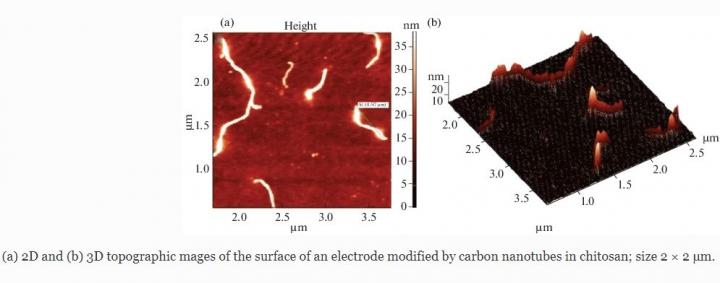
The paper describes amperometric biosensors developed for the determination of diclofenac based on planar platinum electrodes modified with carbon nanotubes (CNTs) in chitosan, fullerene C60 in Boltorn H20, gold nanoparticles (Au NPs) in chitosan, and immobilized tyrosinase enzyme. It was found that diclofenac is a reversible tyrosinase inhibitor (a decrease in the analytical signal is observed), which makes it possible to determine it using appropriate biosensors modified with nanomaterials in the concentration range from 10 pM to 1 μM with CH 5 pM. Modification with composites of CNT / Au NPs and fullerene C60 / Au NPs made it possible to improve the analytical characteristics of the developed biosensors, in particular, to expand the range of determined concentrations and reduce CH compared to the unmodified analogue.

Kinetic studies of the reaction of enzymatic conversion of phenol showed that noncompetitive inhibition is observed in the presence of diclofenac on a tyrosinase biosensor.

The content of this drug in food is strictly regulated by European Union regulations, according to which the MPC for diclofenac in milk is 0.1 μg / l.

In this case, diclofenac was not detected in four studied milk samples with 1.5% fat content.

To assess the correctness of the results obtained for the determination of diclofenac using the developed biosensors, the method of fluorescence polarization was used.

The results show that the developed tyrosinase biosensor modified with CNT/Au NPs is not inferior in its analytical capabilities to known analogs, and in some cases even surpasses them and can be used for milk quality control.

Currently, non-steroidal anti-inflammatory drugs (NSAIDs) are often used as analgesics and anti-inflammatory treatment in diseases of the musculoskeletal system. Drugs of this class have a wide range of side effects, which, according to statistics, manifest in 10% of patients. NSAIDs are used in veterinary medicine to treat cattle and, therefore, can be found in dairy products. With that in mind, the content of NSAIDs in food should be strictly controlled. Diclofenac is one of the widely used medications of this class.

Since the presence of diclofenac in baby food is unacceptable, and its content in food products is subject to strict control, the determination of the content of this drug in food products, such as dairy, meat, and processed products, is very important. Recently, information about the content of diclofenac in seawater and wastewater has become increasingly common, so monitoring the content of the drug in them is also an important task. Further improvement of biosensor devices with the involvement of modern ideas about the role of the surface in the mechanism of analytical response will be very useful both for solving specific problems and for the development of the theory of biosensorics in general.

###

Media Contact
Yury Nurmeev
[email protected]

Original Source

https://eng.kpfu.ru/novosti/amperometric-biosensors-used-to-control-diclofenac-content-in-food/

Related Journal Article

http://dx.doi.org/10.1134/S1061934821050075

Tags: Chemistry/Physics/Materials SciencesElectromagneticsFood/Food ScienceMaterials
Share13Tweet8Share2ShareShareShare2

Related Posts

Urdu Fall Risk Questionnaire Adapted for Elderly

May 10, 2026

Key Pharmacological Markers for HIV Prevention in MSM

May 10, 2026

Taking 8,500 Steps Daily May Aid Long-Term Weight Management, Study Finds

May 10, 2026

Group Exercise Boosts Cognition, Fitness in Dementia

May 10, 2026
Please login to join discussion

POPULAR NEWS

  • Research Indicates Potential Connection Between Prenatal Medication Exposure and Elevated Autism Risk

    840 shares
    Share 336 Tweet 210
  • New Study Reveals Plants Can Detect the Sound of Rain

    727 shares
    Share 290 Tweet 181
  • Scientists Investigate Possible Connection Between COVID-19 and Increased Lung Cancer Risk

    68 shares
    Share 27 Tweet 17
  • Salmonella Haem Blocks Macrophages, Boosts Infection

    61 shares
    Share 24 Tweet 15

About

We bring you the latest biotechnology news from best research centers and universities around the world. Check our website.

Follow us

Recent News

Urdu Fall Risk Questionnaire Adapted for Elderly

Key Pharmacological Markers for HIV Prevention in MSM

Taking 8,500 Steps Daily May Aid Long-Term Weight Management, Study Finds

Subscribe to Blog via Email

Success! An email was just sent to confirm your subscription. Please find the email now and click 'Confirm' to start subscribing.

Join 82 other subscribers
  • Contact Us

Bioengineer.org © Copyright 2023 All Rights Reserved.

Welcome Back!

Login to your account below

Forgotten Password?

Retrieve your password

Please enter your username or email address to reset your password.

Log In
No Result
View All Result
  • Homepages
    • Home Page 1
    • Home Page 2
  • News
  • National
  • Business
  • Health
  • Lifestyle
  • Science

Bioengineer.org © Copyright 2023 All Rights Reserved.