• HOME
  • NEWS
  • EXPLORE
    • CAREER
      • Companies
      • Jobs
    • EVENTS
    • iGEM
      • News
      • Team
    • PHOTOS
    • VIDEO
    • WIKI
  • BLOG
  • COMMUNITY
    • FACEBOOK
    • INSTAGRAM
    • TWITTER
Saturday, May 16, 2026
BIOENGINEER.ORG
No Result
View All Result
  • Login
  • HOME
  • NEWS
  • EXPLORE
    • CAREER
      • Companies
      • Jobs
        • Lecturer
        • PhD Studentship
        • Postdoc
        • Research Assistant
    • EVENTS
    • iGEM
      • News
      • Team
    • PHOTOS
    • VIDEO
    • WIKI
  • BLOG
  • COMMUNITY
    • FACEBOOK
    • INSTAGRAM
    • TWITTER
  • HOME
  • NEWS
  • EXPLORE
    • CAREER
      • Companies
      • Jobs
        • Lecturer
        • PhD Studentship
        • Postdoc
        • Research Assistant
    • EVENTS
    • iGEM
      • News
      • Team
    • PHOTOS
    • VIDEO
    • WIKI
  • BLOG
  • COMMUNITY
    • FACEBOOK
    • INSTAGRAM
    • TWITTER
No Result
View All Result
Bioengineer.org
No Result
View All Result
Home NEWS Science News Chemistry

Ammonia has been wrongly missing in portraying air pollution impacts

Bioengineer by Bioengineer
March 20, 2020
in Chemistry
Reading Time: 2 mins read
0
IMAGE
Share on FacebookShare on TwitterShare on LinkedinShare on RedditShare on Telegram

IMAGE

Credit: Yuepeng Pan

Nitrogen is essential for all living things. Synthetic fertilizer, which contains rich reactive nitrogen, has sustained food production and thereby the global population, but the nitrogen it emits is also a burden to the environment–air pollution, soil acidification, water eutrophication, to name just some of the consequences.

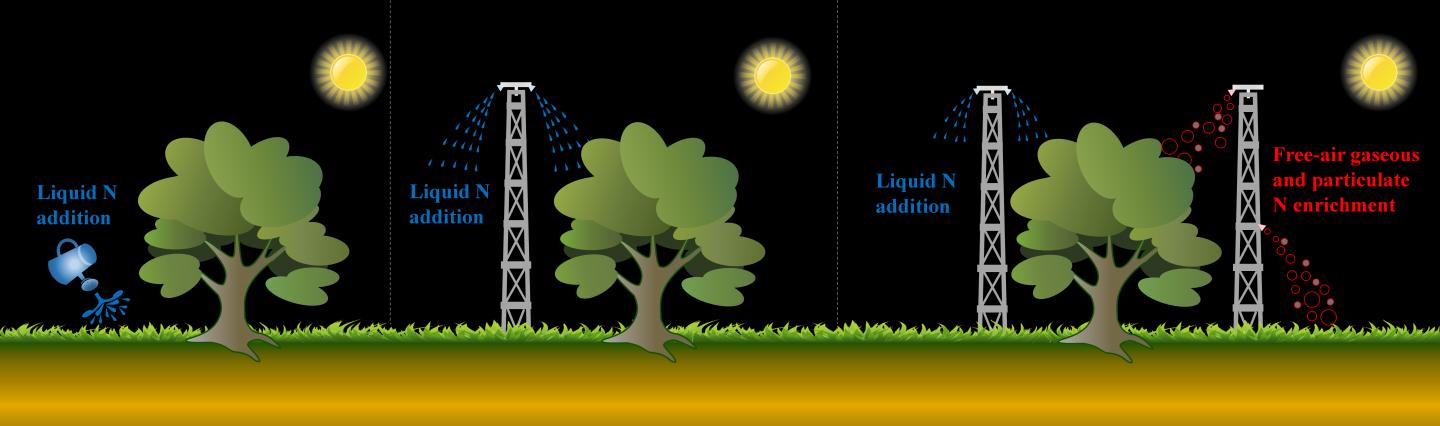
Although numerous field studies have been conducted to understand the implications of atmospheric nitrogen deposition in the environment, conventional manipulative experiments have mostly been employed, by adding nitrogen solution directly onto grassland or forest floors (soil).

In an article recently published in Atmospheric and Oceanic Science Letters, Dr Yuepeng Pan, from the Institute of Atmospheric Physics, Chinese Academy of Sciences, and his coauthors, challenge the traditional approach in evaluating the impacts of nitrogen deposition.

“There are three ways for nitrogen to be deposited: rainfall, aerosol and gas; and spraying nitrogen solution onto soil assumes that atmospheric deposition occurs mainly as rainfall (wet deposition),” says Dr Pan. “However, dry deposition of gaseous and particulate reactive nitrogen species, especially ammonia, is also an important deposition process.”

Dr Pan also points out that there have only been a limited number of field studies that have investigated the bidirectional exchange of ammonia between the atmosphere and plants, not to mention the impacts of ammonia on natural ecosystems.

“Ammonia plays a vital role in nitrogen deposition and haze pollution. To make things worse, atmospheric ammonia concentrations have increased worldwide in recent decades,” suggests Dr Pan. “The next generation of field experiments simulating nitrogen deposition should further consider ammonia.”

###

Media Contact
Ms. Zheng Lin
[email protected]
86-108-299-5053

Original Source

http://159.226.119.58/aosl/EN/news/news34.shtml

Related Journal Article

http://dx.doi.org/10.1080/16742834.2020.1733919

Tags: AgricultureAtmospheric ScienceChemistry/Physics/Materials SciencesPollution/Remediation
Share12Tweet8Share2ShareShareShare2

Related Posts

New Drexel Study Reveals Key to Keeping Students on Track in Physics Learning — Chemistry

New Drexel Study Reveals Key to Keeping Students on Track in Physics Learning

May 15, 2026
Reversible Glue Technology Powers Up with Electric Activation — Chemistry

Reversible Glue Technology Powers Up with Electric Activation

May 15, 2026

Sweet as Honey: Unveiling a New Heat Transport Regime in Ultrathin Semiconductors

May 15, 2026

High-Precision Boltzmann Luminescent Nanothermometry Achieved Through Predictive Rules

May 15, 2026
Please login to join discussion

POPULAR NEWS

  • Research Indicates Potential Connection Between Prenatal Medication Exposure and Elevated Autism Risk

    843 shares
    Share 337 Tweet 211
  • New Study Reveals Plants Can Detect the Sound of Rain

    730 shares
    Share 291 Tweet 182
  • Salmonella Haem Blocks Macrophages, Boosts Infection

    62 shares
    Share 25 Tweet 16
  • Breastmilk Balances E. coli and Beneficial Bacteria in Infant Gut Microbiomes

    58 shares
    Share 23 Tweet 15

About

We bring you the latest biotechnology news from best research centers and universities around the world. Check our website.

Follow us

Recent News

Perinatal and Early Childhood Factors in PFAPA Persistence

New Actinomycin Derivatives Target Malaria More Selectively

Mobile App Enhances Exercise for Older Adults’ Cognition

Subscribe to Blog via Email

Enter your email address to subscribe to this blog and receive notifications of new posts by email.

Join 82 other subscribers
  • Contact Us

Bioengineer.org © Copyright 2023 All Rights Reserved.

Welcome Back!

Login to your account below

Forgotten Password?

Retrieve your password

Please enter your username or email address to reset your password.

Log In
No Result
View All Result
  • Homepages
    • Home Page 1
    • Home Page 2
  • News
  • National
  • Business
  • Health
  • Lifestyle
  • Science

Bioengineer.org © Copyright 2023 All Rights Reserved.