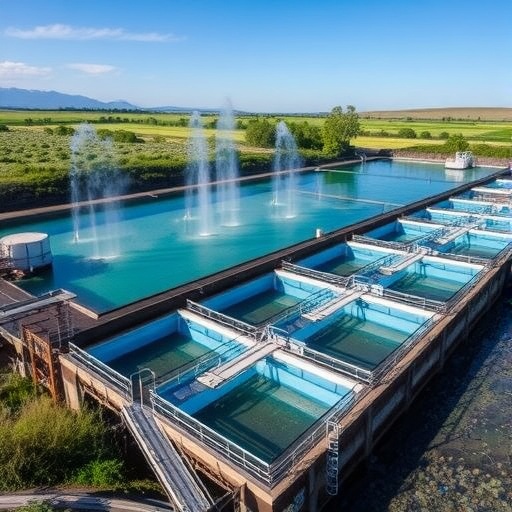
Wastewater treatment has long been viewed as an unavoidable environmental expense: a system that consumes electricity, produces sludge and releases greenhouse gases while cleaning water for reuse. A new study by Zheng, Xiao, Zhu and colleagues presents a radically different possibility. Published in Nature Communications, the research describes a sequential thermochemical–electrochemical process designed to transform wastewater treatment from a carbon-emitting necessity into a potential source of valuable products and even net atmospheric carbon removal. The central idea is deceptively simple but technically ambitious: instead of treating wastewater only as something to be purified, the process treats it as a chemically rich resource containing water, organic carbon, nutrients and recoverable energy.
The phrase “net-negative carbon valorization” refers to a system that removes more carbon dioxide from the atmosphere, directly or indirectly, than it emits across its operation. Conventional wastewater plants typically require large amounts of electricity for aeration, pumping and sludge processing. They can also release methane and nitrous oxide, two powerful greenhouse gases, if biological treatment and sludge management are not carefully controlled. The approach presented in the new study seeks to address these challenges by combining two different forms of conversion in sequence. Thermochemical processing first uses heat to break down or transform complex organic matter, while electrochemical processing then uses electricity to drive selective chemical reactions. By linking the stages, the researchers aim to extract more value from wastewater while reducing the carbon intensity of treatment.
Thermochemical conversion can include processes such as pyrolysis, hydrothermal treatment or gasification, depending on the water content and composition of the feedstock. These methods use controlled heat, with limited or no oxygen in some configurations, to convert organic materials into gases, liquids and carbon-rich solids. Wastewater and sewage sludge contain proteins, carbohydrates, lipids and other compounds that can be difficult to recover through conventional biological treatment. Heating can reorganize these molecules into more manageable intermediates, concentrate carbon into solid products or produce chemical building blocks that are easier to process in a later stage. The thermochemical step may also help reduce pathogens and persistent organic contaminants, an important consideration when dealing with materials derived from municipal and industrial wastewater.
The second stage, electrochemical conversion, uses electrodes and an external electrical circuit to control chemical reactions with a precision that is difficult to achieve through ordinary combustion or biological digestion. At the cathode, reduction reactions can convert dissolved carbon compounds into products such as hydrogen, carbon monoxide, formate or other commodity chemicals, depending on the catalyst and operating conditions. At the anode, oxidation reactions can break down unwanted compounds or generate useful chemicals instead of simply producing oxygen. Electrochemical systems can also be powered by renewable electricity, allowing the process to operate with a much lower emissions footprint than fossil-fuel-based thermal treatment. The sequential arrangement is crucial because thermochemical treatment can prepare the wastewater-derived carbon for more selective electrochemical reactions.
The study’s significance lies not only in combining two technologies, but in connecting them through a carbon-management strategy. Wastewater contains carbon that originated in food, biomass, industrial materials and human activity. If that carbon is rapidly oxidized to carbon dioxide during treatment, its chemical energy is lost and emissions increase. If part of it is converted into stable carbon materials, durable chemicals or fuels produced with low-carbon electricity, the overall climate balance can improve. A net-negative system would require more than simply making a useful product. It would need to account for energy inputs, electrode and catalyst manufacture, chemical consumption, transport, emissions from treatment, the fate of recovered carbon and the eventual use or disposal of all products. The researchers’ framework is therefore relevant to the full life cycle of wastewater treatment, not just the chemistry inside a reactor.
One of the most intriguing implications is that wastewater treatment could become linked to carbon capture and resource manufacturing at the same time. Stable carbon-rich solids produced during thermochemical processing might be stored in controlled applications, provided they meet safety requirements and do not release contaminants. Other carbon streams could be directed toward electrochemical production of fuels or industrial feedstocks. Nitrogen and phosphorus, which are major causes of eutrophication when discharged into rivers and coastal waters, may also be recoverable as fertilizers or chemical intermediates. Recovering these elements would reduce pressure on conventional fertilizer production, which is energy-intensive and, in the case of phosphorus, dependent on finite mineral reserves. The result could be a treatment plant that produces clean water, carbon products, nutrients and chemical energy rather than generating only waste sludge.
The technology also addresses a major weakness of many proposed carbon-removal systems: the need for clean, concentrated inputs. Direct-air-capture machines remove carbon dioxide from the atmosphere, but they often require substantial energy because atmospheric carbon dioxide is extremely dilute. Wastewater, by contrast, arrives with a concentrated mixture of organic molecules and dissolved minerals. Its carbon content is not automatically climate-negative, but it is physically accessible and already collected by municipal infrastructure. By using existing wastewater streams as a feedstock, sequential thermochemical–electrochemical systems could potentially combine pollution control with carbon utilization. This does not eliminate the need for renewable energy or careful emissions accounting, but it could improve the economics of carbon management by producing saleable materials alongside environmental services.
The process is not without obstacles. Wastewater composition can change dramatically from hour to hour and from one location to another. Salts, metals, suspended solids and toxic compounds may foul electrodes, poison catalysts or interfere with thermal reactors. Electrochemical conversion can also be expensive if it requires rare catalytic materials, high current densities or frequent replacement of components. Heat recovery is another critical issue: if the thermochemical stage is powered by natural gas or inefficiently generated electricity, the climate benefits may disappear. In addition, carbon products made from wastewater-derived material must be tested for pathogens, heavy metals, pharmaceuticals and other contaminants before they can be used in agriculture, construction or long-term storage. A process that appears carbon-negative at the reactor level could become carbon-intensive when its entire supply chain is included.
For that reason, the reported research is best understood as a roadmap toward a new class of treatment systems rather than proof that every wastewater plant can immediately become a carbon sink. Demonstrating the concept at laboratory scale is only the beginning. Future work will need to establish long-term stability, continuous operation, catalyst durability, energy efficiency and economic performance under realistic wastewater conditions. Researchers and regulators will also have to agree on how to verify net carbon removal and how to classify materials produced from sewage-derived feedstocks. If those challenges can be solved, the technology could give cities a powerful new tool for climate action: infrastructure that protects waterways while converting an unavoidable waste stream into useful chemicals and potentially storing carbon. The most viral part of the idea is also its most consequential—tomorrow’s wastewater plant may not merely clean pollution; it could help manufacture the materials needed for a lower-carbon world.
Subject of Research: Net-negative carbon valorization in wastewater treatment through sequential thermochemical and electrochemical conversion
Article Title: Net-negative carbon valorization in wastewater treatment via sequential thermochemical-electrochemical coupling
Article References: Zheng, X., Xiao, M., Zhu, J. et al. “Net-negative carbon valorization in wastewater treatment via sequential thermochemical-electrochemical coupling.” Nature Communications (2026). https://doi.org/10.1038/s41467-026-76941-2
Image Credits: AI Generated
DOI: 10.1038/s41467-026-76941-2
Keywords: wastewater treatment, carbon removal, net-negative emissions, thermochemical conversion, electrochemical conversion, carbon valorization, sustainable engineering, resource recovery, climate technology, circular economy
Tags: advanced wastewater treatment technologydecarbonizing wastewater treatment plantsenvironmental benefits of wastewater carbon capturegreenhouse gas reduction in wastewater treatmentinnovative methods for wastewater energy recoverynet-negative carbon removal in wastewater treatmentreducing methane and nitrous oxide emissions in wastewatersequential heat and electrochemical wastewater processingsustainable wastewater management innovationsthermochemical-electrochemical wastewater valorizationwastewater as a resource for valuable productsWastewater carbon negative treatment