Osaka, Japan – A high-energy particle falls from space to the Earth’s surface—it is not clear where it came from or even what it is, exactly. This may sound like something out of science fiction, but it is in fact a scientific reality, as evidenced by the research led by Associate Professor Toshihiro Fujii from the Graduate School of Science and Nambu Yoichiro Institute of Theoretical and Experimental Physics at Osaka Metropolitan University.
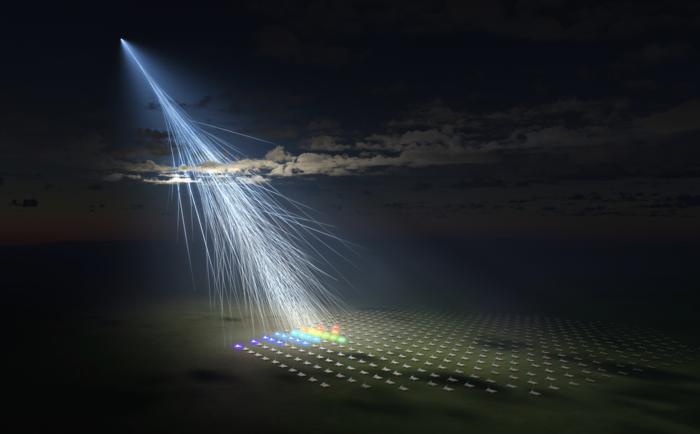
Credit: Osaka Metropolitan University/L-INSIGHT, Kyoto University/Ryuunosuke Takeshige
Osaka, Japan – A high-energy particle falls from space to the Earth’s surface—it is not clear where it came from or even what it is, exactly. This may sound like something out of science fiction, but it is in fact a scientific reality, as evidenced by the research led by Associate Professor Toshihiro Fujii from the Graduate School of Science and Nambu Yoichiro Institute of Theoretical and Experimental Physics at Osaka Metropolitan University.
Cosmic rays are energetic charged particles originating from galactic and extragalactic sources. Cosmic rays with extremely high energy are exceptionally rare; they can reach greater than 1018 electron volts or one exa-electron volt (EeV), which is roughly a million times higher than achieved by the most powerful accelerators ever made by humans.
Chasing after such rays from space, Professor Fujii and an international team of scientists have been conducting the Telescope Array experiment since 2008. This specialized cosmic ray detector consists of 507 scintillator surface stations, covering an expansive detection area of 700 square kilometers in Utah, United States. On May 27, 2021, the researchers detected a particle with a whopping energy level of 244 EeV.
“When I first discovered this ultra-high-energy cosmic ray, I thought there must have been a mistake, as it showed an energy level unprecedented in the last 3 decades,” shared Professor Fujii.
Such an energy level is comparable to that of the most energetic cosmic ray ever observed, dubbed the “Oh-My-God” particle, which had an estimated energy of 320 EeV when detected in 1991.
Of the many candidates for the particle’s name, Professor Fujii and colleagues settled on “Amaterasu,” after the sun goddess that, according to Shinto beliefs, was instrumental in the creation of Japan.
The Amaterasu particle is perhaps as mysterious as the Japanese goddess herself. Where did it come from? What exactly was it? These questions remain. There is hope that the Amaterasu particle will pave the way for illuminating the origins of cosmic rays.
“No promising astronomical object matching the direction from which the cosmic ray arrived has been identified, suggesting possibilities of unknown astronomical phenomena and novel physical origins beyond the Standard Model,” Professor Fujii mused. “In the future, we commit to continue operating the Telescope Array experiment, as we embark, through our ongoing upgraded experiment with fourfold sensitivities, dubbed TAx4, and next-generation observatories, on a more detailed investigation into the source of this extremely energetic particle.”
Their findings are set for publication in Science on November 24, 2023.
###
About OMU
Osaka Metropolitan University is the third largest public university in Japan, formed by a merger between Osaka City University and Osaka Prefecture University in 2022. OMU upholds “Convergence of Knowledge” through 11 undergraduate schools, a college, and 15 graduate schools. For more research news, visit https://www.omu.ac.jp/en/ or follow us on Twitter: @OsakaMetUniv_en, or Facebook.
Journal
Science
DOI
10.1126/science.abo5095
Method of Research
Imaging analysis
Article Title
An extremely energetic cosmic ray observed by a surface detector array
Article Publication Date
23-Nov-2023