• HOME
  • NEWS
  • EXPLORE
    • CAREER
      • Companies
      • Jobs
    • EVENTS
    • iGEM
      • News
      • Team
    • PHOTOS
    • VIDEO
    • WIKI
  • BLOG
  • COMMUNITY
    • FACEBOOK
    • INSTAGRAM
    • TWITTER
Thursday, May 14, 2026
BIOENGINEER.ORG
No Result
View All Result
  • Login
  • HOME
  • NEWS
  • EXPLORE
    • CAREER
      • Companies
      • Jobs
        • Lecturer
        • PhD Studentship
        • Postdoc
        • Research Assistant
    • EVENTS
    • iGEM
      • News
      • Team
    • PHOTOS
    • VIDEO
    • WIKI
  • BLOG
  • COMMUNITY
    • FACEBOOK
    • INSTAGRAM
    • TWITTER
  • HOME
  • NEWS
  • EXPLORE
    • CAREER
      • Companies
      • Jobs
        • Lecturer
        • PhD Studentship
        • Postdoc
        • Research Assistant
    • EVENTS
    • iGEM
      • News
      • Team
    • PHOTOS
    • VIDEO
    • WIKI
  • BLOG
  • COMMUNITY
    • FACEBOOK
    • INSTAGRAM
    • TWITTER
No Result
View All Result
Bioengineer.org
No Result
View All Result
Home NEWS Science News Health

Aluminum is intricately associated with the neuropathology of familial Alzheimer’s disease

Bioengineer by Bioengineer
April 9, 2021
in Health
Reading Time: 2 mins read
0
IMAGE
Share on FacebookShare on TwitterShare on LinkedinShare on RedditShare on Telegram

IMAGE

Credit: Dr. Mold

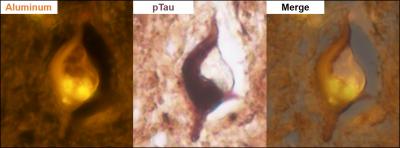
Amsterdam, April 9, 2021 — This study builds upon two earlier published studies (Mold et al., 2020, Journal of Alzheimer’s Disease Reports) from the same group. The new data, also published in the Journal of Alzheimer’s Disease Reports, demonstrate that aluminum is co-located with phosphorylated tau protein, present as tangles within neurons in the brains of early-onset or familial Alzheimer’s disease (AD). “The presence of these tangles is associated with neuronal cell death, and observations of aluminum in these tangles may highlight a role for aluminum in their formation,” explained lead investigator Matthew John Mold, PhD, Birchall Centre, Lennard-Jones Laboratories, Keele University, Staffordshire, UK.

The earlier research highlighted widespread co-localization of aluminum and amyloid-β in brain tissue in familial AD. The researchers used a highly-selective method of immunolabelling in the current study, combined with aluminum-specific fluorescence microscopy. Phosphorylated tau in tangles co-located with aluminum in the brain tissue of the same cohort of Colombian donors with familial AD were identified. “It is of interest and perhaps significance with respect to aluminum’s role in AD that its unequivocal association with tau is not as easily recognizable as with amyloid-β. There are many more aggregates of aluminum with amyloid-β than with tau in these tissues and the latter are predominantly intracellular,” remarked co-author, Professor Christopher Exley.

Per Dr. George Perry, Editor-in-Chief of Journal of Alzheimer’s Disease, “Aluminum accumulation has been associated with Alzheimer’s disease for nearly half a century, but it is the meticulously specific studies of Drs. Mold and Exley that are defining the exact molecular interaction of aluminum and other multivalent metals that may be critical to formation of the pathology of Alzheimer’s disease.”

“The new data may suggest that the association of aluminum with extracellular senile plaques precedes that with intracellular aggregates of tau. These relationships with both amyloid-β and tau may account for the high levels of aluminum observed in the brain tissue of donors with familial AD versus those without a diagnosis of neurodegenerative disease,” said Dr Mold. “Tau and amyloid-beta are known to act in synergy to produce neurotoxicity in AD and our data provide new evidence for a role of aluminum in this process”.

###

Media Contact
Diana Murray
[email protected]

Related Journal Article

http://dx.doi.org/10.3233/ADR-210011

Tags: AlzheimerMedicine/Healthneurobiology
Share12Tweet8Share2ShareShareShare2

Related Posts

UofL Pediatrics Researcher Discovers Novel Signaling Mechanism Linked to Anxiety and Overgrooming

May 14, 2026
New Study Finds No Evidence Linking First Trimester Pain Reliever Use to Birth Defects — Medicine

New Study Finds No Evidence Linking First Trimester Pain Reliever Use to Birth Defects

May 14, 2026

Absolute Quantification of IgG Glycans Unlocks New Avenue for Predicting Biological Age

May 14, 2026

Engineered Bacteria in Implantable Living Materials Enable Autonomous Therapeutic Delivery

May 14, 2026
Please login to join discussion

POPULAR NEWS

  • Research Indicates Potential Connection Between Prenatal Medication Exposure and Elevated Autism Risk

    842 shares
    Share 337 Tweet 211
  • New Study Reveals Plants Can Detect the Sound of Rain

    729 shares
    Share 291 Tweet 182
  • Salmonella Haem Blocks Macrophages, Boosts Infection

    62 shares
    Share 25 Tweet 16
  • Breastmilk Balances E. coli and Beneficial Bacteria in Infant Gut Microbiomes

    57 shares
    Share 23 Tweet 14

About

We bring you the latest biotechnology news from best research centers and universities around the world. Check our website.

Follow us

Recent News

UofL Pediatrics Researcher Discovers Novel Signaling Mechanism Linked to Anxiety and Overgrooming

New Study Finds No Evidence Linking First Trimester Pain Reliever Use to Birth Defects

Absolute Quantification of IgG Glycans Unlocks New Avenue for Predicting Biological Age

Subscribe to Blog via Email

Enter your email address to subscribe to this blog and receive notifications of new posts by email.

Join 82 other subscribers
  • Contact Us

Bioengineer.org © Copyright 2023 All Rights Reserved.

Welcome Back!

Login to your account below

Forgotten Password?

Retrieve your password

Please enter your username or email address to reset your password.

Log In
No Result
View All Result
  • Homepages
    • Home Page 1
    • Home Page 2
  • News
  • National
  • Business
  • Health
  • Lifestyle
  • Science

Bioengineer.org © Copyright 2023 All Rights Reserved.