Freeze-dried fruit snacks can lose their color, nutrients, and aroma on the shelf, and a new study from China suggests that the choice of packaging makes a decisive difference. Across every measure, quality declined during storage, but the combination of aluminum foil and nitrogen flushing consistently preserved the product best, retaining 79.59% of anthocyanins after 120 days.
The product, abbreviated MPFBs by the authors, was built to solve two problems at once. Mulberries are rich in anthocyanins, polysaccharides, polyphenols, alkaloids, and flavonoids, but their delicate skin and high moisture content make them highly perishable, with a short harvest window and limited shelf life. Vacuum freeze-drying is the preferred preservation method because it avoids the high-temperature exposure that degrades nutrients. However, single-ingredient freeze-dried products tend to be fragile and nutritionally narrow. Purple potatoes, which contain anthocyanins and selenium, were combined with mulberries at a mass ratio of 3:7. Their abundant starch reduces the tendency of mulberry-only blocks to fragment during freeze-drying, while their sweetness balances mulberry sourness and their purple color matches the product’s visual identity.
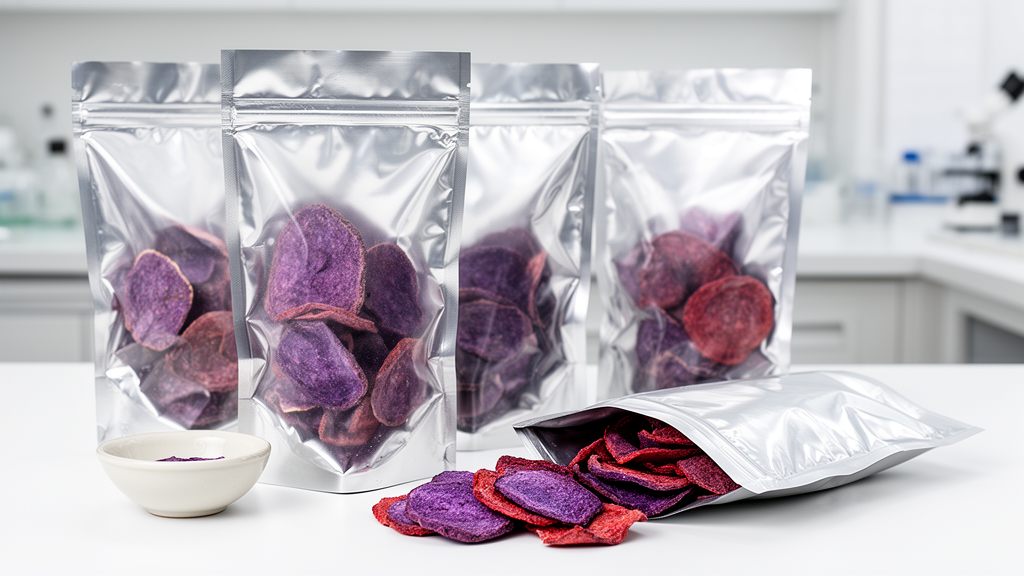
To make the blocks, the researchers pulped mulberries and steamed and crushed purple potatoes, then added 0.2% pectin, 8% maltodextrin, 0.2% gum Arabic, 0.24% citric acid, and 4% fructose syrup. Twelve-gram portions were pre-frozen for 12 hours at minus 80 degrees Celsius and then freeze-dried at 10 degrees Celsius with a cold trap at minus 50 degrees Celsius and a vacuum pressure of 10 pascals. Drying stopped when moisture content reached 5%. The finished blocks were packed in 36-gram lots, either vacuum-sealed at 0.090 megapascals or flushed with nitrogen, using aluminum foil composite bags 0.22 millimeters thick or nylon composite bags 0.16 millimeters thick. Samples were stored at 25 degrees Celsius and 75% relative humidity and analyzed at 20, 40, 60, 80, 100, and 120 days.
Moisture uptake was the first warning sign of quality loss. Freeze-dried blocks readily absorb water from the air, and moisture content rose in all four packaging systems over the 120 days. The pattern, however, was revealing. With the same packaging material, nitrogen-filled bags kept moisture lower than vacuum bags. The authors attribute this to the low-pressure environment of vacuum packaging, which can disrupt the structure of the freeze-dried matrix, releasing bound water and increasing water migration. Nitrogen flushing maintains normal pressure, preserving the fruit piece structure, and as an inert gas it also reduces contact with outside air. Comparing materials, aluminum foil packaging showed less moisture variation than nylon, and the smallest change occurred in aluminum foil nitrogen-filled bags while the largest appeared in nylon vacuum bags.
Color told a similar story. Over storage, the lightness, red-green, and yellow-blue values of the blocks gradually decreased while total color difference increased, changes the researchers link to anthocyanin oxidation and degradation. Anthocyanins give the blocks their bright purple hue but are chemically fragile: they hydrolyze into colorless intermediates, ring-open into yellow chalcones, and finally degrade into colorless phenolic acids and aldehydes. Aluminum foil packaging limited these changes more than translucent nylon, which allows light through and can degrade photosensitive anthocyanins. Nitrogen-filled packaging also outperformed vacuum packaging on color, consistent with earlier reports that nitrogen helps maintain peanut color and retards surface browning.
Texture shifted in packaging-dependent ways. Vacuum-packed blocks, whether in foil or nylon, first hardened and then softened, while their fracturability continuously declined. Nitrogen-filled blocks showed continuous decreases in both hardness and fracturability. The authors suggest that withdrawing gas in vacuum packaging compresses the blocks against the film, collapsing microscopic pores and producing denser tissue. Under identical gas conditions, aluminum foil preserved hardness and fracturability better than nylon, likely because the two materials differ in water vapor transmission; nylon-packaged blocks absorbed more airborne moisture, softening their structure.
The nutritional core of the product fared best under foil and nitrogen. Ascorbic acid content, total phenolic content, total flavonoid content, and total anthocyanin content all declined overall during storage, but blocks in aluminum foil packaging retained more of all four than blocks in nylon. The explanation is mechanical: aluminum foil blocks light and transmits little oxygen or water vapor, preventing light-induced anthocyanin isomerization, phenolic oxidation, and moisture-driven hydrolysis, while nylon’s permeability allows photo-oxidative decomposition and enzymatic reactions to proceed. Nitrogen added further protection by displacing oxygen, inhibiting the oxidation of phenolic compounds that drives enzymatic browning. After 120 days, anthocyanin retention in aluminum foil nitrogen-filled packaging reached 79.59%, 23.8 percentage points higher than nylon vacuum packaging and 18.17 percentage points higher than nylon nitrogen-filled packaging. Phenolic compound retention reached 98.25%, significantly higher than the other methods. Antioxidant capacity, measured by DPPH and ABTS radical scavenging and FRAP assays, changed least in the foil-and-nitrogen group, tracking the bioactive compound data.
Microbial results were reassuring across the board. No mold or Escherichia coli was detected in any package throughout the 120 days, and the maximum total bacterial count reached 3.1 log colony-forming units per gram, within hygiene limits. The authors credit the low moisture content after freeze-drying, combined with vacuum and nitrogen environments that suppress aerobic respiration and bacterial proliferation. Nitrogen-filled packages showed relatively low colony counts, and aluminum foil limited microbial growth more effectively than nylon.
Flavor was assessed with an electronic nose and headspace solid-phase microextraction gas chromatography-mass spectrometry. The electronic nose, equipped with ten metal-oxide-semiconductor sensors, responded most strongly to nitrogen oxides, terpenes, and aromatic compounds. In principal component analysis, the first two components accounted for 92.1% and 5.1% of variance, and samples stored for 120 days separated clearly from fresh and 60-day samples on the plot. The aroma of foil-nitrogen blocks at 60 days most closely resembled day-zero samples. Gas chromatography identified 35 volatile substances, including 10 esters, 2 ketones, 3 phenols, 3 alcohols, 2 acids, 5 alkanes, 3 olefins, and 6 aromatic hydrocarbons. Esters dominated, contributing fruity and floral notes; methyl benzoate rose from 0.22% at day zero to 1.13% in foil-nitrogen packages at 120 days, likely as acids and alcohols esterified and faster-volatilizing aldehydes escaped. Ketone content was significantly higher in foil packages than nylon, and limonene survived only in foil-nitrogen bags at 120 days. The team also detected phthalate derivatives attributed to the polyurethane adhesive in nylon film, noting concentrations complied with European food safety limits.
The authors conclude that both packaging material and internal gas composition significantly shape storage quality, with aluminum foil offering superior light-blocking, oxygen-sealing, and moisture-proofing and nitrogen outperforming vacuum in inhibiting oxidation and maintaining structure. They position aluminum foil nitrogen-filled packaging as the optimal solution for these blocks and suggest it can be scaled commercially for freeze-dried fruit and vegetable products, particularly for long-distance transport and shelf-life extension of anthocyanin-rich composite foods. As a single laboratory storage trial on one product formulation, the findings provide a theoretical and practical reference for packaging oxidation-prone freeze-dried foods rather than a demonstration across product categories, but the consistent advantage of foil and nitrogen across moisture, color, texture, nutrients, antioxidants, microbes, and aroma gives the recommendation unusually broad internal support.
Subject of Research: Packaging effects on the storage quality of mulberry and purple potato freeze-dried fruit blocks
Article Title: Effects of different packaging methods on the storage quality of mulberry–purple potato compound freeze-dried fruit blocks
Article References: Zhou, Y., Cheng, W., Liu, Y., Dong, H., Li, L., Zhang, W., Guo, M., Yang, W., Chen, G., & Cheng, S. (2026). Effects of different packaging methods on the storage quality of mulberry–purple potato compound freeze-dried fruit blocks. Agricultural Products Processing and Storage, 2(1), Article 41. https://doi.org/10.1007/s44462-026-00074-4
Image Credits: AI Generated
DOI: 10.1007/s44462-026-00074-4
Keywords: freeze-drying, mulberry, purple potato, anthocyanins, aluminum foil packaging, nitrogen flushing, vacuum packaging, food storage, antioxidant capacity, volatile flavor compounds, shelf life, food packaging
News Source: Alan Morgan. (October 29, 2026). Aluminum Foil Nitrogen Packaging Keeps Freeze-Dried Mulberry and Purple Potato Snacks Fresh. Scienmag.