• HOME
  • NEWS
  • EXPLORE
    • CAREER
      • Companies
      • Jobs
    • EVENTS
    • iGEM
      • News
      • Team
    • PHOTOS
    • VIDEO
    • WIKI
  • BLOG
  • COMMUNITY
    • FACEBOOK
    • INSTAGRAM
    • TWITTER
Thursday, June 25, 2026
BIOENGINEER.ORG
No Result
View All Result
  • Login
  • HOME
  • NEWS
  • EXPLORE
    • CAREER
      • Companies
      • Jobs
        • Lecturer
        • PhD Studentship
        • Postdoc
        • Research Assistant
    • EVENTS
    • iGEM
      • News
      • Team
    • PHOTOS
    • VIDEO
    • WIKI
  • BLOG
  • COMMUNITY
    • FACEBOOK
    • INSTAGRAM
    • TWITTER
  • HOME
  • NEWS
  • EXPLORE
    • CAREER
      • Companies
      • Jobs
        • Lecturer
        • PhD Studentship
        • Postdoc
        • Research Assistant
    • EVENTS
    • iGEM
      • News
      • Team
    • PHOTOS
    • VIDEO
    • WIKI
  • BLOG
  • COMMUNITY
    • FACEBOOK
    • INSTAGRAM
    • TWITTER
No Result
View All Result
Bioengineer.org
No Result
View All Result
Home NEWS Science News Health

AJR researchers take step toward automating thyroid cancer triage

Bioengineer by Bioengineer
January 23, 2020
in Health
Reading Time: 2 mins read
0
IMAGE
Share on FacebookShare on TwitterShare on LinkedinShare on RedditShare on Telegram

Team develops quantitative framework to sonographically differentiate thyroid nodules at levels comparable to expert radiologists–a big step towards automated triage of thyroid cancer
IMAGE

Credit: American Journal of Roentgenology (AJR)

According to an article published ahead-of-print in the April issue of the American Journal of Roentgenology (AJR), a Stanford University team has developed a quantitative framework able to sonographically differentiate between benign and malignant thyroid nodules at a level comparable to that of expert radiologists, which may prove useful for establishing a fully automated system of thyroid nodule triage.

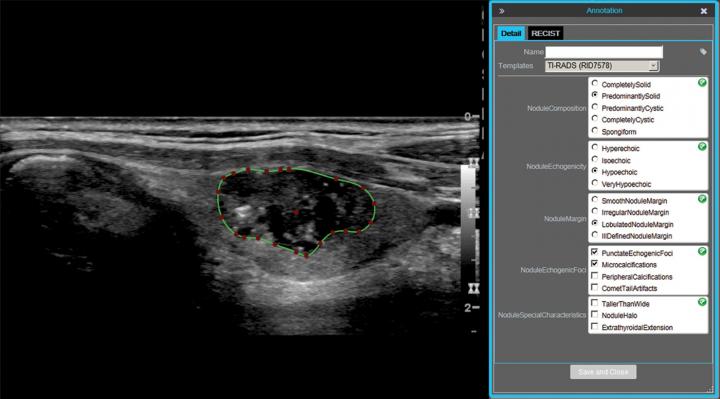
Alfiia Galimzianova et al. retrospectively collected ultrasound images of 92 biopsy-confirmed nodules, which were annotated by two expert radiologists using the American College of Radiology’s Thyroid Imaging Reporting and Data System (TI-RADS).

In the researchers’ framework, nodule features of echogenicity, texture, edge sharpness, and margin curvature properties were analyzed in a regularized logistic regression model to predict nodule malignancy. Authenticating their method with leave-one-out cross-validation, the Stanford team used ROC AUC, sensitivity, and specificity to compare the framework’s results with those obtained by six expert annotation-based classifiers.

The AUC of the proposed framework measured 0.828 (95% CI, 0.715-0.942)–“greater than or comparable,” Galimzianova noted, “to that of the expert classifiers”–whose AUC values ranged from 0.299 to 0.829 (p = 0.99).

Additionally, in a curative strategy at sensitivity of 1, use of the framework could have avoided biopsy in 20 of 46 benign nodules–statistically significantly higher than three expert classifiers. In a conservative strategy at specificity of 1, the framework could have helped to identify 10 of 46 malignancies–statistically significantly higher than five expert classifiers.

“Our results confirm the ultimate feasibility of computer-aided diagnostic systems for thyroid cancer risk estimation,” concluded Galimzianova. “Such systems could provide second-opinion malignancy risk estimation to clinicians and ultimately help decrease the number of unnecessary biopsies and surgical procedures.”

###

Founded in 1900, the American Roentgen Ray Society (ARRS) is the first and oldest radiology society in North America, dedicated to the advancement of medicine through the profession of radiology and its allied sciences. An international forum for progress since the discovery of the x-ray, ARRS maintains its mission of improving health through a community committed to advancing knowledge and skills with an annual scientific meeting, monthly publication of the peer-reviewed American Journal of Roentgenology (AJR), quarterly issues of InPractice magazine, AJR Live Webinars and Podcasts, topical symposia, print and online educational materials, as well as awarding scholarships via The Roentgen FundĀ®.

Media Contact
Logan K. Young
[email protected]
703-858-4332

Original Source

https://arrs.org/ARRSLIVE/Pressroom/PressReleases/AJR_Researchers_Step_Toward_Automated_Triage_Thyroid_Cancer.aspx

Related Journal Article

http://dx.doi.org/10.2214/AJR.19.21350

Tags: BiologycancerCarcinogensDiagnosticsEndocrinologyMedicine/HealthPublic HealthTechnology/Engineering/Computer Science
Share12Tweet8Share2ShareShareShare2

Related Posts

Chiral Laser Gyroscopes Surpass Lock-In Limit

June 25, 2026

Boosting Genomic Equity: Africa’s National Genome Projects

June 25, 2026

Landmark UCLA Health Study Reveals Successful One-Year Outcomes After First-Ever Bladder Transplant

June 25, 2026

GW250114 Uncovers Post-Merger Black Hole Clues

June 25, 2026
Please login to join discussion

POPULAR NEWS

  • Saying Goodbye to PGY-6: Pediatric Fellowship Realities

    103 shares
    Share 41 Tweet 26
  • Multi-Hospital Study Reveals Long Covid Burden Is Twice as High as Current Estimates

    92 shares
    Share 36 Tweet 23
  • Detection of EDCs in Breast Milk and Infant Urine Up to Six Months Highlights Early Exposure Risks

    77 shares
    Share 31 Tweet 19
  • New Drug Candidate Developed at McMaster Shows Potential for Treating Brain Cancer

    58 shares
    Share 23 Tweet 15

About

We bring you the latest biotechnology news from best research centers and universities around the world. Check our website.

Follow us

Recent News

Energy-Saving Membrane Technology Developed by KAIST and Georgia Tech Enables Crude Oil Separation Without Boiling

Cracking the Code: How Cancer Evades Antibody-Drug Conjugates and New Strategies to Overcome Resistance

Chiral Laser Gyroscopes Surpass Lock-In Limit

Subscribe to Blog via Email

Enter your email address to subscribe to this blog and receive notifications of new posts by email.

Join 82 other subscribers
  • Contact Us

Bioengineer.org Ā© Copyright 2023 All Rights Reserved.

Welcome Back!

Login to your account below

Forgotten Password?

Retrieve your password

Please enter your username or email address to reset your password.

Log In
No Result
View All Result
  • Homepages
    • Home Page 1
    • Home Page 2
  • News
  • National
  • Business
  • Health
  • Lifestyle
  • Science

Bioengineer.org Ā© Copyright 2023 All Rights Reserved.