• HOME
  • NEWS
  • EXPLORE
    • CAREER
      • Companies
      • Jobs
    • EVENTS
    • iGEM
      • News
      • Team
    • PHOTOS
    • VIDEO
    • WIKI
  • BLOG
  • COMMUNITY
    • FACEBOOK
    • INSTAGRAM
    • TWITTER
Friday, June 26, 2026
BIOENGINEER.ORG
No Result
View All Result
  • Login
  • HOME
  • NEWS
  • EXPLORE
    • CAREER
      • Companies
      • Jobs
        • Lecturer
        • PhD Studentship
        • Postdoc
        • Research Assistant
    • EVENTS
    • iGEM
      • News
      • Team
    • PHOTOS
    • VIDEO
    • WIKI
  • BLOG
  • COMMUNITY
    • FACEBOOK
    • INSTAGRAM
    • TWITTER
  • HOME
  • NEWS
  • EXPLORE
    • CAREER
      • Companies
      • Jobs
        • Lecturer
        • PhD Studentship
        • Postdoc
        • Research Assistant
    • EVENTS
    • iGEM
      • News
      • Team
    • PHOTOS
    • VIDEO
    • WIKI
  • BLOG
  • COMMUNITY
    • FACEBOOK
    • INSTAGRAM
    • TWITTER
No Result
View All Result
Bioengineer.org
No Result
View All Result
Home NEWS Science News Health

Airborne particles can send our detox systems into overdrive

Bioengineer by Bioengineer
July 25, 2019
in Health
Reading Time: 2 mins read
0
IMAGE
Share on FacebookShare on TwitterShare on LinkedinShare on RedditShare on Telegram

An international team of scientists have observed a previously unclear inflammatory mechanism caused by airborne particles that can worsen asthma symptoms, it has been reported in Toxicological Sciences.
IMAGE

Credit: Yasuhiro Ishihara/Hiroshima University

An international team of scientists have observed a previously unclear inflammatory mechanism caused by airborne particles that can worsen asthma symptoms, it has been reported in Toxicological Sciences.

As the world gets more and more industrialized, the risk of developing respiratory diseases increases. Very small particles released from industry and vehicle fumes are harmful to our health but exactly how is still unclear. In a collaborative study, researchers in Japan, the US and Germany have uncovered one mechanism that can exaggerate inflammation in response to diesel fumes and worsen symptoms of respiratory diseases.

Tiny particles in the air are released from vehicles with diesel exhausts, factories or urban landscapes. People living in urban or industrial areas have a higher risk of developing diseases such as asthma. However, the mechanism behind how asthma develops is very complicated, explains Associate Professor Yasuhiro Ishihara of the Graduate School of Integrated Sciences for Life, Hiroshima University. Many different factors can trigger asthma, such as genetics and allergies, but Ishihara speculates that:

“If we know the mechanism maybe we can prevent particle-induced asthma,”

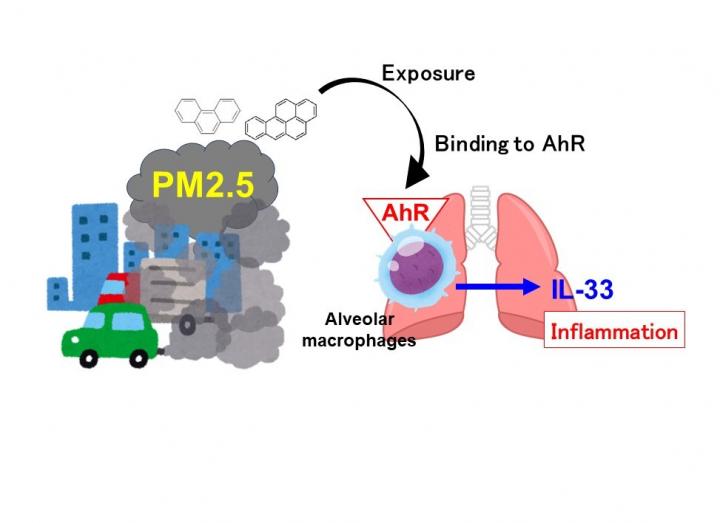
Research teams from Hiroshima University, the University of California and the Leibniz Research Institute identified a cell receptor that was activated by these particles, called AhR. This receptor promotes the production of inflammatory molecules to get rid of toxins in the body (such as fumes and diesel particles). It is found on cells in organs that are in contact with air, such as the skin, the gut and lungs. AhR’s function is to detoxify the body, but overactivation of this receptor can often cause health problems.

In their study, the group stimulated human and mice immune cells with diesel particles that activated AhR. The cells produced IL-33, a chemical messenger that promotes inflammation. To confirm that the levels of IL-33 were caused by AhR the researchers blocked signals from AhR in the cells and no IL-33 was found.

The researchers concluded that AhR activation by airborne particles can make symptoms of diseases like asthma more severe. Diesel fumes aggravate immune cells to release chemicals that promote inflammation.

Ishihara states that even though this is a promising finding and opens the door to a deeper understanding of the mechanisms of these diseases, the best way to avoid these is to “escape”. Even if you are not living right beside a factory or lots of vehicles, airborne particles can be distributed by the wind.

“This is an urgent issue in our drastically developed world.” emphasizes Ishihara.

Though scientists are performing great research to improve our quality of urban life, living in the countryside could still be the best bet for avoiding particle-based asthma.

###

Media Contact
Norifumi Miyokawa
[email protected]

Related Journal Article

http://dx.doi.org/10.1093/toxsci/kfz114

Tags: BiologyImmunology/Allergies/AsthmaMedicine/HealthPhysiologyPulmonary/Respiratory Medicine
Share12Tweet8Share2ShareShareShare2

Related Posts

Tracking Lanthanide-Labeled Microplastics in Plants

June 25, 2026

Neural Design Enables Zero-Shot Drug-Binding Proteins

June 25, 2026

Genomic Insights into Human Skin Fungi Diversity

June 25, 2026

Chiral Laser Gyroscopes Surpass Lock-In Limit

June 25, 2026
Please login to join discussion

POPULAR NEWS

  • Saying Goodbye to PGY-6: Pediatric Fellowship Realities

    103 shares
    Share 41 Tweet 26
  • Multi-Hospital Study Reveals Long Covid Burden Is Twice as High as Current Estimates

    92 shares
    Share 36 Tweet 23
  • Detection of EDCs in Breast Milk and Infant Urine Up to Six Months Highlights Early Exposure Risks

    77 shares
    Share 31 Tweet 19
  • New Drug Candidate Developed at McMaster Shows Potential for Treating Brain Cancer

    58 shares
    Share 23 Tweet 15

About

We bring you the latest biotechnology news from best research centers and universities around the world. Check our website.

Follow us

Recent News

Tracking Lanthanide-Labeled Microplastics in Plants

POSTECH Researchers Slash Cost of Reconstituted Cell-Free Systems by 95%

AI and Physics Collaborate to Design Advanced Hydrogen Storage Materials

Subscribe to Blog via Email

Success! An email was just sent to confirm your subscription. Please find the email now and click 'Confirm' to start subscribing.

Join 82 other subscribers
  • Contact Us

Bioengineer.org © Copyright 2023 All Rights Reserved.

Welcome Back!

Login to your account below

Forgotten Password?

Retrieve your password

Please enter your username or email address to reset your password.

Log In
No Result
View All Result
  • Homepages
    • Home Page 1
    • Home Page 2
  • News
  • National
  • Business
  • Health
  • Lifestyle
  • Science

Bioengineer.org © Copyright 2023 All Rights Reserved.