• HOME
  • NEWS
  • EXPLORE
    • CAREER
      • Companies
      • Jobs
    • EVENTS
    • iGEM
      • News
      • Team
    • PHOTOS
    • VIDEO
    • WIKI
  • BLOG
  • COMMUNITY
    • FACEBOOK
    • INSTAGRAM
    • TWITTER
Friday, May 22, 2026
BIOENGINEER.ORG
No Result
View All Result
  • Login
  • HOME
  • NEWS
  • EXPLORE
    • CAREER
      • Companies
      • Jobs
        • Lecturer
        • PhD Studentship
        • Postdoc
        • Research Assistant
    • EVENTS
    • iGEM
      • News
      • Team
    • PHOTOS
    • VIDEO
    • WIKI
  • BLOG
  • COMMUNITY
    • FACEBOOK
    • INSTAGRAM
    • TWITTER
  • HOME
  • NEWS
  • EXPLORE
    • CAREER
      • Companies
      • Jobs
        • Lecturer
        • PhD Studentship
        • Postdoc
        • Research Assistant
    • EVENTS
    • iGEM
      • News
      • Team
    • PHOTOS
    • VIDEO
    • WIKI
  • BLOG
  • COMMUNITY
    • FACEBOOK
    • INSTAGRAM
    • TWITTER
No Result
View All Result
Bioengineer.org
No Result
View All Result
Home NEWS Science News Chemistry

Air-guiding in solid-core optical waveguides: A solution for on-chip trace gas spectroscopy

Bioengineer by Bioengineer
February 2, 2021
in Chemistry
Reading Time: 2 mins read
0
IMAGE
Share on FacebookShare on TwitterShare on LinkedinShare on RedditShare on Telegram

IMAGE

Credit: by Marek Vlk, Anurup Datta, Sebastián Alberti, Henock Demessie Yallew, Vinita Mittal, Ganapathy Senthil Murugan, Jana Jágerská

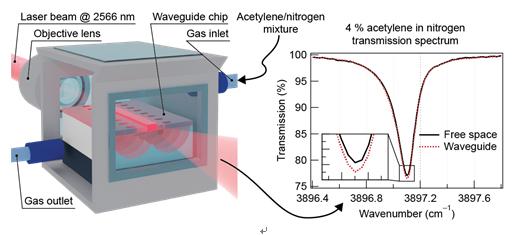
Optical waveguides suspended in air are capable to beat free-space laser beams in light-analyte interaction even without complex dispersion engineering. This phenomenon has been predicted more than 20 years ago, yet never observed in experiment.

In a new paper published in Light Science & Application, a team of scientists, led by Professor Jana Jágerská from Department of Science and Technology, UiT The Arctic University of Norway, and co-workers have devised a mid-infrared free standing solid core optical waveguide which pushes the light interaction with the surrounding air beyond what has been reported up until now: 107 % interaction strength compared to that of a free-space beam has been demonstrated.

“The guided mode of our thin waveguide resembles a free-space beam: it is strongly de-localized and travels predominantly in air. But, at the same time, it is still bound to the chip and can be guided along a pre-defined e.g. spiral waveguide path.”

This is a significant achievement from the perspective of basic research but also an important step towards practical applications in on-chip gas sensing. Thanks to the high air-confinement of the guided mode, the waveguide not only improves upon the light-analyte interaction, but the guided light also experiences minimal overlap with the solid waveguide core material. This means that the guided mode is only marginally disturbed by material or structural imperfections, which suppresses undesired loss, scattering or reflections. The waveguide hence delivers transmission nearly free from spurious etalon fringes, which are of utmost importance for applications in trace gas spectroscopy.

“The main killer of precision of TDLAS instruments are [spectral] fringes, and integrated nanophotonic components typically produce plenty of them. Our chips are different. The theoretical reflections on the waveguide facets are as low as 0.1 %, and spurious fringes in transmission are therefore suppressed to below the noise level.”

This optical waveguide fits therefore very well into the prospect of a future miniature trace gas sensors. Sensitive and selective integrated sensors based on the reported waveguide chips would not only down scale the dimensions of existing trace gas analysers, but also allow for microlitre sensing volumes and deployment in distributed sensors networks, leading to new applications in environmental monitoring, biology, medicine, as well as industrial process control.

###

Media Contact
Jana Jágerská
[email protected]

Related Journal Article

http://dx.doi.org/10.1038/s41377-021-00470-4

Tags: Chemistry/Physics/Materials SciencesOptics
Share12Tweet8Share2ShareShareShare2

Related Posts

Study Reveals How Valproate Affects Early Brain Development: Insights into the Antiepileptic Drug’s Impact — Chemistry

Study Reveals How Valproate Affects Early Brain Development: Insights into the Antiepileptic Drug’s Impact

May 22, 2026
Sustainable Chemistry: Iron Replaces Noble Metals in Catalytic Reactions — Chemistry

Sustainable Chemistry: Iron Replaces Noble Metals in Catalytic Reactions

May 22, 2026

Advancing Thin-Film Device Manufacturing with Imaging Ellipsometry for Enhanced Process Control

May 22, 2026

Simple Adjustment in 3D Printing Enhances Fit of Dental Crowns

May 22, 2026
Please login to join discussion

POPULAR NEWS

  • blank

    New Study Reveals Plants Can Detect the Sound of Rain

    734 shares
    Share 293 Tweet 183
  • ESMO 2025: mRNA COVID Vaccines Enhance Efficacy of Cancer Immunotherapy

    310 shares
    Share 124 Tweet 78
  • Research Indicates Potential Connection Between Prenatal Medication Exposure and Elevated Autism Risk

    847 shares
    Share 339 Tweet 212
  • Breastmilk Balances E. coli and Beneficial Bacteria in Infant Gut Microbiomes

    58 shares
    Share 23 Tweet 15

About

We bring you the latest biotechnology news from best research centers and universities around the world. Check our website.

Follow us

Recent News

Stable Circulating Proteins in Older Adults Over Time

Engineered Superconducting Diamonds Pave Way for Multi-Modality Quantum Chips, Researchers Reveal

Global Rice Paddy Emissions Double in Six Decades

Subscribe to Blog via Email

Enter your email address to subscribe to this blog and receive notifications of new posts by email.

Join 82 other subscribers
  • Contact Us

Bioengineer.org © Copyright 2023 All Rights Reserved.

Welcome Back!

Login to your account below

Forgotten Password?

Retrieve your password

Please enter your username or email address to reset your password.

Log In
No Result
View All Result
  • Homepages
    • Home Page 1
    • Home Page 2
  • News
  • National
  • Business
  • Health
  • Lifestyle
  • Science

Bioengineer.org © Copyright 2023 All Rights Reserved.