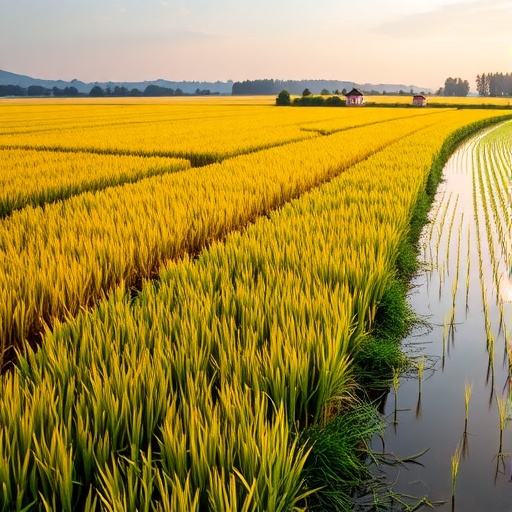
Rice paddies have long stood as a cornerstone of global food security, sustaining billions of people worldwide. However, recent scientific findings reveal a troubling paradox: while rice cultivation feeds the world, it also significantly contributes to greenhouse gas emissions, exacerbating climate change. A groundbreaking study published in Nature Food by Zhang et al. (2026) sheds light on how global rice paddy emissions have nearly doubled over the past six decades. This dramatic increase is primarily attributed to the expansion of rice cultivation areas coupled with intensified agricultural practices, particularly residue incorporation.
The researchers employed a comprehensive approach to unravel the sources and trends of greenhouse gas (GHG) emissions from rice paddies, combining data-driven modeling, sophisticated process-based ecosystem simulations, and an extensive meta-analysis encompassing over 1,255 field experiment sites. This triangulation of methods provides a robust and nuanced understanding of how global rice agriculture increasingly contributes to atmospheric greenhouse gases, primarily methane (CH4) and carbon dioxide (CO2).
Historically, rice paddies have been recognized as substantial methane emitters. Methane is a potent greenhouse gas, possessing a global warming potential approximately 28 to 36 times greater than CO2 over a 100-year period. The anaerobic conditions of flooded rice fields create ideal environments for methanogenic archaea, microbes responsible for generating methane during organic matter decomposition. The study’s findings reveal a 44% increase in soil methane emissions from the period 1961–1980 to 2001–2020, underscoring the growing climate impact of rice agriculture.
Equally concerning is the 52% rise in soil CO2 emissions detected over the same period. Soil respiration, driven by microbial decomposition of organic residues and root respiration processes, releases CO2 into the atmosphere, further contributing to GHG emissions. These combined increases in methane and carbon dioxide have led to a doubling of net GHG emissions from rice paddies globally in the past six decades.
Quantitatively, for the most recent decade studied—the 2010s—global rice paddies emitted approximately 1,090 teragrams (Tg) of CO2-equivalent gases per year, with an emission intensity of 0.33 megagrams CO2e per million kilocalories of rice produced. This emission intensity metric illustrates the carbon footprint associated with the caloric yield of rice, providing a critical link for evaluating the climate impact of rice as a dietary staple.
One of the pivotal drivers behind these soaring emissions is the expansion of rice cultivation areas across the globe. As demand for rice escalates with rising populations and changing dietary patterns, more land is converted into flooded paddies. This territorial growth not only enlarges the emission base but also often involves the transformation of natural ecosystems — such as wetlands and forests — releasing sequestered carbon into the atmosphere.
In addition to area expansion, intensified farming practices significantly exacerbate emission levels. The widespread adoption of residue incorporation—whereby rice straw and other crop residues are plowed back into the soil—has become a common strategy aimed at enhancing soil fertility and crop yields. However, excessive residue incorporation creates an abundance of decomposable organic matter, fueling methanogenesis in the anaerobic soil environment, and thus amplifying methane emissions.
Regional dynamics of rice paddy emissions reveal heterogeneous patterns. East Asia, a major rice-producing region, experienced a troubling rebound in methane output recently, tied to excessive straw incorporation practices. This resurgence signals potential pitfalls in agronomic management that prioritize short-term productivity gains without adequately addressing environmental trade-offs.
Contrastingly, Africa emerges as a rising hotspot for methane emissions due to rapid expansion of rice paddy areas. While historically less dominant in global rice production, Africa’s burgeoning agriculture sector is expanding rapidly, driven by efforts to achieve greater food security. This growth, if unmanaged, threatens to propel emissions upward in a region previously characterized by comparatively lower GHG contributions from rice cultivation.
To combat these escalating emissions, the study emphasizes mitigation strategies that balance productivity with environmental stewardship. Approaches such as reducing excessive residue and nitrogen fertilizer inputs, optimizing tillage practices, and fine-tuning irrigation regimes can collectively achieve approximately a 10% reduction in future total net greenhouse gas emissions from rice paddies. Crucially, these interventions promise to maintain yields, thus safeguarding food security while curtailing climate impacts.
Nevertheless, the authors caution that these mitigation potential gains are relatively moderate and insufficient to fully reverse emission trajectories. Achieving more substantial reductions in GHG emissions from rice agriculture will necessitate robust, multifaceted policy frameworks embracing climate-smart agricultural principles. Such frameworks must incentivize sustainable practices, support technological innovation, and foster farmer engagement at scale.
The urgent need for integrated solutions stems from the interplay of environmental, economic, and social factors underpinning rice production systems. Given the central role of rice in global nutrition and rural livelihoods, any interventions must be sensitive to local contexts and viable for smallholder farmers who constitute a large proportion of rice cultivators worldwide.
Moreover, the findings of Zhang et al. highlight the critical importance of continuous long-term monitoring of greenhouse gas emissions in agricultural systems. Advanced ecosystem modeling and empirical field measurements remain indispensable tools to guide policy decisions, optimize mitigation practices, and track progress toward climate targets.
In an era dominated by global calls for climate action, this study underscores the dual challenge of feeding an expanding world population while urgently reducing agriculture’s environmental footprint. Rice paddies, as vital yet climate-sensitive ecosystems, stand at the nexus of this challenge, demanding innovative, scalable strategies to sustainably manage their greenhouse gas emissions.
By shining light on the intricate drivers of emissions growth—from expansion to agronomic intensification—this research empowers stakeholders to navigate a path forward. It reveals previously underappreciated hotspots and practices that can be targeted to curb emissions without compromising rice yields, offering hope for a more climate-resilient agricultural future.
Looking ahead, strengthened international cooperation, investment in sustainable agricultural technologies, and targeted policy reforms are vital to harmonize food security with climate mitigation imperatives. The resilience of rice-dependent societies and the health of the global climate hinge on such transformative efforts.
As this pivotal research demonstrates, unraveling the complex relationships between agricultural practices and greenhouse gas emissions is foundational for meeting the dual imperatives of feeding humanity and protecting the planet. Only through rigorous science, informed policy, and concerted action can rice cultivation continue to nourish billions while becoming a cornerstone of climate change solutions.
Subject of Research: Global greenhouse gas emissions from rice paddies and their drivers over the past six decades
Article Title: Global rice paddy greenhouse gas emissions have doubled over the past six decades driven by area expansion and intensified residue incorporation
Article References:
Zhang, J., Tian, H., Liang, XZ. et al. Global rice paddy greenhouse gas emissions have doubled over the past six decades driven by area expansion and intensified residue incorporation. Nat Food (2026). https://doi.org/10.1038/s43016-026-01355-8
Image Credits: AI Generated
DOI: https://doi.org/10.1038/s43016-026-01355-8
Tags: carbon dioxide emissions in rice farmingexpansion of rice cultivation areasglobal rice paddy emissionsgreenhouse gas emissions from rice cultivationimpact of rice paddies on climate changeintensified agricultural practicesmeta-analysis of field experiments in rice paddiesmethane emissions in agriculturemethane global warming potentialprocess-based ecosystem simulations in agricultureresidue incorporation in rice fieldssustainable rice farming practices