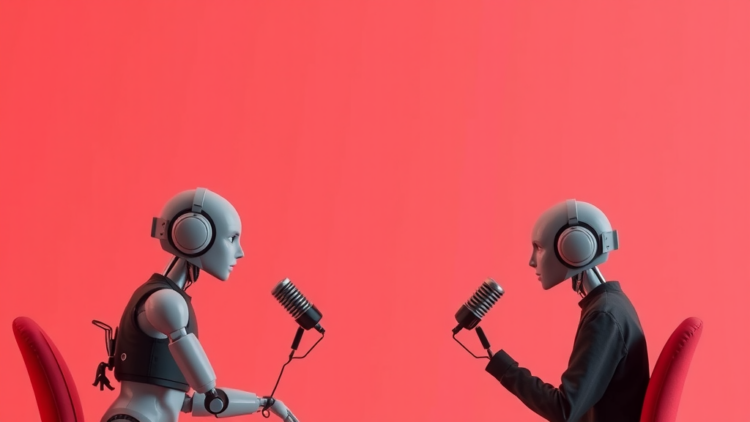
Artificially generated podcasts have become one of the most striking demonstrations of how far speech technology has come. Google’s NotebookLM, with its Audio Overview or “Deep Dive” feature, can transform any document into a lively two-host conversation that sounds remarkably like a real radio programme. But a new exploratory study from the University of Aberdeen and the University of Edinburgh suggests that beneath the polished surface, AI-generated dialogues operate by fundamentally different rules from human conversation, and that these differences reveal exactly what makes human dialogue so hard to replicate.
The study, published in the journal AI & Society by Yasmin A. Carruthers and Johannes M. Heim, compared podcasts generated by NotebookLM with naturally produced human podcasts on the same topics, examining two hallmarks of human conversation: the timing of turn-taking and the way speakers adopt contextually appropriate conversational roles. The researchers argue that naturalness in dialogue requires far more than getting the timings right; it demands a contextually appropriate, addressee-oriented approach that responds to how a conversation actually unfolds.
Human turn-taking is a marvel of predictive coordination. Decades of research, beginning with the landmark work of Sacks, Schegloff and Jefferson in 1974, have established that conversation is governed by an organized system in which only one person typically speaks at a time, transitions are smooth, and gaps or overlaps are minimized. Listeners exploit morphosyntactic, semantic and prosodic cues to anticipate when a speaker’s turn will end, preparing their responses while the previous speaker is still talking. Average turn transitions fall in the range of roughly 200 to 250 milliseconds, far shorter than the approximately 600 milliseconds humans need to plan and produce a spoken response. This means that human interlocutors must be predicting, not merely reacting, and traces of this ability appear remarkably early in development, with infants showing sensitivity to conversational turn structure from birth.
Yet the “no-gap, no-overlap” principle is not absolute. Subsequent research has shown that overlaps can account for a substantial share of speaker transitions, and that brief overlaps often signal engagement rather than disruption. Backchannels, the brief vocal acknowledgments such as “mm-hm” or “right” that listeners produce without claiming the floor, add a dynamic and expressive quality to human dialogue. In podcast settings, hosts and guests also follow genre-specific social scripts: hosts introduce topics and then step back into a novice role to give guests a platform, while guests predominantly adopt expert stances. These role expectations, rooted in the broadcasting heritage of podcasting, make conversational behavior highly predictable despite frequent shifts between expert and novice positions.
Against this backdrop, the researchers annotated approximately ten-minute excerpts from two human podcasts and two NotebookLM-generated podcasts built from their transcripts, using the acoustic analysis software Praat. They coded speaker contributions, role shifts, turn durations, overlaps and transitions, achieving very high inter-annotator agreement. The human podcasts came from a series on productivity, featuring a recurring host and invited guests, while the AI versions were generated by NotebookLM using Gemini-based script writing and Google’s own text-to-speech voices, with no additional training data supplied.
On the surface, the AI podcasts behaved similarly to their human counterparts: questions structured the conversation, topics were expanded through follow-ups, and both hosts and guests provided feedback through backchannels. A statistical model confirmed that guests, whether human or artificial, produced significantly more expert contributions than hosts, in line with the conventions of the podcast genre. But the deeper measurements told a different story. Human turns were dramatically longer, averaging 22.3 seconds for hosts and 49.4 seconds for guests, compared with just 11.3 and 14.8 seconds for the AI agents. Human distributions of turn length were skewed toward long, developed contributions, while AI turns were short and symmetrically distributed.
The most striking divergence appeared in overlapping speech. Human guests overlapped for an average of more than four seconds and human hosts for over two seconds, whereas AI overlaps lasted mere milliseconds. AI backchannels rarely overlapped at all; instead, the current speaker paused, waited for the backchannel to be uttered, and then resumed, producing a mechanical politeness that no human interlocutor would display. The researchers interpret human overlaps as signals of engagement and emotional alignment, made possible by the fact that human listeners continuously predict where turns will end. NotebookLM, by contrast, sidesteps the problem of endpoint prediction entirely by pre-planning the entire dialogue script before converting it to speech, strictly enforcing the avoidance of gaps and overlaps in a way that humans never do.
The study also tested a newer NotebookLM feature that allows a human to join the AI conversation live, and the results were revealing. Every human intervention disrupted the pre-planned script: transitions slowed dramatically, overlaps vanished, audio glitches caused sudden voice switches, and the agents could only acknowledge the human’s contribution after long, silence-based delays before returning to their prepared narrative. Because spontaneous intervention requires resource-intensive, real-time context integration that pre-planning was designed to avoid, the hybrid dialogues lost the fluidity that made the fully scripted versions sound convincing. The authors conclude that pre-determining role behavior and turn-taking only goes so far, and that NotebookLM clearly hits its limits when responding to unpredictable input.
Taken together, the findings suggest that AI-generated dialogue can mimic individual features of natural conversation in isolation but fails to synthesize them into the dynamic negotiation of information and social relation that defines human talk. The AI agents spoke shorter, overlapped far less, and behaved more like two equally informed participants than like a host giving a guest a platform, breaking with genre conventions that listeners intuitively expect. Human conversation, the authors argue, is not optimized for seamless information exchange but for building common ground, an emergent and collaborative process shaped by mutual attention, verbal feedback and shared, growing context. Variable turn-taking timings and adaptive conversational role behavior remain unmatched human skills, and achieving genuine naturalness will require AI systems that can interpret social contexts and respond dynamically to the fluid negotiation of interlocutor relations, not merely imitate their surface elements.
Subject of Research: Turn-taking timings and conversational role behavior in AI-generated podcast dialogues compared with natural human conversation
Article Title: Not your average podcaster: turn-taking timings and conversational role behavior in AI-generated dialogues
Article References: Carruthers, Y. A., & Heim, J. M. (2026). Not your average podcaster: turn-taking timings and conversational role behavior in AI-generated dialogues. AI & SOCIETY. https://doi.org/10.1007/s00146-026-03365-3
Image Credits: AI Generated
DOI: 10.1007/s00146-026-03365-3
Keywords: AI-generated podcasts, NotebookLM, turn-taking, conversational roles, dialogue generation, backchannels, overlaps, knowledge asymmetry, common ground, pragmatics, human-machine interaction, speech technology
Cite Scienmag News
APA
MLA
Chicago
Denise Maddox. (September 12, 2026). AI Podcasts Sound Human but Miss the Hidden Rhythm of Real Conversation. Scienmag. https://scienmag.com/ai-podcasts-sound-human-but-miss-the-hidden-rhythm-of-real-conversation/
Denise Maddox. “AI Podcasts Sound Human but Miss the Hidden Rhythm of Real Conversation.” Scienmag, 12 September 2026, https://scienmag.com/ai-podcasts-sound-human-but-miss-the-hidden-rhythm-of-real-conversation/. Accessed 12 September 2026.
Denise Maddox. “AI Podcasts Sound Human but Miss the Hidden Rhythm of Real Conversation.” Scienmag. September 12, 2026. https://scienmag.com/ai-podcasts-sound-human-but-miss-the-hidden-rhythm-of-real-conversation/
Copy citation
Download RIS
Tags: AI speech synthesis limitationsAI-generated podcastsbackchannelschallenges in replicating human dialoguecommon groundcontextually appropriate conversational rolesconversational rhythm and timingconversational rolesdialogue generationdifferences between human and AI communicationhuman conversation vs AI dialoguehuman-machine interactionimpact of AI on podcastingknowledge asymmetrynaturalness in dialogueNotebookLMoverlapspragmaticspredictive coordination in speechspeech technologyturn-takingturn-taking in conversation