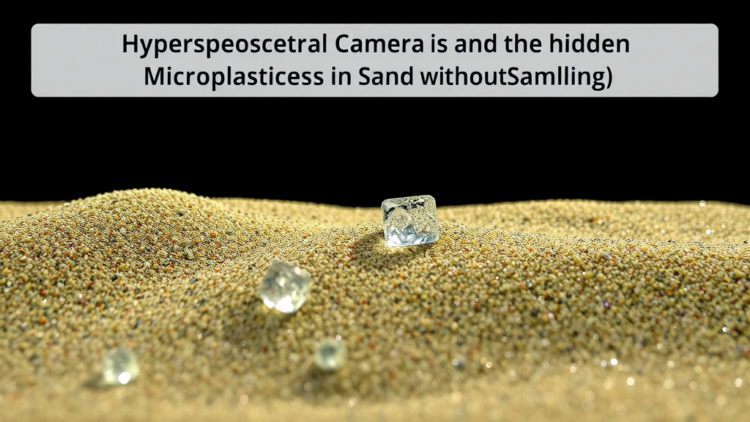
Microplastics have become one of the most pervasive pollutants on the planet, turning up everywhere from the deepest ocean trenches to the air we breathe. Yet for all the alarm surrounding these tiny fragments, scientists still lack fast, reliable ways to measure how heavily a beach, a riverbank, or an agricultural soil is contaminated without scooping up samples and hauling them back to a laboratory. A new study published in the journal Microplastics and Nanoplastics offers a striking answer: a camera system paired with an unsupervised machine learning algorithm that can photograph a patch of sand and simultaneously identify which polymers are present and how much of the surface they cover, all without touching a single grain.
The research, led by Sureerat Makmuang and Kanet Wongravee of the Sensor Research Unit at Chulalongkorn University in Thailand, together with Simon Maher of the University of Liverpool and Sanong Ekgasit of Chulalongkorn University, combines near-infrared hyperspectral imaging (NIR-HSI) with a self-organizing map, or SOM, a type of artificial neural network that learns to organize complex data without being told what to look for. The result is a workflow that transforms the invisible chemical signatures of plastics into vivid color-coded maps, in which each polymer class—PET, polyethylene, polypropylene, or polystyrene—appears as its own distinct hue painted across the sandy terrain.
The physics behind the technique is elegant. When near-infrared light strikes a plastic fragment, the chemical bonds within the polymer absorb specific wavelengths in patterns as unique as fingerprints. A hyperspectral camera captures not just a conventional image but a full spectrum at every pixel, effectively recording hundreds of narrow wavelength bands simultaneously. Each pixel therefore carries a chemical identity waiting to be decoded. The challenge has always been interpretation: a sandy surface littered with fragments of different shapes, sizes, colors, and orientations produces spectra that are noisy, mixed, and difficult to separate with conventional statistical tools.
That is where the self-organizing map enters. An SOM is trained on the spectral data by repeatedly adjusting an internal grid of artificial neurons so that similar spectra cluster together, forming a topology that mirrors the chemical relationships in the data. In this study, the researchers enhanced the standard approach with a modified SOM and a novel percent-based expansion tolerance, or PBET, scheme that allows the model to estimate semi-quantitatively how much of a scanned surface is covered by each polymer type. The output is doubly informative: qualitative maps that show exactly where each class of microplastic sits, and quantitative coverage estimates expressed as percentages of the imaged area.
To test the system, the team prepared fragments of polyethylene terephthalate, polyethylene, polypropylene, and polystyrene from everyday household plastic materials, cut them into particles ranging from one to five millimeters, and distributed them on sand surfaces at controlled coverage levels spanning roughly 0.78 to 12.5 percent. After preprocessing the hyperspectral data to sharpen spectral quality, the modified SOMs classified the plastics with remarkable fidelity. Visually, individual fragments and mixed-polymer scenes alike were rendered as clean, color-separated maps. Quantitatively, the model’s predictions of surface coverage achieved coefficients of determination reaching as high as 1.00, with very low root-mean-square errors—performance figures that suggest the approach can rival labor-intensive reference methods.
Critically, the researchers did not stop at idealized laboratory conditions. They deliberately stressed the model with sources of real-world variability that plague field measurements: variations in particle size, differences in pigment color, and overlapping particles that stack atop one another and produce mixed spectra. The SOM workflow remained robust under these challenges, holding its classification accuracy where simpler methods would falter. The team then pushed the test further by imaging microplastic particles collected from natural beach samples—plastics the model had never seen before, weathered and coated by the environment. It identified and classified them correctly, a demonstration that the laboratory-trained system generalizes to the messy chemistry of the real world.
Perhaps the most striking finding concerns size. Conventional visual surveys of microplastic contamination rely on human eyes or standard photography, both of which routinely miss particles below about one millimeter. The hyperspectral approach proved capable of detecting and correctly classifying particles smaller than that threshold, underscoring a sensitivity that could close one of the largest blind spots in microplastic monitoring. Because smaller fragments are generally more bioavailable to organisms—and more likely to carry adsorbed toxins—this capability matters not just for counting pollution but for assessing its ecological risk.
The non-destructive nature of the method is its other defining advantage. Traditional microplastic analysis typically requires collecting sediment, transporting it to a lab, digesting organic matter, and running samples through spectroscopic instruments such as Fourier-transform infrared or Raman spectrometers—accurate techniques, but slow, costly, and destructive to the sample. Hyperspectral imaging flips that model: the sand stays in place, the measurement takes the form of a scan, and the same patch of ground can be revisited over time to track how contamination evolves. That opens the door to genuine longitudinal monitoring of beaches, dunes, and remediation sites, where repeated sampling has historically been impractical.
The researchers are careful to frame the achievement within the boundaries of their experiments. The workflow was developed and evaluated on sandy substrates with the four most common commodity polymers, under controlled illumination and geometry, and the coverage estimates are semi-quantitative rather than exhaustive particle counts. Wet sediments, dark soils, biofilms, and polymers beyond the tested four remain open challenges, and translating laboratory performance to drones or handheld field scanners will require further engineering. Yet the analytical foundation the study establishes—polymer-class mapping paired with surface-coverage estimation in a single rapid scan—is precisely the kind of groundwork needed before such instruments can be built.
If the approach matures as the results suggest, the implications reach far beyond sandy shores. Agricultural soils amended with plastic mulch fragments, construction sites receiving recycled aggregates, and coastal zones awaiting cleanup all demand the same basic information: which plastics are present, where, and in what abundance. By fusing hyperspectral imaging with self-organizing maps, this study demonstrates that answer can be rendered almost photographically—a colored chemical portrait of pollution that regulators, remediation engineers, and the public can read at a glance. In a world drowning in plastic fragments too small to see, a camera that makes them visible may prove one of the most consequential environmental tools of the decade.
Subject of Research: Non-destructive detection and mapping of microplastic contamination in sandy substrates using hyperspectral imaging and self-organizing maps
Article Title: Hyperspectral imaging and self-organizing map approach for non-destructive monitoring of microplastic contamination in sandy substrates
Article References: Makmuang, S., Maher, S., Ekgasit, S., & Wongravee, K. (2026). Hyperspectral imaging and self-organizing map approach for non-destructive monitoring of microplastic contamination in sandy substrates. Microplastics and Nanoplastics. https://doi.org/10.1186/s43591-026-00225-1
Image Credits: AI Generated
DOI: 10.1186/s43591-026-00225-1
Keywords: microplastics, hyperspectral imaging, self-organizing map, machine learning, sand substrates, polyethylene, polypropylene, polystyrene, PET, environmental monitoring, non-destructive analysis, beach pollution
Cite Scienmag News
APA MLA Chicago
Denise Maddox. (September 12, 2026). Hyperspectral Camera and AI Map Hidden Microplastics in Sand Without Sampling. Scienmag. https://scienmag.com/hyperspectral-camera-and-ai-map-hidden-microplastics-in-sand-without-sampling/
Denise Maddox. “Hyperspectral Camera and AI Map Hidden Microplastics in Sand Without Sampling.” Scienmag, 12 September 2026, https://scienmag.com/hyperspectral-camera-and-ai-map-hidden-microplastics-in-sand-without-sampling/. Accessed 12 September 2026.
Denise Maddox. “Hyperspectral Camera and AI Map Hidden Microplastics in Sand Without Sampling.” Scienmag. September 12, 2026. https://scienmag.com/hyperspectral-camera-and-ai-map-hidden-microplastics-in-sand-without-sampling/
Copy citation Download RIS
Tags: advanced AI techniques for environmental monitoringAI-based microplastic identification in sandbeach pollutionchemical signature mapping of plastics in soil and sandEnvironmental Monitoringhyperspectral imaginghyperspectral imaging for microplastic detectioninnovative methods for microplastic pollution measurementMachine learningmicroplasticsnear-infrared hyperspectral imaging in environmental analysisnon-destructive analysisnon-invasive microplastic contamination assessmentPETpolyethylenepolypropylenepolystyrenereal-time microplastic detection with hyperspectral imagingremote sensing of microplastics using hyperspectral camerassand substratesself-organizing mapself-organizing map neural networks for pollution detectionunsupervised machine learning for pollutant mapping