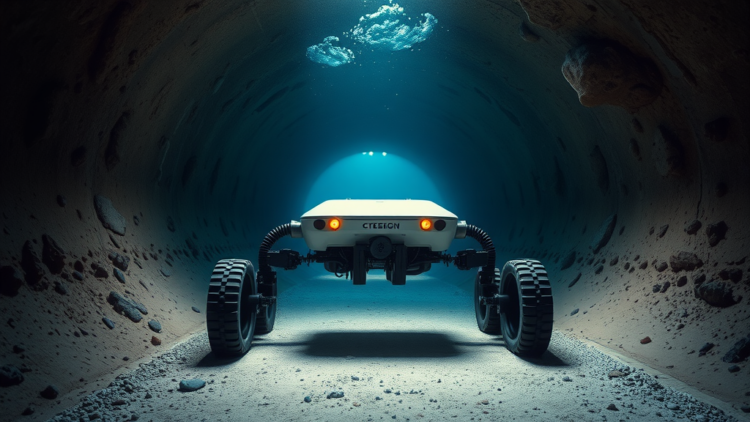
Beneath many of the world’s cities and agricultural regions lies a hidden network of long-distance water conveyance tunnels, structures that move drinking water, irrigation supplies and hydropower flows across tens or even hundreds of kilometres. These tunnels are among the most critical yet least inspected pieces of infrastructure on the planet. Draining them for human inspection is often impossible, and sending divers into long, dark, pressurised conduits is dangerous and slow. A new study published in Communications Engineering describes an unmanned underwater vehicle designed specifically to close this gap, offering a robotic way to examine tunnel interiors over distances that have traditionally defeated conventional inspection technology.
The core engineering challenge addressed by the researchers is deceptively simple to state and extremely difficult to solve: how do you build a free-swimming robot that can travel far into a confined, water-filled tunnel, navigate reliably without satellite positioning, and return with usable data about the tunnel’s structural condition? Most commercial remotely operated vehicles were designed for open water, harbours or offshore platforms. In a tunnel just a few metres in diameter, propeller wash stirs up clouds of sediment, acoustic navigation signals bounce chaotically off curved walls, and any loss of control could leave a multi-million-dollar robot wedged irretrievably far from the nearest access shaft.
Water conveyance tunnels also present an environment that is hostile in less obvious ways. Flowing water inside an operating tunnel generates currents that can sweep a small vehicle off course, and the tunnel lining itself may include bends, junctions, steep gradient changes and transitions between free-surface and pressurised flow sections. Visibility is frequently near zero because of suspended silt, biological growth and air bubbles entrained by turbulence. The vehicle described in the new work was therefore conceived from the outset as a long-range, confined-space platform rather than an adaptation of offshore robotics, with its hull, propulsion, sensing and navigation systems all shaped by the geometry and hydraulics of conveyance tunnels.
Central to the design is a propulsion and control scheme tuned for low-disturbance operation in narrow passages. Conventional thrusters produce downwash that resuspends sediment and destroys optical visibility, so the vehicle’s thrust configuration and control algorithms prioritise smooth, low-speed transit with minimal wake. The body is typically streamlined to a compact diameter so it can pass through access ports, bends and variable cross-sections that would block larger machines. Redundant thrusters or vectored thrust arrangements allow the vehicle to hold station against tunnel flow while still imaging the walls, a capability that matters because inspection is not simply a matter of driving through a tunnel but of systematically covering every metre of its surface.
Navigation without GPS is the second pillar of the system. Inside a tunnel, satellite positioning is unavailable the moment the vehicle submerges past an access portal, so the robot must estimate its own position using onboard sensors alone. The reported approach relies on combinations of inertial measurement, velocity estimation from onboard instruments such as Doppler velocity logs or flow sensors, and feature matching against the tunnel walls themselves. In a smooth cylindrical conduit, acoustic ranging to the perimeter provides a natural odometry signal: by continuously measuring distances to the wall in multiple directions, the vehicle can infer how far it has travelled and where it sits within the tunnel cross-section, correcting drift that would otherwise accumulate over kilometres of travel.
Perception in murky water is equally demanding, and the study reflects the broader shift in underwater inspection toward sensor fusion. Optical cameras deliver the highest-resolution images of cracks, spalling, joint displacement and rebar exposure in the tunnel lining, but only within a short range and only when the water is clear. Sonar penetrates turbidity but at coarser resolution. By combining optical imagery, acoustic profiling and distance measurements, the vehicle can build a structural map of the tunnel that remains informative even when individual sensors degrade. Onboard lighting must also be engineered carefully, because uneven illumination in a reflective wet surface can wash out the very defects inspectors need to see.
The practical payoff of such a vehicle is substantial. Long-distance tunnels are typically inspected at great cost by dewatering sections of the conduit, a process that interrupts water supply for days or weeks, requires energy-intensive pumping, and can itself stress the structure by changing pore pressures and loads. Robotic in-service inspection would allow operators to assess lining integrity, sediment accumulation, leakage paths and joint condition without taking the tunnel offline. Early detection matters: small lining cracks and localised seepage can progress into major failures that are enormously expensive to repair, particularly in tunnels buried deep underground or crossing difficult terrain where access for heavy machinery is limited.
The work also speaks to a wider trend in civil infrastructure management: the move from periodic, disruption-heavy manual inspection toward continuous, data-rich robotic monitoring. Engineers increasingly describe infrastructure in terms of digital condition models that are updated over time, allowing maintenance to be scheduled on evidence rather than on fixed calendars. A vehicle that can repeatedly traverse a conveyance tunnel, collect consistent imagery and sensor data, and localise its findings precisely along the tunnel axis becomes a mobile sensing node for such models. Over repeated missions, change detection algorithms could highlight newly developed cracks or growing sediment deposits long before they become visible to a human inspection crew working in drained conditions.
Significant engineering hurdles remain before such systems become routine. Energy storage still constrains endurance, since pushing a vehicle against tunnel flow for many kilometres demands sustained power, and battery capacity has not kept pace with the ambitions of long-range missions. Communication is another constraint: radio signals do not penetrate water and rock, so the vehicle must operate with high autonomy, making its own decisions about obstacle avoidance, data quality and abort conditions, with only intermittent contact through tether or acoustic links. Robustness against entanglement, snagging on protrusions, and unexpected obstructions such as gates or debris is essential, because a stranded vehicle in an operating water tunnel could become an obstruction far more costly than the inspection it was meant to perform.
The researchers frame the vehicle as a step toward making confined-water infrastructure inspectable on demand rather than on rare, disruptive occasions. As urban water systems age and climate variability places new demands on conveyance networks, the ability to look inside the pipes and tunnels that sustain cities, without emptying them, may shift from an engineering curiosity to a standard expectation. If the endurance, autonomy and sensing capabilities demonstrated in this work can be scaled and hardened for field deployment, the dark, inaccessible interiors of the world’s water conveyance tunnels could become among the most closely watched infrastructure spaces anywhere, monitored kilometre by kilometre by machines that were built precisely for the environment where humans cannot safely go.
Subject of Research: Development of an unmanned underwater vehicle for autonomous inspection of long-distance water conveyance tunnels
Article Title: An unmanned underwater vehicle for long-distance water conveyance tunnel inspection
Article References: Shen, X., Chu, Z., & Zhu, D. (2026). An unmanned underwater vehicle for long-distance water conveyance tunnel inspection. Communications Engineering. https://doi.org/10.1038/s44172-026-00758-6
Image Credits: AI Generated
DOI: 10.1038/s44172-026-00758-6
Keywords: unmanned underwater vehicle, water conveyance tunnel, infrastructure inspection, autonomous navigation, tunnel lining, robotics, civil engineering, sensor fusion, underwater perception, infrastructure monitoring, unmanned, underwater
Cite Scienmag News
APA MLA Chicago
Denise Maddox. (September 12, 2026). Autonomous Underwater Robot Set to Inspect Kilometres of Hidden Water Tunnels. Scienmag. https://scienmag.com/autonomous-underwater-robot-set-to-inspect-kilometres-of-hidden-water-tunnels/
Denise Maddox. “Autonomous Underwater Robot Set to Inspect Kilometres of Hidden Water Tunnels.” Scienmag, 12 September 2026, https://scienmag.com/autonomous-underwater-robot-set-to-inspect-kilometres-of-hidden-water-tunnels/. Accessed 12 September 2026.
Denise Maddox. “Autonomous Underwater Robot Set to Inspect Kilometres of Hidden Water Tunnels.” Scienmag. September 12, 2026. https://scienmag.com/autonomous-underwater-robot-set-to-inspect-kilometres-of-hidden-water-tunnels/
Copy citation Download RIS
Tags: acoustic navigation challenges in water-filled tunnelsautonomous navigationautonomous underwater vehicle for confined space tunnel navigationcivil engineeringdesign of free-swimming underwater robots for tunnel environmentsinfrastructure inspectioninfrastructure monitoringlong-distance autonomous water conveyance inspectionnon-invasive inspection technology for long water pipelinesrobotic tunnel inspection for drinking water and irrigation systemsroboticssafety and efficiency of robotic inspection in submerged infrastructuresediment disturbance caused by underwater tunnel robotssensor fusionstructural health monitoring of water conveyance tunnelstunnel liningunderwaterunderwater drone for structural assessment of submerged water tunnelsunderwater perceptionUnderwater robot inspection of hidden water tunnelsunmannedunmanned underwater vehiclewater conveyance tunnel