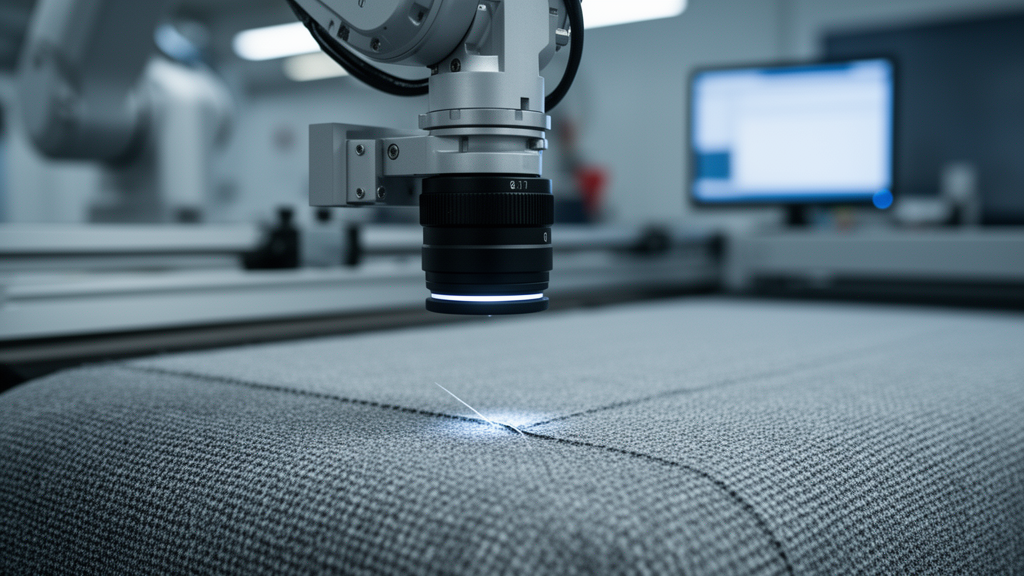
An artificial intelligence model that combines convolutional feature extraction with a spiking neural network has been reported to classify microscopic fabric defects with an accuracy of 98.42 percent, according to a study published in Discover Artificial Intelligence. The work, led by Haoyuan Chen and colleagues, targets a problem that sounds niche but carries real safety weight: the protective clothing worn by people working near ultra-high voltage transmission lines depends on textile materials whose shielding performance can be quietly undermined by defects far too small for the human eye to catch.
Ultra-high voltage shielding clothing is a special-purpose technical textile designed to minimize the exposure of personnel to intense electromagnetic fields. Its protective properties come from conductive fibers and multilayered structures that must remain continuous and uniform. Pinholes, micro-cracks, fiber fractures, and coating discontinuities can interrupt that continuity locally, allowing electromagnetic energy to leak through and reducing the garment’s shielding capacity. Because these flaws are microscopic, conventional manual inspection struggles to find them, and a missed defect could mean partial protection failure for a worker in a high-voltage environment.
The researchers built their detection pipeline around a publicly available benchmark rather than proprietary imagery. They used the Kaggle Multi-Class Fabric Defect Detection Dataset, which contains 3,077 high-resolution fabric images of 1280 by 720 pixels spanning nine categories, including holes, horizontal and vertical lines, pinched fabric, needle marks, broken stitches, stains, and defect-free samples. The team is explicit about an important caveat: the images are generic fabric defects and contain no information about ultra-high voltage shielding clothing, conductive threads, or electromagnetic shielding degradation. The results therefore demonstrate the architecture’s ability to classify general fabric defects, not a validated inspection system for actual shielding garments.
Preprocessing played a central role in making tiny flaws visible to the network. Gaussian filtering smooths the image by convolving it with a Gaussian kernel, weighting central pixels more heavily than distant ones, which suppresses noise from sensors, illumination, and surface irregularities without destroying fine structural detail. Adaptive histogram equalization then enhances contrast locally rather than globally, revealing faint defects under uneven lighting, with contrast limiting and bilinear interpolation used to avoid artificial boundaries. Together, the two steps reduce the risk that noise is mistaken for a defect while making pinholes and micro-cracks stand out for the next stage.
A convolutional neural network then extracts hierarchical features from the preprocessed images, learning edges, textures, fiber irregularities, and local structural patterns through successive convolution, activation, and pooling layers. The flattened feature vectors feed into the study’s central innovation, a deep spiking neural network. Unlike conventional networks that continuously compute real-valued activations, spiking neural networks process information through discrete spike events, encoding image intensities and texture variations as temporal spike trains. Neurons fire only when their membrane potential crosses a threshold, so computations occur only when spikes are generated, a property the authors argue makes the approach computationally sparse and well suited to low-power inspection.
To train the spiking network effectively, the team wrapped it in an adaptive optimization scheme they call AdapAqu, an improvement on the classical Aquila Optimization algorithm. Instead of switching between exploration and exploitation with fixed behaviors, AdapAqu adjusts the balance dynamically: early iterations search broadly across the weight and threshold space to avoid premature convergence on misleading local optima produced by noisy defect features, while later iterations refine promising regions. The scheme also employs random opposition-based learning, which evaluates mirrored candidate solutions to maintain population diversity. The reported fitness value improved from 0.125 at the first iteration to 0.98, which the authors present as evidence of stable convergence.
The reported headline numbers are strong. On the held-out test split, the full AdapAqu-DeepSNN model achieved 98.42 percent accuracy, 96.81 percent precision, 95.37 percent recall, a 96.08 percent F1-score, and 97.54 percent specificity, along with a computational efficiency figure of 97 percent. Five-fold cross-validation produced means of 98.42 plus or minus 0.17 percent for accuracy and similarly tight spreads for the other metrics, and paired statistical tests found the improvements over a DenseNet baseline significant. In a controlled comparison in which baselines including YOLOv10, U-Net, LeNet-5, IM-RCNN, ResNet-101, Inception-Net, DenseNet, and TGANet were retrained on the same dataset with identical splits and preprocessing, the proposed model reached the highest scores while using 2.10 GFLOPS, 7.20 milliseconds of inference time, 0.31 million spikes, and 9.80 milliseconds of latency.
The authors are careful to qualify several of these claims. The computational efficiency metric is described as a constructed comparative measure of performance during the experiments, not a measurement of electrical energy consumption, since hardware power was not recorded. The event-driven design is referred to as energy-efficient only in the computational sense, with the actual energy benefit depending on hardware implementation, spike sparsity, and network architecture. Comparisons with earlier literature are labeled as reference values rather than controlled head-to-head results, because those studies used different datasets and settings. The team also notes that deployment on standard factory-floor hardware, which has less parallel processing capability than the GPU-accelerated experimental setup, could raise latency and would require further optimization.
Some of the experimental figures are simulations rather than measurements of physical garments. Latency analysis at conveyor belt speeds of 15 to 25 meters per minute, batch-level defect rate variations, spatial defect density maps, and class-weight scaling were all explored computationally on the Kaggle dataset attributes, not on electromagnetic shielding measurements. The paper states plainly that no decibel reduction in shielding effectiveness was quantified, and that relating visible defects to conductivity or shielding performance requires direct testing on actual ultra-high voltage conductive fabrics, which remains outside the scope of the current dataset.
Even with those limitations, the study sketches a plausible path toward automated quality control for safety-critical protective textiles. The authors suggest that future work could collect images of real ultra-high voltage apparel defects, connect them to electrical conductivity and shielding effectiveness measurements, test lightweight implementations on industrial hardware, and extend the approach to aerospace protective textiles and medical smart fabrics. For now, the contribution is a demonstrated architecture: a pipeline that turns generic microscopic fabric images into spike-based classifications with high reported accuracy, awaiting validation on the materials it was ultimately designed to protect.
Subject of Research: An AI-based detection model for classifying microscopic defects in fabric materials intended for ultra-high voltage shielding clothing applications.
Article Title: Artificial intelligence-assisted intelligent detection model for microscopic defects in ultra-high voltage shielding clothing materials
Article References: Chen, H., Li, M., Hu, H., Yin, H., & Wu, Q. (2026). Artificial intelligence-assisted intelligent detection model for microscopic defects in ultra-high voltage shielding clothing materials. Discover Artificial Intelligence, 6(1), Article 1700. https://doi.org/10.1007/s44163-026-02599-w
Image Credits: AI Generated
DOI: 10.1007/s44163-026-02599-w
Keywords: artificial intelligence, spiking neural networks, fabric defect detection, ultra-high voltage, protective clothing, convolutional neural networks, computer vision, textile inspection, machine learning, quality control, electromagnetic shielding, Artificial
News Source: Blake Davidson. (October 30, 2026). AI Model Spots Microscopic Fabric Defects With 98 Percent Accuracy. Scienmag.