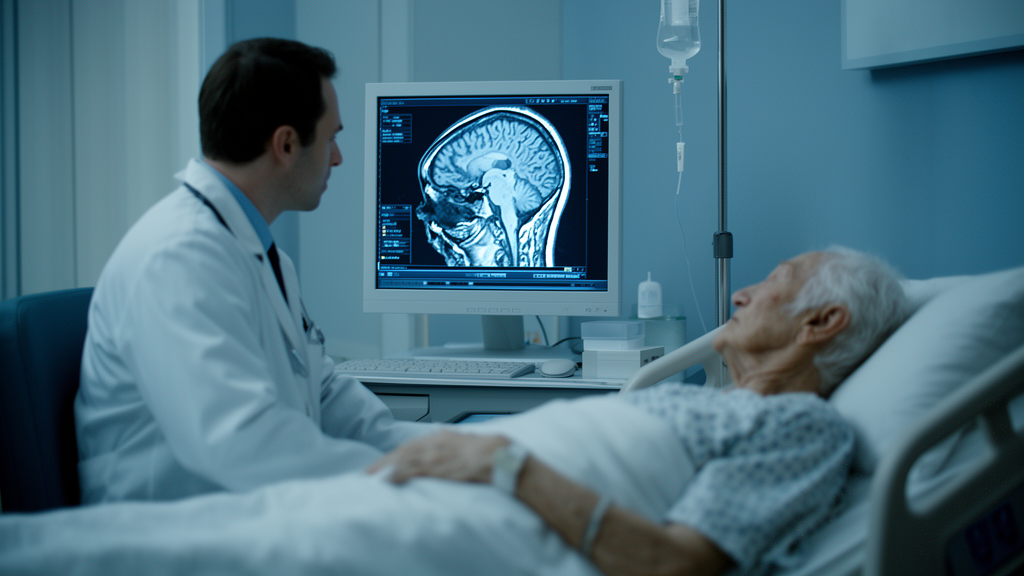
Every year, millions of people arrive at hospitals with strokes so mild that they can still walk, talk, and largely care for themselves. Doctors call these minor strokes, defined by a National Institutes of Health Stroke Scale score of five or lower, and they account for roughly half of all acute ischemic stroke cases. The standard treatment, intravenous thrombolysis, dissolves the offending clot and, in most cases, works well. Yet a stubborn minority of these seemingly low-risk patients never regain full independence. A new study from Tianjin Fourth Central Hospital in China suggests that an artificial intelligence model, built from nothing more exotic than routine blood tests and basic clinical measurements, can identify those patients before the clot-busting drug is even administered.
The research, published in Frontiers in Neurology, followed 507 patients with mild acute ischemic stroke who received intravenous thrombolysis between January 2024 and June 2025. Ninety days after treatment, neurologists assessed each patient using the modified Rankin Scale, the standard yardstick of stroke recovery. A score of zero or one, meaning no symptoms or no significant disability, was considered an excellent outcome. Anything from two to six, ranging from mild restriction to death, was classified as non-excellent. The result was sobering: 136 patients, or 26.8 percent, fell into that latter category despite having strokes mild enough that many clinicians would have expected near-complete recovery.
That figure is not an anomaly. Previous studies have estimated that between 20 and 35 percent of patients with minor stroke fail to achieve excellent functional status at three months even after timely thrombolysis. What makes the new work distinctive is its focus. Most existing prediction models lump together patients of all severities, or rely on variables such as in-hospital complications that only become known after treatment has begun. Neither approach helps a physician standing at the bedside deciding how aggressively to monitor a patient whose stroke looks trivial. The Tianjin team deliberately restricted their model to information available at admission, before the first drop of alteplase or tenecteplase entered the vein.
The technical pipeline reflects current best practice in clinical machine learning. The researchers first applied LASSO regression, a statistical technique that shrinks the coefficients of uninformative variables to zero, effectively performing automatic feature selection. From a wide panel of demographic, clinical, laboratory, and neuroimaging variables, LASSO retained just six predictors: age, baseline NIHSS score, platelet count, monocyte count, blood glucose level, and the neutrophil-to-lymphocyte ratio, a widely used marker of systemic inflammation. Six variables, all obtainable from a standard complete blood count and chemistry panel, became the raw material for seven competing algorithms.
Those algorithms spanned the spectrum of modern machine learning, from classical logistic regression and decision trees to random forests, support vector machines, artificial neural networks, and two gradient-boosting methods, XGBoost and LightGBM. Each of the six non-linear models underwent hyperparameter optimization through grid search combined with stratified five-fold cross-validation, a procedure that repeatedly partitions the training data to find the settings that generalize best. The dataset was split 70:30 into training and internal validation cohorts using stratified random sampling, with a fixed random seed to guarantee reproducibility. When the dust settled, XGBoost, an algorithm that builds an ensemble of decision trees in which each new tree corrects the errors of its predecessors, emerged as the top performer.
On the validation cohort, XGBoost achieved an area under the receiver operating characteristic curve of 0.753, with a 95 percent confidence interval of 0.660 to 0.840. That number, while not spectacular, is respectable for a prediction made from six routine variables, and it edged out the support vector machine at 0.750 and logistic regression at 0.747. The decision tree fared worst at 0.614. Beyond raw discrimination, the team evaluated calibration, how closely predicted probabilities match observed outcomes, using calibration curves and the Brier score, and clinical usefulness through decision curve analysis, which compares the net benefit of acting on the model’s predictions against treating everyone or no one. XGBoost performed adequately on all three fronts, with a Brier score of 0.165.
What elevates the study above a simple algorithm bake-off is its commitment to interpretability. Black-box predictions are notoriously hard for clinicians to trust, so the researchers turned to SHAP, or Shapley Additive Explanations, a technique borrowed from cooperative game theory that assigns each predictor a contribution value for every individual prediction. The SHAP analysis ranked the baseline NIHSS score as the single most influential predictor, followed by blood glucose, age, platelet count, the neutrophil-to-lymphocyte ratio, and monocyte count. Crucially, the direction of each association was consistent with clinical intuition: higher values of every one of the six predictors pushed the model’s output toward a higher probability of poor recovery.
The biology behind those predictors is plausible and, in several cases, well supported by prior literature. Elevated admission glucose has long been linked to worse outcomes after thrombolysis, partly because stress hyperglycemia amplifies oxidative stress, promotes lactate accumulation, and disrupts the blood-brain barrier, increasing the risk of hemorrhagic transformation. A high neutrophil-to-lymphocyte ratio signals an innate immune system in overdrive: neutrophils infiltrating the ischemic brain release reactive oxygen species, matrix metalloproteinase-9, and neutrophil extracellular traps that damage the blood-brain barrier and clog the microvasculature, while lymphocytes, depleted by stroke-induced immunosuppression, can no longer restrain the damage. Even a successful recanalization of the large occluded artery can be undermined by this no-reflow phenomenon at the capillary level.
Platelet count is the most counterintuitive of the six predictors, since higher platelets might seem protective in a disease defined by clotting. Yet the SHAP dependence plots suggested a threshold-like pattern, with counts above roughly 280 to 300 billion per liter associated with higher predicted risk. The authors point to thromboinflammation: activated platelets adhere to injured endothelium and bind leukocytes through molecules such as P-selectin, forming aggregates that promote microvascular thrombosis and endothelial dysfunction. They are careful to note that this is a model-based predictive association, not proof of causation, and that SHAP attributions can be distorted by correlations among predictors. The same caution applies to the entire model, which the researchers frame as an adjunct to, not a replacement for, clinical judgment.
The study’s limitations are acknowledged candidly. It was retrospective and single-center, with internal validation only, so generalizability across institutions and populations remains unproven. The XGBoost model’s sensitivity of 0.525 means roughly half of the patients who ultimately fared poorly were not flagged, a meaningful gap for any screening tool. The cohort contained only nine patients treated with tenecteplase, precluding any analysis of whether the choice of thrombolytic matters. Still, the authors argue that the model’s real value lies in what it enables at the bedside: patients identified as high risk could receive closer neurological monitoring, earlier rehabilitation assessment, more aggressive management of modifiable factors such as glucose, and tighter follow-up after discharge. For a patient population often dismissed as low-risk, a six-variable algorithm that whispers a warning before the needle goes in could, if validated externally, change how mild strokes are managed.
Subject of Research: Machine learning prediction of 90-day functional outcomes after intravenous thrombolysis in mild acute ischemic stroke
Article Title: Machine learning-based models to predict 90-day non-excellent functional outcomes among patients with mild acute ischemic stroke after intravenous thrombolysis
Article References: Wang, Y., Qiu, X., Wang, Y., & Wang, L. (2026). Machine learning-based models to predict 90-day non-excellent functional outcomes among patients with mild acute ischemic stroke after intravenous thrombolysis. Frontiers in Neurology, 17, Article 1960403. https://doi.org/10.3389/fneur.2026.1960403
Image Credits: AI Generated
DOI: 10.3389/fneur.2026.1960403
Keywords: acute ischemic stroke, intravenous thrombolysis, machine learning, XGBoost, SHAP, neutrophil-to-lymphocyte ratio, modified Rankin Scale, blood glucose, platelet count, risk stratification, explainable AI, stroke prognosis
News Source: Cassandra Pierce. (October 19, 2026). AI Model Flags Which Mild Stroke Patients Won’t Fully Recover After Clot-Busting Drugs. Scienmag.