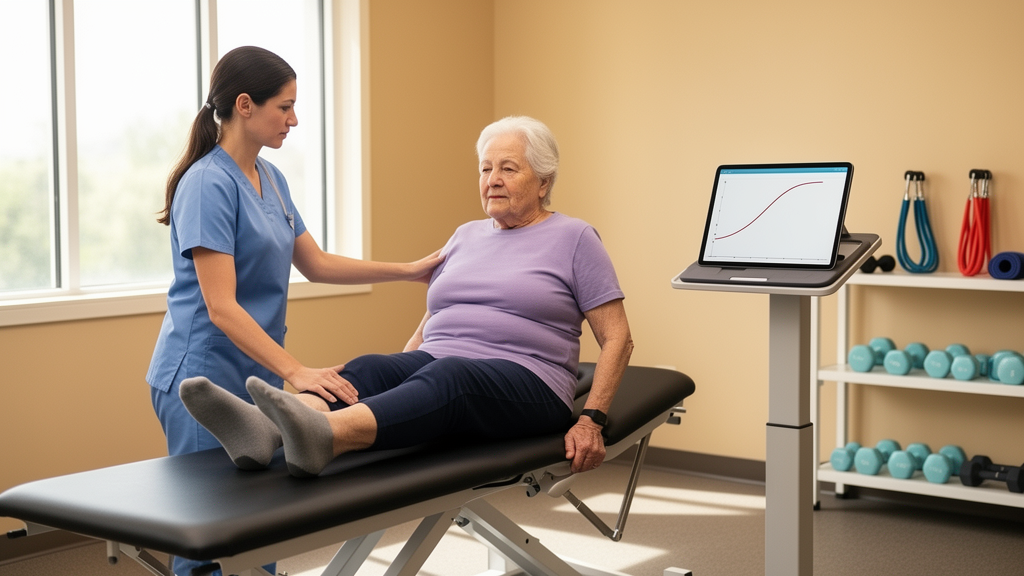
Physiotherapy is rarely delivered in neat, standardized doses. Clinicians tailor the duration, frequency, and intensity of each session to the person in front of them, yet most machine learning tools built to predict how patients will respond still treat the therapy as a simple yes-or-no intervention. A new study from researchers at Vrije Universiteit Amsterdam, Amsterdam UMC, and Dalhousie University, published in Frontiers in Digital Health, argues that this binary shortcut throws away exactly the information clinicians need most, and shows that a continuous causal machine learning model can estimate individualized dose–response curves for physiotherapy in older adults with greater accuracy than conventional approaches.
The team, led by Louk van Remmerden of the Department of Computer Science at Vrije Universiteit Amsterdam together with clinical collaborators from Amsterdam UMC’s Department of General Practice and Dalhousie University’s School of Physiotherapy, trained their model on Canadian community care records and validated it on an independent home care cohort. Their central question was deceptively simple: how does the amount of physiotherapy a person receives affect their ability to perform everyday activities such as bathing, dressing, walking, and eating? Answering it requires more than a standard prediction model, because the people who receive more therapy may differ systematically from those who receive less, in ways that also shape their outcomes.
To handle this confounding, the researchers turned to causal machine learning, a family of methods designed to estimate treatment effects from observational data by adjusting for variables that influence both treatment assignment and outcomes. Their implementation, which they call CausalPhysioNet, is an attention-based continuous counterfactual neural network adapted from an architecture proposed by Kazemi and Ester. Unlike binary meta-learners, it can map every feasible physiotherapy intensity to an expected outcome for a given individual, producing a personalized curve rather than a single number. That curve can then be inspected to find the dose at which a particular patient is predicted to benefit most.
The data came from the Canadian InterRAI dataset, specifically Community Health Assessment and Home Care Assessment records collected in Ontario. Each individual contributed one baseline assessment and one follow-up assessment, typically conducted roughly three months apart. Physiotherapy exposure was quantified as the total number of minutes of therapy received during the seven days preceding the baseline assessment, a measure the authors argue is more granular than simply counting treatment days. The outcome was the ADL Long Form scale, which sums seven functional domains scored from 0 (independent) to 4 (total dependence), yielding a total from 0 to 28 where higher scores indicate greater difficulty.
The cohort construction reflected careful clinical filtering. Individuals experiencing severe pain, end-stage disease, palliative care, or coma were excluded, because such people would not typically receive physiotherapy and their inclusion would violate the causal assumption that similar patients could feasibly receive a range of doses. The final training set contained 22,216 older adults with a mean age of 83.1 years, of whom 71.6 percent were women. Baseline ADL scores averaged 12.7, and mean physiotherapy exposure was just over 20 minutes per week, though the distribution ranged from none to 120 minutes. Fourteen covariates, selected through a two-stage process combining clinical expertise and statistical refinement, captured factors from cognitive performance and continence to fall history, unsteady gait, and depression.
Evaluating a causal model is inherently difficult because the counterfactual outcome, what would have happened under a different dose, is never observed. The researchers therefore used three complementary strategies. Factual validation checked predictions against outcomes actually recorded for held-out patients receiving their real-world doses. External validation tested generalization on an independent Canadian Home Care dataset of 8,194 individuals with a different case-mix. Most novel was their proxy counterfactual procedure: for each patient, they identified a clinically similar matched individual who had received a different physiotherapy dose, then compared the model’s prediction for the unobserved dose against the matched patient’s actual outcome. The authors stress that these matched outcomes are assumption-dependent proxies, not true counterfactuals, and that the matched cohort of 2,138 people had substantially lower baseline ADL impairment than the training population.
The results showed a consistent advantage for continuous modeling. Under factual validation, CausalPhysioNet achieved a root mean squared error of 3.79 and a mean absolute error of 2.05, statistically comparable to the X-Learner’s best RMSE of 3.69 and clearly better than linear regression’s 4.09. The gap widened dramatically in the proxy counterfactual setting, where CausalPhysioNet reached an RMSE of 3.89 against 6.49 for linear regression, 6.31 for the generalized propensity score approach, and 4.19 for the X-Learner. In external validation on the home care cohort, CausalPhysioNet again led with an RMSE of 3.85, while linear regression generalized surprisingly well at 3.93. Because counterfactual accuracy is what matters when clinicians contemplate adjusting therapy beyond previously observed regimens, the authors highlight the proxy counterfactual results as the most clinically consequential.
The individualized dose–response curves themselves revealed striking heterogeneity. In one representative case, the model predicted an improvement of roughly 2.2 points on the ADL Long Form scale at around 60 minutes of weekly physiotherapy relative to no treatment; since no validated minimal clinically important difference exists for this scale, the authors note that a two-point change was considered potentially clinically relevant based on expert judgement. Another patient showed meaningful benefit only at higher doses near 90 minutes. A third displayed a nearly flat curve suggesting no therapeutic benefit, the scenario in which a clinician might reasonably forgo physiotherapy. A fourth showed a negative response, with worsening ADL scores as intensity increased, a pattern the authors link to the possibility of an overdosed intervention producing adverse effects such as pain or stiffness.
Across a random sample of the proxy counterfactual validation set, downward trends indicating improvement with more therapy were most common at 43.7 percent, followed by flat or no-effect patterns at 27.2 percent. Upward trends, meaning worse functional outcomes with increasing intensity, occurred in 13.6 percent of cases, with the remaining 15.5 percent showing noisy or mixed responses. One association stood out: individuals with a history of falls accounted for approximately 69 percent of noisy trends and 67 percent of upward trends, compared with 31 and 33 percent respectively among those without a fall history, suggesting that fall history may flag patients whose response to therapy intensity is less predictable or less favorable.
The study also exposed an important trade-off between flexibility and robustness. In sensitivity analyses that randomly dropped one, two, or three of the fourteen covariates, CausalPhysioNet degraded more than any competitor, with RMSE increases of 0.79, 0.78, and 1.46 respectively, while simpler parametric models remained comparatively stable. The authors attribute this to the model’s reliance on complex interactions among patient-specific covariates and call for missingness-aware architectures and safeguards ensuring essential patient information is available before predictions are generated. They are equally candid about other limitations: the seven-day treatment snapshot assumes it represents usual weekly therapy, only 7.7 percent of recipients actually discontinued between assessments, cumulative exposure over the three-month follow-up is unavailable, and observational modeling cannot replicate the causal guarantees of randomization. Validation across diverse populations and healthcare systems, they conclude, will be essential before individualized dose–response curves can be trusted in routine rehabilitation planning for older adults.
Subject of Research: Continuous causal machine learning for modeling individualized physiotherapy dose–response effects on daily functioning in older adults
Article Title: Personalized physiotherapy effect modeling with continuous causal machine learning
Article References: van Remmerden, L., Kooijmans, E., Yu, S., Joling, K., Hoogendijk, E., McArthur, C., Hoogendoorn, M., & van Hout, H. (2026). Personalized physiotherapy effect modeling with continuous causal machine learning. Frontiers in Digital Health, 8, 1793661. https://doi.org/10.3389/fdgth.2026.1793661
Image Credits: AI Generated
DOI: 10.3389/fdgth.2026.1793661
Keywords: causal machine learning, physiotherapy, dose-response modeling, personalized medicine, older adults, activities of daily living, counterfactual estimation, non-pharmacological intervention, InterRAI, functional independence, observational data, rehabilitation
News Source: Ophelia Keating. (October 27, 2026). AI Maps Personalized Physiotherapy Dose–Response Curves for Older Adults. Scienmag.